Affordable
Our courses are affordable keeping in mind the global demand for quality education

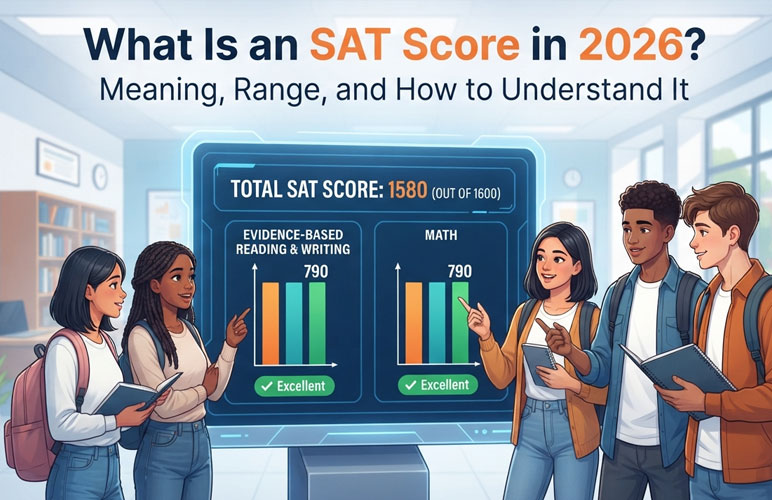
For many students, an SAT score starts to feel important long before anyone explains what the number actually means. You may hear that you need a 1400, a 1500, or higher, but without context those targets create pressure rather than direction. Most people who search for what is SAT score want more than a definition. They want to know whether their score is good, whether it fits their preferred universities, and whether they should test again. This guide explains the SAT score meaning, how the digital SAT is scored, how to read your report, and what scores are commonly seen at top universities in 2026.
An SAT score is a number between 400 and 1600 that represents how you performed on the SAT. It is the sum of your two section scores.
| SAT Component | Score Range |
|---|---|
| Reading and Writing | 200 to 800 |
| Math | 200 to 800 |
| Total SAT Score | 400 to 1600 |

For example, a student who scores 680 in Reading and Writing and 720 in Math has a total of 1400.
Two things are worth knowing early. The SAT score is not a percentage, so 1200 out of 1600 does not mean 75% of questions were correct. And it does not work like a school mark, because students from many different schools, boards, and countries take the same test. The shared 400 to 1600 scale simply gives universities one common measure to read alongside your grades, essays, and activities.
The digital SAT uses a multistage adaptive system. Both sections are split into two modules. The first module has a mix of easy, medium, and hard questions, and how you perform there helps decide the difficulty of the second module.
Your final score depends on several things together: which questions you answered correctly, how difficult those questions were, your performance across both modules, and the statistical properties of your test form. This is why two students can answer the same number of questions correctly and still receive different scaled scores.
There is no penalty that deducts marks for a wrong answer, so attempting a question is almost always better than leaving it blank, especially after removing one or two clearly wrong options. College Board's Spring 2026 guidance confirms the SAT uses multistage adaptive testing and item response theory, and that both question difficulty and correctness shape the final score. Notice that College Board does not publish a fixed score ceiling for any module route.
One calm piece of advice: do not spend the exam trying to guess which module you received. It is almost impossible to judge accurately while testing, and worrying about it only wastes time. Treat every question seriously, manage your time steadily, and keep moving.
Understanding the SAT score means looking past the total. Your report holds several useful signals.
There is no complete national report for the Class of 2026 yet, so the most reliable figures are the latest available, from the Class of 2025.
| SAT Component | Latest Reported Average |
|---|---|
| Reading and Writing | 521 |
| Math | 508 |
| Total SAT Score | 1029 |
These are national averages, not university targets. A good score depends entirely on where you plan to apply, but the ranges below give a general starting point.
| SAT Score Range | General Interpretation |
|---|---|
| Below 1000 | Below the latest national average |
| 1000 to 1190 | Average to moderately above average |
| 1200 to 1340 | Good for many US universities |
| 1350 to 1440 | Strong for several selective universities |
| 1450 to 1490 | Very strong for highly selective universities |
| 1500 to 1600 | Competitive at many top universities |
These are guidance, not admission rules. A score near 1350 places you roughly in the top 10% of SAT takers, though you should always check the latest percentile table. The best definition is simple: a good SAT score is one that supports your application at the universities and programmes you genuinely plan to target.
The eight Ivy League universities do not share one admission policy or one minimum score, and their testing rules have changed a lot recently. The ranges below are middle 50% figures, meaning the central half of enrolled students who submitted scores. They are context, not minimums.
| Ivy League University | Recent Middle 50% SAT | 2026 Testing Position |
|---|---|---|
| Harvard | Very high; no published minimum | SAT or ACT required, with limited alternatives |
| Yale | 1480 to 1560 | Required for current applicants |
| Princeton | 1490 to 1560 | Test optional through the 2026 to 27 cycle |
| Columbia | 1510 to 1560 | Test optional for the 2026 to 27 cycle |
| Pennsylvania | 1510 to 1560 | Required under its reinstated policy |
| Brown | 1480 to 1560 | Required |
| Dartmouth | Reads scores within the student's school context | Required |
| Cornell | 1480 to 1550 (Fall 2023 data) | Required for Fall 2026 and later |
Cornell's figures come from an earlier test optional period, so treat them as context rather than a prediction. Princeton and Columbia have both announced a planned return to required testing in later cycles.
Yes. A 1500 is a strong SAT score for the Ivy League and can fall within the competitive range at several of these universities. Its meaning still depends on the university, your section split, your intended programme, your school and curriculum, and the rest of your application. A 1500 with 790 Math supports a quantitative application differently from a 1500 with 710 Math, and neither guarantees admission.
Many highly selective universities outside the Ivy League have score profiles as high as, or higher than, the Ivies.
| University | Recent Middle 50% SAT | Current Testing Position |
|---|---|---|
| Stanford | 1510 to 1570 | Required |
| MIT | 1520 to 1570 (Math 780 to 800) | Required |
| Caltech | Check current class data | Required for Fall 2026 |
| University of Chicago | Broad submitted-score range | Test optional |
| Duke | 1520 to 1570 | Test optional for 2026 to 27 |
| Northwestern | No single published range | Test optional |
| Johns Hopkins | 1530 to 1570 | Required for Fall 2026 and later |
| Vanderbilt | R&W 740 to 770; Math 770 to 790 | Test optional through Fall 2027 |
| Rice | 1510 to 1560 | Recommended, not required |
| Carnegie Mellon | Varies by college | Required for Computer Science |
Programme matters as much as the university. Engineering and computer science applicants benefit from strong Math, humanities applicants from a balanced score with strong Reading and Writing, and some universities set different expectations across their undergraduate schools. Read the rules for your specific programme rather than relying on a university-wide summary.
A middle 50% range has three reference points: the 25th percentile, where about a quarter of submitted scores sat at or below; the median; and the 75th percentile, where about a quarter sat at or above. If a university reports 1480 to 1560, that does not mean 1480 is the minimum or 1560 guarantees a place. It means the middle half of enrolled students who submitted scores fell between those figures.
A realistic way to set a target is to list the programmes you plan to apply to, check each one's latest official data, note the 25th, median, and 75th percentiles, compare both total and section scores, confirm the policy for your exact entry year, and then choose a goal that is challenging but achievable in your available time.
It also helps to know the common testing policies.
| Policy | What It Usually Means |
|---|---|
| Test required | A score must be submitted |
| Test optional | You choose whether to submit |
| Test flexible | Testing is required, but options may go beyond the SAT or ACT |
| Test blind | Scores are not considered, even if sent |
The exact meaning varies by university, so read the official wording. At a test optional university, consider submitting when your score sits within or above the recent range, supports your programme, or adds useful evidence from a less familiar curriculum. Consider holding it back when it falls well below the range and does not reflect your real ability. There is no rule that every below-median score must be withheld, and some universities, such as Dartmouth, have said a score can be meaningful when it is well above the norm at your own school.
The SAT uses the same 400 to 1600 scale everywhere, so a student preparing for SAT in India or preparing SAT in Singapore receives a score on the same scale as one testing in the US. Even so, international students should focus on more than the US national percentile. Check university-specific ranges, international admission requirements, your intended programme, your curriculum, English-language testing rules, and scholarship conditions. The SAT does not replace IELTS or TOEFL where a university separately requires proof of English.
For reference, let’s just consider a student who got 1450, with 700 in Reading and Writing and 750 in Math, is a strong score for an engineering applicant. It may be competitive at many selective universities, though it can fall below the usual range at the most selective ones.
A retake may help if practice scores regularly reach 1500 or higher. Otherwise, the student may benefit more from improving grades, essays and the overall application.
How much the score matters depends on the policy. At a test required university it is a formal part of the review, at a test optional one you decide whether it helps, and at a test blind one it plays no part. Even when required, it is never the whole application. Grades, course difficulty, essays, recommendations, activities, and context all count. A 1550 does not cancel out weak school performance, and a score below a median does not automatically mean rejection.
A retake can make sense when your practice scores are consistently higher than your official one, when one section is much weaker than the other, when a clear test-day problem occurred, when you have time to prepare differently, or when your target universities superscore. It makes less sense when your score already fits your list, when practice scores have stopped improving, when the next date is too close to deadlines, or when you would only be retaking because others are.
Students put real effort into this exam, and it is normal to feel disappointed when a first result is lower than hoped. But one score does not erase the work already done. It shows what worked, what did not, and where the next few weeks of effort will count most.
Superscoring means a university combines your highest Reading and Writing score and your highest Math score from different test dates.
| Test Date | Reading and Writing | Math | Total |
|---|---|---|---|
| Attempt 1 | 730 | 700 | 1430 |
| Attempt 2 | 700 | 760 | 1460 |
| Superscore | 730 | 760 | 1490 |
Not every university superscores, so confirm whether each one combines section scores, reviews every attempt, or asks for specific dates.
SAT scores do not simply vanish after five years, but older scores may be archived and each university sets its own recency rules. Brown notes that scores technically do not expire, while Penn has applied a five-year recency condition. Check each university's policy rather than assuming one universal rule.
An SAT target should come from your university plans, not a random number seen online. Masterclass Space helps you review your current Reading and Writing and Math performance, find weaker knowledge areas, and connect a target score to the latest expectations of your preferred universities. Full length digital SAT mock tests can also show whether your difficulty comes from concepts, accuracy, time management, or the adaptive format, so you prepare with a clear purpose. Its SAT live sessions then focus your effort on the exact areas that need work. The goal is not to promise a score or an outcome, but to help you decide with confidence and spend your effort where it creates the most value.
An SAT score is a total between 400 and 1600, built from equal Reading and Writing and Math sections, and its meaning cannot be read from the total alone. Section scores, percentiles, readiness benchmarks, skill areas, and your target universities all add context. Top universities often report very high profiles, but no score guarantees admission, and policies differ across schools in 2026.
Preparing for the SAT can take months of effort alongside schoolwork and applications. That effort should lead to clarity, not fear of a single number. Once you understand what your result shows and how it fits your plans, you can move forward with a calmer, more confident strategy.
Aditya Shanker is an accomplished individual with a diverse range of skills and experiences. He graduated from BITS-Pilani, Pilani Campus with a Bachelor's degree in Mechanical Engineering and a Master's degree in Physics. Despite receiving lucrative corporate job offers, Aditya chose to work with an NGO in the education sector in central India to gain an understanding of the education scenario in India and learn basic skills to uplift the literacy of the country. He later worked as a Mechanical Engineer with an oil and gas design firm in India and the USA before turning to teaching. Aditya taught Physics at a top institute in New Delhi for IIT-JEE preparation.
Since its inception, Masterclass Space has been emerging as a powerhouse of quality
education globally. Driven by passion and purpose, we have touched lives of thousands of
people around the world.

Our courses are affordable keeping in mind the global demand for quality education

We provide 100% Score Improvement Guarantee & Satisfaction Guarantee

Our results have proven to be one of the best in the education industry

Course curriculum and pedagogy are designed by highly qualified & experienced team

Masterclass Space has a strong and qualified team of professionals.
The highest possible SAT score is 1600, made up of 800 in Reading and Writing and 800 in Math.
The lowest total is 400, which is 200 in each section.
Yes, 1200 is above the latest national average and is a good score for many US universities. Whether it suits you depends on the ranges and policies of your chosen colleges.
A 1400 is strong nationally and competitive at several selective universities, but it sits below the recent middle 50% at many Ivy League and similar schools. Compare it against each university, not one general label.
Yes, 1500 is excellent and falls within or close to the competitive range at several Ivy League universities. Some report medians above 1500, and admission still depends on the full application.
No. Several require testing, while Princeton and Columbia remain test optional for the 2026 to 27 cycle, with future changes announced. Always check the policy for your exact entry year.
Many superscore, but not all follow the same approach. Confirm each institution's official policy before choosing which scores to send.
SAT scores do not automatically expire after five years, but older ones may be archived and universities can set their own recency rules.
Yes. Through its digital SAT test series and expert guidance, Masterclass Space helps you assess your current performance, understand university score ranges, weigh programme-level expectations, and find realistic areas to improve, so your target reflects your profile and college list rather than a generic promise.