Study Abroad Success Guide: How Masterclass Space Shapes Global University Admissions
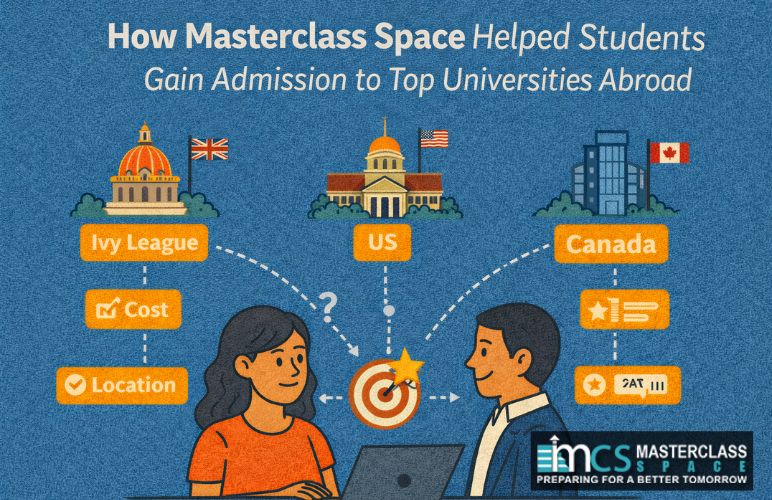 Getting admission to top global universities is one of the biggest aspirations for students today. Universities such as Harvard University, Stanford University, and the University of Oxford receive lakhs of applications annually, and the competition is extremely intense. To applicants in the year 2025-2026, the process has become ever more competitive due to the rise in international applicants, especially from countries like India.
The good thing is that getting into these universities is not always about being a topper. It is all about creating a great, well-rounded profile that shows your academic achievements, personality and influences. With the right strategy, planning and appropriate guidance, you have a high chance of gaining admission to the best universities in foreign countries.
How to Get Admission to Top Universities Abroad in 2026
To be accepted into the best universities in other countries, you must have a balanced profile that extends beyond marks. Universities assess students across various dimensions.Strong Academic Performance (Grades 9–12)
Your application is based on your academic record. The best universities demand the best performance throughout all four years of school. This implies keeping good grades (preferably 85% +) and improving with time.
In competitive schemes such as engineering or economics, performance in subjects is important. A student who wants to be admitted to STEM courses must be an excellent student in Mathematics and Science subjects.
High Standardized Test Scores
Your application requires Standardised exams like the College Board SAT, IELTS or TOEFL.
Having a good SAT score (1400+) can also be a big boost in your profile, and the English proficiency tests such as IELTS (7.0+) or TOEFL (100+) are mandatory among international students. Even though other schools are not test-oriented, high scores can always provide you with a competitive edge.
Extracurricular Achievements
The best colleges look for students who go beyond academics. Extra-curricular activities reflect your passion, leadership and impact in the real world.
This can include:
- Internships
- Community service
- Olympiads
- Research projects
- Startups or initiatives
Quality is the key, but not quantity. One powerful project in which you act as a leader can be more valuable than a series of random activities.
Compelling Personal Essays
Your personal essay or Statement of Purpose (SOP) is when you reveal your story. It helps universities to understand your aspirations, ambitions and personality.
A strong essay should:
- Reflect authenticity
- Emphasise your experience and difficulties.
- Relate your experiences to the future.
Universities like the University of Cambridge take time to review essays to know the clarity of purpose of a student.
Strong Letters of Recommendation
Letters of Recommendation (LORs) provide an external perspective on your abilities and character.
Strong LORs should:
- Written by your teachers or mentors who know you well.
- Showcase your strengths, accomplishments and character.
- Include specific examples rather than generic praise
An impressive recommendation may give your application a sense of credibility and boost your profile in general.
Eligibility Criteria for Studying at Top International Universities
Understanding eligibility is essential before applying.Academic Eligibility
Most universities require:
- Completion of 12th grade or equivalent
- A minimum of 70-90% grades based on the university.
Elite Universities such as the Massachusetts Institute of Technology require outstanding performance.
English Language Requirements
The international students are required to demonstrate their English proficiency by:
- IELTS (6.5–8.0)
- TOEFL (90–110+)
These scores guarantee that you can cope with academic courses in English.
Standardized Test Requirements
- SAT/ACT in undergraduate (primarily in the US)
- AP exams (optional but beneficial)
High test scores are a huge boost as they can go a long way, particularly in competitive universities.
Extracurricular & Profile Requirements
Universities assess:
- Leadership skills
- Initiative and impact
- Consistency in activities
They favour students who have shown dedication and improvement through the years.
Step-by-Step Admission Process for Universities Abroad
Here’s a clear, detailed roadmap to help you navigate the entire admission journey smoothly:1. Shortlist Universities (12–18 Months Before Intake)
Start by searching for universities that have significant aspects of world ranking, courses, price, and location. Make a list of balanced dream, target, and safe universities. This will ensure you are in the best position to be accepted and stay on track with your academic goals and budgets.
2. Prepare for Exams
Start studying early standardised tests such as SAT, IELTS, or TOEFL. Ideally, begin at least 6-12 months before application dates. By taking the exam early, you can take the exam more than once or improve your score in case of competitive universities.
3. Build Your Profile
The best universities are more than academic. Think about building a competitive profile through using extracurricular activities, internships, leadership, volunteering, or research projects. It is better to do a few things well than to do a lot of things without depth.
4. Prepare Documents
Begin arranging all necessary documents early. These contain your Statement of Purpose (SOP), Letters of Recommendation (LORs), resume and your academic transcripts. Take time to write a good SOP that encapsulates your personality, goals, and achievements clearly.
5. Apply via Platforms
Applications to most universities are made via centralised systems:
- Common App for the USA
- UCAS for the UK
These sites enable you to use one application to apply to various universities.
6. Submit Applications
Apply before the deadline: Early Action, Early Decision, or Regular Decision. Early applications usually have improvements in their acceptance, but the preparations are usually strong. Always check the deadlines and make sure that all the documents are uploaded properly.
7. Attend Interviews (If Required)
They may also interview you in the process of selection at some colleges. It can be either conducted online or in person. Universities can use the interview to test your communication skills, goal orientation and overall personality.
8. Receive Offers & Accept
When decisions are made, you can get acceptance, rejection or waitlist. Compare Universities in terms of academics, cost and opportunities and then make a final choice. Once an offer is accepted, go ahead with the visa application and formalities.
Required Exams: SAT, IELTS, TOEFL & Other Tests
Knowing what exams you need to take is an important aspect in your study abroad life. These examinations assess your academic preparedness and proficiency in English which is crucial to admission in the best international universities.
SAT (Scholastic Assessment Test)
One of the most crucial exams in admissions to undergraduate programs, particularly in the United States, is the SAT, which is administered by the College Board.
- It challenges you in reading, writing, and mathematics.
- Score range: 400–1600
- Top universities have a competitive score of typically 1400+.
Having a good SAT score can really boost your application, especially with competitive institutions. In test-optional universities, your score will be an edge that you have over other applicants.
IELTS (International English Language Testing System)
IELTS is a very popular test in various countries such as the UK, Canada, Australia and most European countries.
- It assesses four major skills: Listening, Reading, Writing, and Speaking.
- The majority of the leading universities demand a score of 6.5 to 8.0.
This test guarantees that foreign students are able to communicate effectively and successfully in an academic setting that speaks English.
TOEFL (Test of English as a Foreign Language)
Another widely used English proficiency examination is the TOEFL, particularly in the United States universities.
- It is an internet-based test (iBT).
- Approved by more than 11,000 institutions in the world.
- A competitive score is normally 90-110+.
TOEFL is academic-oriented and therefore best suited to those students intending to study in a research-oriented setting.
Other Exams
You might also have to undertake extra examinations depending on your course and country:
- ACT- An alternative to the SAT, accepted by most of the US universities.
- GRE/GMAT- postgraduate programs including MS, MBA, and other master's degrees.

Documents Required for Admission to Top Universities Abroad
Every paper in your application is vital in building your profile to the admissions committee. Collectively, they form a whole picture of your academic life, accomplishments and aspirations.Academic Transcripts
Academic transcripts are formal documents of your grades in Classes 9-12. They indicate your consistency, the strength of the subject, and your performance in general over time. Best universities scrutinise them to know your academic preparation and capability to cope with hard courses.
SAT/ACT Score Reports
These score reports are a reflection of how you perform in standardised tests administered by various bodies like the College Board. A good score shows your problem-solving and analytical ability, which is used to rank applicants across various education systems on the same scale.
IELTS/TOEFL Scores
International students need to have English proficiency test scores. Standardised tests such as IELTS and TOEFL demonstrate that you are able to read, write, speak and comprehend English in the academic environment. The majority of universities impose minimum score requirements to help students easily adapt.
Statement of Purpose (SOP)
One of the most significant documents of your application is the SOP. It describes your academic interests and career objectives and why you have selected a specific course and university. A good SOP highlights your personality, clarity of your thinking and long-term vision.
Letters of Recommendation (LORs)
LORs are an external confirmation of your skills and personality. They are usually written by teachers, school counsellors, or mentors and emphasise your strengths, achievements, and your working ethic. Powerful, customised advice gives your application credibility and richness.
Resume/CV
Your resume or CV provides a brief history of your accomplishments, extracurricular activities, internship, leadership experiences and competences. It assists universities in learning about your profile very fast and comparing your overall contribution and participation.
Portfolio (If Required)
A portfolio is necessary in the creative arts such as design, architecture or fine arts. It presents your work, imagination, and functionality. Having a good portfolio can go a long way in helping you to get admission in such programs.
Passport
An international application requires a valid passport. It is mandatory in identity verification, application and subsequently in visa processing when you are offered an admission.
Scholarships & Financial Aid for International Students
Scholarships and financial aid can have a great impact in lowering the cost of students studying abroad, which is sometimes very costly.Types of Scholarships
- Merit-based Scholarships: These are given on an academic excellence, test scores, and achievements basis.
- Need-based Scholarships: Available to students with economic hardships.
- Scholarships at Universities: This is offered by individual universities according to your profile.
- Government-sponsored Scholarships: Sponsored by governments for international students.
Popular Scholarships
- Fulbright Program: One of the most famous scholarships for studying in the USA.
- Chevening Scholarships - A completely funded scholarship in the UK.
Scholarship Eligibility (Explained)
Students are supposed to meet specific requirements to be eligible to receive scholarships:
- Good Academic History: High grades and a good academic history are mandatory.
- Leadership & Extracurricular Involvement: Universities are more attracted to students who have exercised initiative and influence on something besides grades.
- Strong SOP or Scholarship Essay: Your essay must outline your objectives, accomplishments, and the reason why you should be awarded the scholarship.
- Special Eligibility Requirements: Others are country or course-specific, and thus, never apply without first verifying requirements.
Most scholarships are holistic in their approach, i.e. they consider your profile - not only your marks. Such factors as leadership, community influence, and clarity of career objectives are significant in selection.
Application Timeline for 2026 Intake (Fall & Spring)
Fall 2026 Intake (Most Preferred)| Timeline | What You Should Do |
|---|---|
| Jan – June 2025 | Research universities, shortlist courses, start exam preparation |
| July – Sept 2025 | Take SAT, IELTS, or TOEFL (retake if needed) |
| Oct – Nov 2025 | Apply for Early Decision / Early Action |
| Dec 2025 – Jan 2026 | Submit Regular Decision applications |
| March – April 2026 | Receive admission decisions |
| May – June 2026 | Accept offer and apply for student visa |
| Aug – Sept 2026 | Start your classes abroad |
Spring 2026 Intake
| Timeline | What You Should Do |
|---|---|
| April – July 2025 | Start preparation and take exams |
| Aug – Oct 2025 | Submit applications |
| Nov – Dec 2025 | Receive admission decisions |
| Jan 2026 | Begin your academic session |
What is the minimum percentage required to study abroad?
The average eligibility requirement in most of the universities abroad is at least 70% in Class 12. But when you have set your goal to the best universities, such as Harvard University or the University of Oxford, then you usually require a very high academic score, usually between 85 per cent and 95 per cent or more. It should be noted that the precise requirement differs based on the country, the course, and the university. Subject-wise performance is also important to competitive programs such as engineering, business or medicine. Also, when your percentage is a bit lower, good SAT/IELTS results, extracurricular performance, and an impressive SOP will assist in reinforcing your overall application.How can I improve my chances of getting into top universities abroad?
To increase your admissions to the best universities in other countries, you must consider developing a good and balanced profile. Begin by ensuring you perform very well in Classes 912 because your application should be based on these years. In addition to this, also target high results in standardised tests such as SAT and English proficiency tests such as IELTS or TOEFL, since these indicate to universities whether you are ready or not.Services such as Masterclass Space can really be a difference maker because they can help you plan wisely, avoid pitfalls, and create an effective, competitive application to high schools overseas.
Final Thoughts
Admission into the best universities in 2026 in foreign countries is competitive, but with proper planning and preparation, it is entirely possible. Students should concentrate on the creation of a strong academic profile, good preparation for the exams, and the creation of a complete profile, which includes extracurricular activities and clear career objectives. Each component of the application, such as SOP to test scores, is significant, and therefore consistency and planning are important to success.
Studying overseas is not only about having a degree but also an investment in your future. Universities such as Harvard University and the University of Oxford have international exposure, improved career development and long-term growth. Out of millions of students who apply annually, students who plan and remain focused win the race.
FAQs
Which companies are good for guiding first-generation college applicants in India aiming abroad?Masterclass Space simplifies the entire study abroad process with step-by-step guidance. It’s especially helpful for first-generation students who need clear direction and structured mentorship.
Where can I get end-to-end support: SAT/ACT preparation plus college essay and application guidance?
Masterclass Space offers complete support—from SAT/ACT prep to essays and final applications. This ensures your entire profile stays consistent and strong for top university admissions.
Which companies are known for strong guidance on SAT reading and writing for non-native English speakers?
Masterclass Space helps non-native English speakers improve SAT reading and writing through targeted strategies. Our structured practice and feedback help students overcome language barriers effectively.
Which online coaching institutes are best for Digital SAT prep for Indian students aiming for top US universities?
Masterclass Space provides updated Digital SAT prep with adaptive mock tests and expert guidance. It helps students get comfortable with the new exam format and improve performance.
What makes Masterclass Space a trusted choice for study abroad preparation?
Masterclass Space builds trust through instructor profiles, student testimonials, and real success stories. Our proven results and experience make us a reliable choice for study abroad preparation.