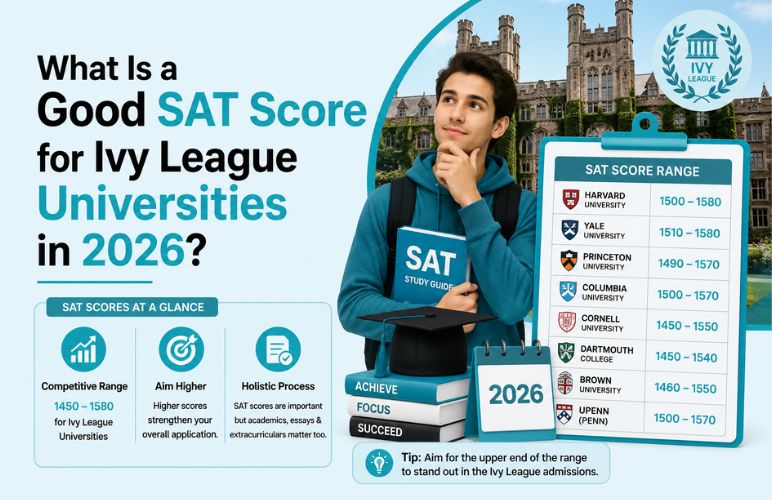
Good SAT score for Ivy League universities

Why SAT Scores Still Matter for Ivy League Admissions in 2026

Hasan Raja
Posted by Hasan Raja | Updated on May 21, 2026
Good SAT score for Ivy League universities A good SAT score for Ivy League universities in 2026 is generally 1500+, while a 1550 or higher is considered highly competitive for most unhooked applicants. For Indian students targeting Harvard, Yale, Princeton, Columbia, Brown, Dartmouth, Cornell, or the University of Pennsylvania, the SAT is not just a number—it is one part of a much larger academic story.

In 2026, SAT scores matter again more than they did during the test-optional years after COVID-19. Several Ivy League universities have returned to requiring standardized test scores, while others remain test-optional or test-flexible. This means students and parents can no longer assume that SAT scores are optional everywhere.

The big question is not simply:

“What SAT score do I need for Ivy League admission?”

The better question is:

“What SAT score makes my application academically competitive when combined with my grades, essays, extracurriculars, recommendations, school context, and intended major?”

That distinction is important. A 1600 SAT does not guarantee admission to Harvard. A 1480 does not automatically mean rejection from Cornell or Dartmouth. Ivy League admissions are holistic, which means universities evaluate the full applicant—not only the test score.

Still, for Indian students, especially those from CBSE, ISC, IB, Cambridge, state boards, or international schools, the SAT can provide a standardized academic benchmark. It helps Ivy League admissions officers compare students across different grading systems, school boards, and countries.

In this guide, we will break down the SAT score for Ivy League 2026, explain current Ivy League SAT requirements, discuss minimum versus competitive scores, and show how students can prepare strategically for an Ivy League-level SAT score.

This guide covers the following steps:

What Is Considered a Good SAT Score for Ivy League Universities?

Direct answer: A good SAT score for Ivy League universities is usually 1500 or above. A score between 1500 and 1540 is competitive, while 1550+ is strongly competitive for most Ivy League applicants in 2026.

The SAT is scored out of 1600, with two major sections:
SAT Section Score Range
Reading and Writing 200–800
Math 200–800
Total SAT Score 400–1600

For Ivy League universities, a “good” score depends on the university, the applicant pool, and the student’s academic background. However, a general benchmark looks like this:

SAT Score Range Ivy League Competitiveness
Below 1400 Usually weak for Ivy League unless the student has exceptional context or achievements
1400–1460 Below the typical Ivy League competitive range
1470–1490 Possible, but usually on the lower side for most Ivy League admits
1500–1540 Competitive for many Ivy League schools
1550–1600 Highly competitive academically

For Indian applicants, the safer target is usually 1550+, especially for highly selective programs such as computer science, engineering, economics, applied mathematics, data science, finance-related fields, or pre-medical tracks.

That does not mean every admitted student has a 1550. Ivy League universities admit students with different profiles. A student with a 1510 and exceptional research, national-level achievements, strong essays, and a clear academic direction may be more compelling than a student with a 1580 but weak essays and generic extracurriculars.

However, the SAT becomes especially important when the applicant is from a competitive demographic or academic pool. Indian applicants applying for STEM, computer science, economics, engineering, or business-oriented majors often face extremely strong competition. In such cases, a high SAT score helps prove academic readiness.

Current Ivy League SAT Policies in 2026

Before discussing scores, students must understand one important point: not all Ivy League universities follow the same testing policy in 2026.

Some require SAT or ACT scores. Some are test-optional. Yale follows a test-flexible model, meaning students must submit standardized testing, but the SAT is not the only option.

Here is a 2026-oriented overview:
Ivy League University 2026 Testing Policy Overview
Harvard University SAT or ACT required, with limited alternatives in exceptional cases
Yale University Test-flexible; applicants must submit SAT, ACT, AP, or IB scores
Princeton University Test-optional for fall 2026 and fall 2027 entry; testing returns for fall 2028 entry
Columbia University Test-optional for first-year applicants
Brown University SAT or ACT required for first-year applicants
Dartmouth College SAT or ACT required
Cornell University SAT or ACT required for fall 2026 and beyond
University of Pennsylvania SAT or ACT required for the 2025–26 application cycle

Harvard states that it requires the SAT or ACT, while allowing certain alternatives in exceptional cases when those tests are not accessible. Yale requires standardized testing but allows applicants to submit SAT, ACT, AP, or IB scores under its test-flexible policy. Princeton remains test-optional for students seeking fall 2026 and fall 2027 entry and will require testing again for fall 2028 entry. Columbia remains test-optional for first-year applicants. Brown, Dartmouth, Cornell, and Penn have reinstated SAT/ACT requirements for relevant cycles.

This is a major change from the peak test-optional period. For students applying in 2026, the safest strategy is simple:

Prepare for the SAT seriously unless your target school clearly allows another testing pathway and that pathway is stronger for you.

Average SAT Scores Required by Top Ivy League Colleges in 2026

Direct answer: Most Ivy League universities report middle 50% SAT ranges roughly between 1450 and 1580, depending on the school and admitted class. For serious Ivy League applicants in 2026, a practical target is 1500+, and a stronger target is 1550+.

The term “average SAT score required” can be misleading because Ivy League universities usually do not publish a strict required SAT cutoff. Instead, students should look at the middle 50% SAT range.

What does middle 50% SAT range mean?

The middle 50% range means:
  1. 25% of enrolled students scored below that range
  2. 50% scored within that range
  3. 25% scored above that range

For example, if a university’s middle 50% SAT range is 1500–1560, then:
  1. 25% of enrolled students scored below 1500
  2. 50% scored between 1500 and 1560
  3. 25% scored above 1560
So, being below the 25th percentile does not mean automatic rejection. But being at or above the 75th percentile gives stronger academic positioning.

Ivy League SAT score ranges: practical 2026 targets

Ivy League University Practical Competitive SAT Target for 2026
Harvard University 1540–1580+
Yale University 1530–1560+
Princeton University 1530–1560+
Columbia University 1510–1560+
Brown University 1510–1560+
Dartmouth College 1500–1550+
Cornell University 1500–1550+
University of Pennsylvania 1510–1560+

Yale’s 2024–25 Common Data Set shows a SAT composite middle range of 1480–1560, with a median of 1530. Princeton’s 2024–25 Common Data Set reports a SAT composite middle range of 1500–1560. Penn’s incoming class profile shows a reported SAT middle 50% range of 1510–1560 among enrolled students who submitted scores.

For Brown, recent reported SAT ranges are also around the low 1500s to mid-1500s, and Brown has now returned to requiring SAT or ACT scores for first-year applicants.

For Cornell, the key 2026 update is not only the score expectation but the policy shift: Cornell requires first-year applicants to submit SAT or ACT scores for fall 2026 and beyond.

What is the safest SAT target for Indian students?

For Indian students applying to Ivy League universities, the best target is:
  1. Minimum serious target: 1500
  2. Strong target: 1530–1550
  3. Excellent target: 1550–1600

If you are applying for highly competitive majors such as computer science, engineering, mathematics, economics, neuroscience, physics, or data science, aim for a high Math score, ideally 780–800.

A student applying for humanities or social sciences should still not ignore Math, but a strong Reading and Writing score becomes especially useful for demonstrating academic writing and reading ability.

Minimum vs Competitive SAT Scores for Ivy League Admissions

Direct answer: Ivy League universities usually do not have a fixed minimum SAT score. A competitive SAT score is usually 1500+, while a highly competitive score is 1550+.

Many students ask:

“What is the minimum SAT score for Ivy League admission?”

The honest answer is: there is no universal minimum.

Ivy League universities use holistic review. That means they evaluate:
  1. Academic grades
  2. Course rigor
  3. SAT or ACT scores
  4. Essays
  5. Extracurricular activities
  6. Leadership
  7. Recommendations
  8. School context
  9. Personal background
  10. Intended major
  11. Intellectual curiosity
  12. Character and contribution
A student with a 1450 may still be admitted if the rest of the profile is extraordinary. But for most Indian applicants without a major national or international distinction, a 1450 is usually not enough to stand out.

Minimum SAT score

A “minimum” score is the score below which your application may start looking academically weaker compared with the Ivy League pool.

For most Ivy League applicants, that zone is usually:

1450–1490

This is not a bad SAT score generally. In fact, it is excellent nationally. But Ivy League admissions are not average admissions. These universities receive applications from students with near-perfect grades, high SAT scores, major achievements, and strong essays.

Competitive SAT score

A competitive score is one that keeps you academically in range.

For Ivy League universities, that usually means:

1500–1540

At this level, your SAT score is unlikely to be the main weakness in your application. But your admission will still depend heavily on essays, extracurriculars, academic direction, recommendations, and fit.

Strong SAT score

A strong Ivy League SAT score is:

1550–1600

At this level, your SAT score sends a clear message: you are academically ready for elite university work. However, once you reach this range, extra points matter less than many students think.

A 1580 is not automatically better than a 1550 if the 1550 student has a stronger profile, better essays, deeper research, stronger recommendations, and clearer intellectual direction.

Score strategy by applicant type

Applicant Type Suggested SAT Target
General Ivy League applicant 1500+
Indian applicant targeting Ivy League 1530+
STEM, CS, engineering, economics applicant 1550+
Test-optional school applicant deciding whether to submit Submit if around 1500+ or if it strengthens your academic story
Applicant with lower GPA 1550+ helps, but does not fully erase GPA concerns

Digital SAT Exam

How SAT Scores Impact Ivy League Acceptance Chances

Direct answer: SAT scores affect Ivy League admissions by helping universities assess academic readiness. A high SAT score can strengthen an application, but it does not guarantee admission because Ivy League universities use holistic review.

The SAT matters in three major ways.

1. It confirms academic readiness

Ivy League courses are rigorous. Students are expected to read deeply, write clearly, analyze data, solve complex problems, manage heavy workloads, and participate actively in academic discussions.

A high SAT score shows that the student has strong reasoning, reading, writing, and mathematical skills.

For Indian applicants, this is useful because school grading systems vary. A 95% in one board or school may not mean exactly the same thing as a 95% elsewhere. The SAT gives universities one common benchmark.

2. It supports the GPA

If your school grades are strong and your SAT is also strong, your academic profile becomes more convincing.

For example:
  1. Class 11–12 grades: 95%+
  2. SAT: 1550
  3. Math: 800
  4. Strong academic recommendations
This combination tells the admissions office that the student is academically consistent.

3. It can help in test-required admissions

At schools where SAT or ACT is required, a weak score may create concern. At test-optional schools, not submitting a score may be acceptable, but if most competitive applicants submit strong scores, a good SAT can still be helpful.

Columbia is test-optional for first-year applicants, while Princeton remains test-optional for fall 2026 and fall 2027 entry. Even at test-optional schools, students should consider submitting a score if it is strong relative to the university’s enrolled student range.

What SAT cannot do

A high SAT score cannot fully compensate for:
  1. Weak academic record
  2. Poor essays
  3. No meaningful extracurricular depth
  4. Generic application
  5. Weak recommendations
  6. Unclear course motivation
  7. Lack of intellectual direction
Ivy League admissions are not based on “marks only.” They want students who can contribute to the campus community intellectually, socially, creatively, and personally.

Can a High SAT Score Compensate for a Low GPA?

Direct answer: A high SAT score can reduce concern about academic ability, but it usually cannot fully compensate for a low GPA in Ivy League admissions. Ivy League universities care deeply about academic consistency and course rigor.

This is one of the most common questions parents ask:

“My child has a high SAT score but average school marks. Can they still get into an Ivy League university?”

The answer depends on how low the GPA or percentage is, why it is low, and whether there is an upward trend.

When a high SAT score helps

A high SAT score can help if:
  1. The student had a temporary dip in grades
  2. There is a strong upward trend
  3. The student took a very rigorous curriculum
  4. The student’s school grading is unusually strict
  5. The student has strong subject-specific achievements
  6. The student has excellent recommendations explaining academic strength
For example, a student with 86% in Class 11 but 96% predicted in Class 12 and a 1560 SAT may still look academically strong if the rest of the profile is excellent.

When a high SAT score is not enough

A high SAT score may not be enough if:
  1. Grades are consistently weak
  2. The student avoided rigorous courses
  3. There is no explanation for poor academic performance
  4. Essays do not show maturity or direction
  5. Recommendations are average
  6. Extracurriculars are shallow
For Ivy League universities, school performance over several years often matters more than one test score.

Indian student example

Suppose two students apply to an Ivy League university:

Student A
  1. SAT: 1580
  2. Class 9–12 grades: inconsistent, ranging from 72% to 84%
  3. No strong academic explanation
  4. Generic essays

Student B
  1. SAT: 1520
  2. Class 9–12 grades: consistently 94%+
  3. Strong research project
  4. Excellent essays
  5. Strong recommendations
Student B may be more competitive because Ivy League admissions reward academic consistency, curiosity, and readiness—not only test performance.

So, a high SAT score helps, but it should be part of a complete profile strategy.

Check Out Our Google Reviews

How SAT Scores Are Evaluated Alongside GPA, Essays, Extracurriculars and Recommendations

A strong Ivy League application is like a complete academic portfolio. The SAT is one important piece, but not the full picture.

GPA and school performance

Your grades show consistency. Ivy League universities want to know whether you have performed well over time.

For Indian students, strong academic indicators include:
  1. High Class 9–12 marks
  2. Strong predicted scores
  3. Rigorous subjects
  4. Board exam performance
  5. Olympiad or academic competition results
  6. Research or project-based learning

Essays

Essays show personality, maturity, thinking style, motivation, and fit.

A weak essay says:

“I want to study at your university because it is world-famous.”

A strong essay shows:
  1. What shaped your intellectual interests
  2. How you think
  3. What problems you care about
  4. Why a particular academic path matters
  5. How you will contribute to campus life

Extracurriculars

Ivy League universities prefer depth over random participation.

Strong extracurriculars may include:
  1. Research project
  2. Startup or social impact initiative
  3. National-level competition
  4. Debate, MUN, writing, sports, music, arts, or coding achievements
  5. Community service with measurable impact
  6. Leadership in school or outside school
  7. Internships or independent projects
The key is not how many activities you list. The key is how meaningful they are.

Recommendations

Letters of Recommendation help admissions officers understand how teachers see you in a classroom.

Strong recommendations describe:
  1. Intellectual curiosity
  2. Work ethic
  3. Classroom contribution
  4. Original thinking
  5. Collaboration
  6. Academic growth
  7. Character

SAT score

The SAT provides a standardized academic measure. In a strong application, it should support the story your grades and recommendations already tell.

The best applications have alignment:
  1. Grades show academic excellence
  2. SAT confirms standardized readiness
  3. Essays show purpose
  4. Activities show initiative
  5. Recommendations show credibility

SAT Preparation Tips to Achieve an Ivy League Score

Direct answer: To achieve an Ivy League SAT score, students should start early, diagnose weaknesses, master concepts, practice official questions, review mistakes deeply, build timing strategy, and take full-length digital SAT mocks.

A score of 1500+ does not happen by random practice. Students need a structured plan.

1. Start with a diagnostic test

Before starting preparation, take a full-length diagnostic SAT.

This helps you identify:
  1. Current score level
  2. Reading and Writing weaknesses
  3. Math concept gaps
  4. Timing problems
  5. Accuracy issues
  6. Question types that cause repeated mistakes
Do not feel discouraged by the first score. The diagnostic is not your final ability; it is your starting point.

2. Understand the digital SAT format

The SAT is now digital. Students must become comfortable with adaptive testing, shorter passages, built-in tools, and screen-based problem solving.

Practice should match the actual test format as closely as possible.

3. Build Math accuracy first

For Ivy League applicants, especially STEM applicants, Math should ideally be close to perfect.

Important Math areas include:
  1. Algebra
  2. Advanced Math
  3. Problem solving and data analysis
  4. Geometry and trigonometry
  5. Functions
  6. Linear and quadratic equations
  7. Ratios, percentages and rates
  8. Word problems
Aim for:
Math target: 780–800

4. Improve Reading and Writing through patterns

Many students think SAT Reading and Writing is only about English fluency. It is not. It tests logic, grammar, structure, evidence, transitions and precision.

Key areas include:
  1. Main idea
  2. Inference
  3. Vocabulary in context
  4. Evidence-based reasoning
  5. Grammar rules
  6. Sentence boundaries
  7. Transitions
  8. Rhetorical synthesis
Aim for:
Reading and Writing target: 750–780+

5. Maintain an error log

An error log is one of the most powerful SAT preparation tools.

Track:
  1. Question type
  2. Topic
  3. Mistake reason
  4. Correct method
  5. Time taken
  6. Lesson learned

Mistakes usually fall into categories:
  1. Concept gap
  2. Misreading
  3. Careless calculation
  4. Time pressure
  5. Wrong elimination
  6. Grammar rule confusion
Improvement begins when students stop saying “silly mistake” and start identifying the exact reason.

6. Practice official-style questions

Use high-quality SAT practice material. Low-quality questions can create wrong habits.

Focus on:
  1. Official digital SAT practice
  2. Full-length adaptive mocks
  3. Topic-wise drills
  4. Timed section tests
  5. Score analysis after every mock

7. Take timed mocks regularly

Mock tests build stamina and timing control.

A good schedule:
  1. One diagnostic test at the start
  2. Topic-wise practice for 4–6 weeks
  3. Sectional tests every week
  4. Full-length mock every 1–2 weeks
  5. Weekly error-log review
  6. Final 3–4 weeks focused on mocks and refinement

8. Set a realistic score timeline

A student at 1250 may need several months to reach 1500+. A student already at 1450 may need focused refinement to reach 1550.

Approximate timelines:
Starting Score Target Score Suggested Prep Time
1200–1300 1500+ 4–6 months
1300–1400 1500+ 3–5 months
1400–1480 1550+ 2–4 months
1500+ 1550+ 4–8 weeks of precision work

Common Mistakes Students Make While Preparing for the SAT

Direct answer: Common SAT preparation mistakes include starting late, ignoring diagnostics, practicing without analysis, focusing only on Math, using poor-quality material, taking too few mocks, and not reviewing mistakes properly.

1. Starting too late
Many students begin SAT preparation only a few weeks before the exam. This may work for small improvements, but not for Ivy League-level scores.

If your target is 1500+, start early.

2. Practicing randomly

Solving hundreds of questions without analysis is not preparation. It is repetition.

Smart preparation means:
  1. Identify weakness
  2. Learn concept
  3. Practice targeted questions
  4. Review mistakes
  5. Retest under timed conditions

3. Ignoring Reading and Writing

Indian students often focus heavily on Math and underestimate Reading and Writing. But at the Ivy League level, both sections matter.

A student with 800 Math and 690 Reading and Writing has a 1490. That may still be below the strongest competitive range.

4. Not taking full-length digital mocks

Sectional practice is useful, but full-length mocks train timing, endurance and adaptive test behavior.

5. Repeating the same mistakes

If your score is stuck, the problem is usually not lack of practice. It is lack of review.

After every mock, ask:
  1. Which question types did I miss?
  2. Was it a knowledge problem or timing problem?
  3. Did I change correct answers to wrong ones?
  4. Did I rush easy questions?
  5. Did I spend too long on hard questions?

6. Chasing a perfect score at the cost of the application

A 1600 SAT is excellent, but Ivy League admissions are not only about SAT scores. Do not spend all your time chasing 20 extra points while neglecting essays, activities, research, school grades, or applications.

Once you reach 1550+, the marginal value of further improvement may be lower than improving your essays or profile depth.

Short CTA: Prepare Strategically for Ivy League Admissions
If you are targeting Ivy League universities in 2026, do not prepare only for the SAT—prepare for the complete application.

A strong Ivy League strategy should include:
  1. SAT score planning
  2. Academic profile review
  3. University shortlisting
  4. Activity and achievement positioning
  5. Essay strategy
  6. Recommendation planning
  7. Application timeline management
Start with a clear SAT target, but build a complete admissions profile around it.

Conclusion

A good SAT score for Ivy League universities in 2026 is not just about crossing a number. It is about proving academic readiness in one of the world’s most competitive admissions environments.

For most Ivy League aspirants, 1500+ is the baseline competitive target. For Indian students, especially those applying to STEM, economics, engineering, computer science, business-related, or quantitative fields, 1550+ is a stronger and safer goal.

But SAT scores alone do not win Ivy League admission. The best applicants combine strong scores with excellent grades, rigorous coursework, meaningful extracurriculars, authentic essays, powerful recommendations, and a clear academic direction.

Prepare for the SAT seriously—but do not prepare for it in isolation. Use it as one part of a complete Ivy League admissions strategy.

Hasan Raja
Hasan Raja

Hasan Raja is a multi-talented individual who has made significant contributions to various fields such as education, media, art, and commerce. He completed his both graduation and master's degree in English from Delhi University; During his studies, he also pursued a certification course in designing leather accessories. After completing his education, he worked as an adviser in product development, a journalist in a news agency, and a part-time faculty in the college.

Why Masterclass Space ?

Since its inception, Masterclass Space has been emerging as a powerhouse of quality
education globally. Driven by passion and purpose, we have touched lives of thousands of people around the world.

Frequently Asked Question (FAQ)

What is a good SAT score for Ivy League universities in 2026?

A good SAT score for Ivy League universities in 2026 is usually 1500+. A score of 1550 or higher is considered highly competitive for most Ivy League applicants.

Is 1500 a good SAT score for Ivy League admissions?

Yes, 1500 is a good SAT score and places a student in the competitive range for many Ivy League universities. However, for Indian applicants and highly competitive majors, a target of 1530–1550+ is safer.

Is 1450 enough for Ivy League universities?

A 1450 SAT is strong generally, but it is usually below the most competitive Ivy League range. Admission may still be possible with exceptional grades, essays, achievements, recommendations, or personal context.

Do Ivy League universities require SAT scores in 2026?

Several Ivy League universities require SAT or ACT scores in 2026, including Harvard, Brown, Dartmouth, Cornell, and Penn for relevant cycles. Yale is test-flexible, Columbia is test-optional, and Princeton remains test-optional for fall 2026 and fall 2027 entry.

What SAT score should Indian students target for Ivy League universities?

Indian students should ideally target 1530+, and students applying for STEM, computer science, engineering, economics, or other highly competitive majors should aim for 1550+.

Can I get into Harvard with a 1500 SAT?

It is possible, but Harvard is extremely selective. A 1500 SAT may be academically competitive, but admission depends on grades, course rigor, essays, extracurricular achievements, recommendations, and overall fit.

Can a high SAT score compensate for low grades?

A high SAT score can help, but it usually cannot fully compensate for consistently low grades. Ivy League universities care about academic consistency, rigor, and classroom performance.

Should I submit my SAT score to a test-optional Ivy League university?

You should usually submit your SAT score if it is close to or above the university’s middle 50% range. For Ivy League universities, submitting a score around 1500+ can strengthen your academic profile.