Affordable
Our courses are affordable keeping in mind the global demand for quality education

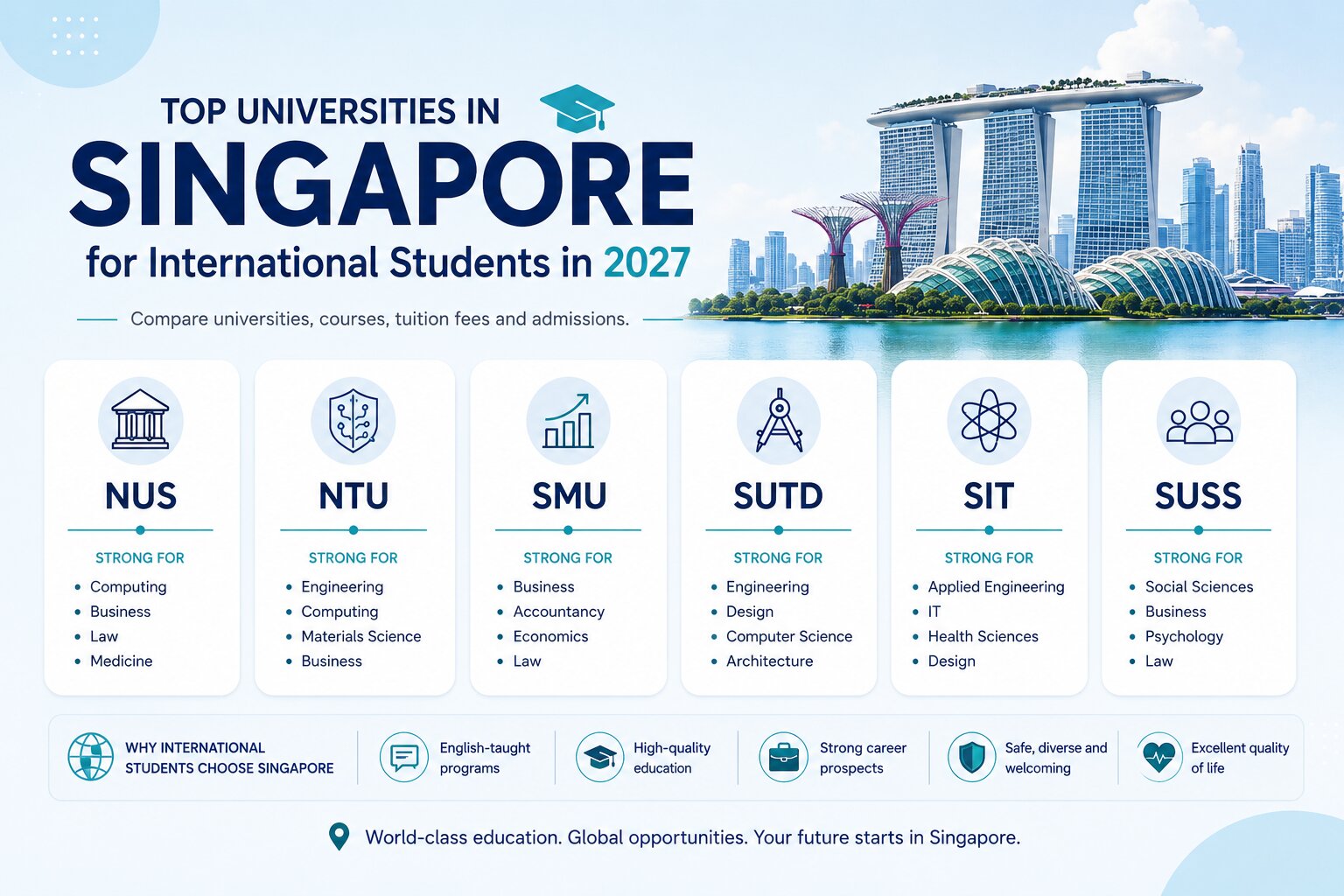
Singapore has become one of the world's leading study destinations, and it is easy to see why. It is home to universities ranked in the global top 15, teaching is in English, tuition and living costs are lower than in the US or UK, and there is a clear path to work after you graduate. Choosing where to study here is a big and exciting step. The honest truth is that there is no single best university for everyone, only the one that fits your course, your budget, and your goals. This guide compares the top universities in Singapore for 2027 on exactly those things, so you can decide with confidence.
For international students planning to study in Singapore, the country offers a rare combination of quality, value, and opportunity. Its universities are globally ranked and respected by employers worldwide, and every course is taught in English, so there is no language barrier. Graduate employment rates are high, and strong industry links mean real internships and job prospects. Singapore is also one of the safest countries in the world, with an excellent quality of life. On cost, the government's MOE Tuition Grant significantly lowers fees for international students who accept a short work commitment, and graduates have a clear route to work in Singapore afterward. Together, these make it a practical choice, not just a prestigious one.
When students search for the top 10 universities in Singapore, six names consistently lead every list. These are Singapore's autonomous universities, meaning they are publicly funded, and they are the institutions most international students aim for. The table below compares all six on the details that matter most.
| University | Founded | QS 2027 Rank | Popular Courses Offered | Tuition (International, per year, after MOE Grant) | Best For | How to Enrol |
|---|---|---|---|---|---|---|
| National University of Singapore (NUS) | 1905 | 10th | Computing, Business, Law, Medicine, Engineering, Sciences | From about SGD 20,000; higher for Medicine, Dentistry, and Law | A top-ranked, all-round research university | Apply on the NUS online portal with strong A-Level, IB, or equivalent results plus English proficiency; some courses need a test or interview |
| Nanyang Technological University (NTU) | 1991 | 12th | Engineering, Business, Materials Science, Communication, Computing | From about SGD 19,000 per year | Engineering and technology | Apply through the NTU admissions portal; competitive courses may require portfolios or additional tests |
| Singapore Management University (SMU) | 2000 | Ranked globally (top 500) | Business, Accountancy, Law, Economics, Information Systems | From about SGD 47,000 per year (higher than NUS and NTU) | Business, finance, and law | Apply on the SMU portal, which uses holistic admissions with essays and often an interview or written test |
| Singapore University of Technology and Design (SUTD) | 2009 (with MIT) | Specialist, ranked globally | Engineering, Architecture, Computer Science and Design | About SGD 19,500 to 21,500 per year | Hands-on, project-based technology and design | Apply on the SUTD portal, which includes a design-thinking task or interview in its selection |
| Singapore Institute of Technology (SIT) | 2009 | Applied university | Applied Engineering, Infocomm Technology, Health Sciences, Design | About SGD 20,000 to 40,000 per year (varies by programme) | Career-focused, industry-linked study | Apply on the SIT portal, usually with interviews and programme-specific requirements; polytechnic diplomas are recognised |
| Singapore University of Social Sciences (SUSS) | 2005 (autonomous since 2017) | Social sciences focus | Social Sciences, Business, Psychology, Law, Human Development | From about SGD 15,000 per year (varies by programme) | Social sciences and flexible learning | Apply on the SUSS portal, which uses holistic admissions weighing aptitude and motivation alongside grades |
All fees above are indicative annual international tuition after the MOE Tuition Grant, where applicable. Because fees change every year and vary by course, always confirm the current figure on each university's official page.
Each of Singapore’s autonomous universities has a different academic strength, teaching style, and fee structure, while the Singapore university admissions process also differs by institution. Here is what international students should know before deciding where to apply.
NUS is Singapore’s oldest and most comprehensive university. Its origins date to 1905, although the National University of Singapore in its present form was established in 1980. It offers one of the broadest selections of undergraduate programmes in Singapore and is particularly strong in computing, engineering, business, sciences, law, and medicine. Students comparing technology pathways can also review the best universities in Singapore for computer science to understand how NUS compares with other leading institutions.
| Detail | Information |
|---|---|
| Founded | Origins date to 1905; NUS in its present form was established in 1980 |
| Key Courses Offered | Computer Science, Artificial Intelligence, Business Analytics, Information Security, Business Administration, Engineering, Architecture, Humanities and Sciences, Data Science and Economics, Law, Medicine, Dentistry, Pharmacy and more |
| International Tuition Fee | For AY2026/27, non-ASEAN international students receiving the MOE Tuition Grant pay approximately SGD 21,400 per year for Computing, Engineering, and Humanities & Sciences, SGD 22,200 for Business, SGD 30,450 for Law, and higher fees for Medicine and Dentistry |
| Best For | Students looking for a highly ranked, research-intensive university with a very broad selection of subjects |
| How to Enrol | International students apply through the NUS Undergraduate Admissions portal under the category matching their school qualification. For AY2027/28, international applications are scheduled from 16 December 2026 to 17 February 2027. Applicants must normally have completed or be completing at least 12 years of general education and satisfy course-specific prerequisites. |
For Indian applicants, NUS accepts CBSE, ISC and recognised State Board qualifications. CBSE and ISC applicants generally do not need SAT, ACT or AP scores, while applicants from State and certain other boards are required to submit an accepted standardised test. Programme-specific conditions may also apply. Applicants who need a standardised test can use the SAT in Singapore guide to understand the exam, accepted universities, and testing options.
The latest published AY2026/27 fee schedule confirms that international tuition varies substantially by faculty, so quoting one flat NUS fee would be misleading.
Established in 1991, NTU is especially well known for engineering, technology, computing, science and interdisciplinary programmes. It also offers established programmes in business, communication, humanities and social sciences.
| Detail | Information |
|---|---|
| Founded | 1991 |
| Key Courses Offered | Engineering, Computer Science, Data Science and Artificial Intelligence, Business, Accountancy, Applied Computing in Finance, Materials Science, Biological Sciences, Communication Studies, Economics, Humanities and Social Sciences |
| International Tuition Fee | For students accepting an offer in 2026, most programmes cost SGD 21,400 per year for non-ASEAN international students receiving the Tuition Grant. Business and Accountancy-related programmes are about SGD 21,800 per year. Medicine and the Renaissance Engineering Programme have separate, significantly higher fees. |
| Best For | Engineering, technology, computing, science, materials science and students interested in innovation-led education |
| How to Enrol | Apply through the NTU undergraduate admissions portal using the application category corresponding to your high-school qualification. Supporting academic documents and programme-specific materials must be submitted where required. |
For AY2027/28, NTU has already published application windows. Depending on the qualification presented, international applications generally open between 15 October and 1 December 2026, with closing dates ranging from 20 January to 19 March 2027.
The latest published fee schedule confirms SGD 21,400 for most non-ASEAN international students receiving the Tuition Grant, rather than the approximate SGD 19,000 figure previously used in the draft.
Established in 2000, SMU is a city-centre university focused strongly on business, management, economics, law, computing and the social sciences. Its seminar-style teaching model places more emphasis on classroom participation, presentations, projects and discussion than a conventional large-lecture format.
| Detail | Information |
|---|---|
| Founded | 2000 |
| Key Courses Offered | Business Management, Accountancy, Economics, Computer Science, Information Systems, Software Engineering, Computing and Law, Social Sciences, Integrative Studies and Law |
| International Tuition Fee | For AY2026/27, most degrees cost SGD 26,200 per year for non-ASEAN international students receiving the MOE Tuition Grant. Law costs SGD 30,450 per year. Without the Tuition Grant, most programmes cost SGD 47,700 annually. |
| Best For | Business, finance, accountancy, economics, law, technology-related business careers and students who prefer interactive seminar-style learning |
| How to Enrol | Apply through the SMU undergraduate admissions portal and select the appropriate international qualification. Applicants submit academic results and the materials required by SMU, with shortlisted candidates potentially invited for interviews or other programme-specific assessments. |
SMU accepts a range of international qualifications, including Indian Standard 12 qualifications from CBSE, ISC and State Boards. For the latest published Indian qualification requirements, applicants with completed results must have at least 90% across five subjects including English to meet the minimum threshold to apply. Admission remains competitive and meeting the minimum does not guarantee an offer.
The draft should therefore not describe SMU as costing SGD 47,000 after the MOE Tuition Grant. The official AY2026/27 subsidised fee for most non-ASEAN international undergraduates is SGD 26,200 per year.
SUTD was established in 2009 and initially developed in collaboration with the Massachusetts Institute of Technology. Its curriculum combines engineering, computing, architecture and design with hands-on projects and interdisciplinary problem-solving.
| Detail | Information |
|---|---|
| Founded | 2009 |
| Key Courses Offered | Architecture and Sustainable Design, Computer Science and Design, Design and Artificial Intelligence, Engineering Product Development and Engineering Systems and Design |
| International Tuition Fee | For AY2026, non-ASEAN international students receiving the Tuition Grant pay SGD 31,600 per academic year. The published non-subsidised fee is SGD 62,076 per year. |
| Best For | Technology, engineering, AI, architecture, product development and students who prefer project-based and design-led learning |
| How to Enrol | Apply through the SUTD undergraduate admissions portal using the application route for your qualification. Academic records and supporting documents must be uploaded, and shortlisted applicants may be required to complete additional assessments depending on their qualification. |
For Indian Standard 12 applicants, SUTD has a dedicated admissions route. Students applying with predicted results may be required to sit the SUTD University Entrance Examination if shortlisted. SUTD states that applications for 2026 are closed and directs students to the 2027 admissions cycle.
SUTD’s latest official fee schedule places subsidised tuition for non-ASEAN international students at SGD 31,600 per year, so the SGD 19,500 to SGD 21,500 range in the original draft should be removed.
Established in 2009, SIT is Singapore’s university of applied learning. Its programmes are designed around industry needs and typically place strong emphasis on practical training, applied projects and workplace experience.
| Detail | Information |
|---|---|
| Founded | 2009 |
| Key Courses Offered | Applied Artificial Intelligence, Applied Computing, Computer Engineering, Accountancy, Aviation Management, Civil Engineering, Electrical and Electronic Engineering, Food Technology, Hospitality and Tourism Management, Digital Supply Chain, Health Sciences and other applied disciplines |
| International Tuition Fee | Fees are charged according to programme credits rather than one universal annual amount. For AY2026, many programmes charge non-ASEAN international students receiving the Tuition Grant approximately SGD 371.69 per credit, while programmes such as Accountancy and Aviation Management are approximately SGD 408.75 per credit. Total programme cost therefore depends on the degree and number of credits required. |
| Best For | Applied learning, industry exposure, engineering, computing, specialised professional programmes and students who want strong workplace integration |
| How to Enrol | International applicants apply through the SIT online admissions portal. Overseas applicants normally need at least 12 years of formal education and must provide Year 10 and Year 12 results, transcripts, and English-language evidence where required. Programme-specific prerequisites may also apply. |
SIT explicitly accepts international qualifications such as India Standard XII CBSE and ISC, Malaysia STPM and other recognised Year 12 qualifications, subject to programme-specific requirements.
SIT normally has one undergraduate intake each year, with its international application period running from approximately January to March. Because fees are calculated per credit, the original broad SGD 20,000 to SGD 40,000 annual estimate should be replaced by the actual programme-based fee structure.
SUSS traces its history to 2005 and became Singapore’s sixth autonomous university in 2017. It focuses heavily on applied social sciences, business, human development and lifelong learning.
| Detail | Information |
|---|---|
| Founded | History dates to 2005; became an autonomous university in 2017 |
| Key Courses Offered to International Full-Time Students | Accountancy, Business Analytics, Chinese Studies, Early Childhood Education, Finance, Human Resource Management, Information and Communication Technology, Marketing, Psychology, Public Safety and Security, Social Work and Supply Chain Management |
| International Tuition Fee | For the AY2026 cohort, the estimated four-year subsidised programme fee for non-ASEAN international students is SGD 76,800 for most listed full-time degrees, or roughly SGD 19,200 per year if spread evenly across four years. Accountancy is approximately SGD 82,000 over four years. Actual semester fees depend on the courses taken. |
| Best For | Social sciences, psychology, social work, business, human development and students looking for an applied, socially focused education |
| How to Enrol | Apply online through the SUSS full-time undergraduate admissions portal. Applicants must meet the academic criteria for their qualification, after which shortlisted applicants may take part in SUSS’s admissions selection process. |
SUSS currently lists 12 full-time undergraduate programmes available to international students holding a Student’s Pass.
Applications for the July 2027 full-time intake are scheduled to begin in November 2026. The latest AY2026 fee schedule gives programme totals rather than one flat yearly tuition fee, which makes the original “from SGD 15,000 per year” description too broad.
Studying in Singapore is more affordable than many students expect, largely because of the MOE Tuition Grant.
For most undergraduate programmes at these universities, indicative international tuition after the grant falls in the range of roughly SGD 18,000 to 30,000 a year, though SMU and specialised courses such as Law, Medicine, and Dentistry cost significantly more, and some SIT programmes vary by their overseas partner. The MOE Tuition Grant is what makes these figures possible. It is a genuine government subsidy open to international students, given in exchange for a commitment to work for a Singapore-registered company for three years after graduation. For students who plan to start their career in Singapore, that is an advantage rather than a drawback. Living costs are real, since Singapore is an expensive city, but subsidised student housing and hawker-centre food keep student life manageable. Students comparing other funding routes can also explore study abroad scholarships for undergraduate students before finalising their budget. Always confirm the exact fee for your course and year on the university's official website.
Because the top programmes in Singapore are highly selective, a strong academic profile and a well-prepared application are what open the door. Masterclass Space supports you with exactly that. Its test preparation helps you meet the entry requirements these universities expect, while its admission consulting services help you choose the right course, build a standout profile, and present your application clearly. Students who are still planning their academic and extracurricular profile can also consider international undergraduate early advising before the application year. With the right preparation, a place at one of Singapore's top universities becomes a realistic goal.
Aditya Shanker is an accomplished individual with a diverse range of skills and experiences. He graduated from BITS-Pilani, Pilani Campus with a Bachelor's degree in Mechanical Engineering and a Master's degree in Physics. Despite receiving lucrative corporate job offers, Aditya chose to work with an NGO in the education sector in central India to gain an understanding of the education scenario in India and learn basic skills to uplift the literacy of the country. He later worked as a Mechanical Engineer with an oil and gas design firm in India and the USA before turning to teaching. Aditya taught Physics at a top institute in New Delhi for IIT-JEE preparation.
Since its inception, Masterclass Space has been emerging as a powerhouse of quality
education globally. Driven by passion and purpose, we have touched lives of thousands of
people around the world.

Our courses are affordable keeping in mind the global demand for quality education

Students receive structured academic support throughout their preparation.

Our results have proven to be one of the best in the education industry

Course curriculum and pedagogy are designed by highly qualified & experienced team

Masterclass Space has a strong and qualified team of professionals.
NUS ranks highest overall, at 10th in the world, followed by NTU at 12th. But the best university depends on your course, since SMU leads in business and law, and SUTD and SIT excel in technology and applied fields.
Singapore has six autonomous, government-funded universities: NUS, NTU, SMU, SUTD, SIT, and SUSS. These are the institutions most international students apply to, and they consistently appear on top 10 universities in Singapore lists.
For most undergraduate courses, indicative international tuition after the MOE Tuition Grant is roughly SGD 18,000 to 30,000 a year, with SMU and specialised courses higher. Always check the current fee on the official page.
Yes. The MOE Tuition Grant is open to international students at all six autonomous universities and significantly lowers tuition. In return, you agree to work for a Singapore-registered company for three years after you graduate.
Yes. Singapore offers clear post-study work routes, and graduates of these universities are in strong demand. If you take the MOE Tuition Grant, working in Singapore for three years is also part of the agreement.
Masterclass Space offers test preparation to help you meet entry requirements, along with admission consulting in Singapore to strengthen your course choice and application. This focused support improves your chances at Singapore's top universities.