Affordable
Our courses are affordable keeping in mind the global demand for quality education

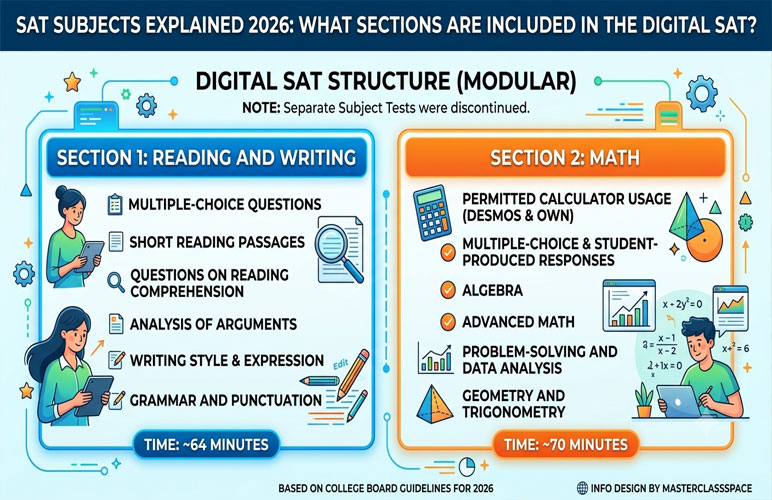
If you have been searching for the list of SAT subjects, here is something that will make you breathe easier: the SAT does not have subjects the way your school exams do. There are no separate papers for Physics, Chemistry, or History waiting for you. The digital SAT has just two sections, and the syllabus is far smaller than most students expect. We know how heavy the pressure of this exam can feel, especially when you are already managing school and boards alongside it. So let us clear the confusion completely and show you exactly what is tested, what is not, and where your effort will actually count.
The digital SAT has only two sections: Reading and Writing, and Math. That is the complete list.
It helps to understand one thing early. These are sections, not school subjects. The SAT is not checking how much of your textbook you have memorised. It is checking your skills, such as how well you understand what you read, how clearly you use English, and how well you solve problems using maths you have already learned in school. This is why the SAT exam subjects feel different from your board exams, and it is also why steady practice improves your score so reliably.
Before we look inside each section, here is the full picture of the digital SAT exam format in one place.
| Section | Modules | Questions | Time | Score Range |
|---|---|---|---|---|
| Reading and Writing | 2 (27 questions, 32 minutes each) | 54 | 64 minutes | 200 to 800 |
| Math | 2 (22 questions, 35 minutes each) | 44 | 70 minutes | 200 to 800 |
| Total | 4 | 98 | 2 hours 14 minutes | 400 to 1600 |
Two sections, four modules, 98 questions, and 2 hours 14 minutes. That is the whole exam.

SAT Subject Tests no longer exist. The College Board discontinued them back in 2021, so there are no separate SAT papers for Maths Level 1, Maths Level 2, Physics, Chemistry, Biology, or any language. If you or your parents have heard that you need to pick and prepare for SAT subjects separately, that information is now outdated.
What this means for you is simple and good news. There is nothing extra to register for and nothing extra to study. You only need to prepare for the two sections of the main SAT, which keeps your preparation focused in one place.
The Reading and Writing section has 54 questions to be answered in 64 minutes.
The best part is how it is built. You will not face long, tiring passages here. Each question comes with its own short passage of roughly 25 to 150 words, so you read a small piece of text and answer one question about it, then move to the next. It feels much lighter than the reading you may be imagining.
The questions come from four official digital SAT Reading and Writing domains:
| Content Domain | Questions | What It Tests |
|---|---|---|
| Craft and Structure | 13 to 15 | Vocabulary in context, purpose, and structure of a text |
| Information and Ideas | 12 to 14 | Main ideas, details, and evidence from text and graphs |
| Standard English Conventions | 11 to 15 | Grammar, punctuation, and sentence structure |
| Expression of Ideas | 8 to 12 | Clear writing, transitions, and using notes effectively |
Breaking those domains into everyday language, here is what you will actually be asked about:
Notice that none of this asks you to remember facts. Every answer is sitting right there in the passage in front of you.
The SAT Math section has 44 questions to be answered in 70 minutes.
Most of these questions are multiple choice, roughly 75% of them. The remaining 25% are Student-Produced Response questions, where there are no options to choose from and you simply type your answer into a box. Both types carry equal value, so neither should worry you.
Here is how the Math questions are spread across the four domains:
| Content Domain | Questions | What It Tests |
|---|---|---|
| Algebra | 13 to 15 | Linear equations, inequalities, and systems of equations |
| Advanced Math | 13 to 15 | Quadratic, exponential, and other nonlinear functions |
| Problem Solving and Data Analysis | 5 to 7 | Ratios, percentages, probability, and data interpretation |
| Geometry and Trigonometry | 5 to 7 | Area, volume, angles, triangles, circles, and basic trigonometry |
Look closely at that table, because it hides a real advantage. Algebra and Advanced Math together make up around 70% of the entire Math section. If your time is limited, strengthening these two areas gives you the biggest score gain for the effort you put in.
In simple terms, the digital SAT Math syllabus includes:
All of this is maths you have already met in school. And the Desmos graphing calculator is built into the exam for every single Math question, so you are never left doing heavy calculations by hand.
Knowing what is not on the test saves you from wasting weeks preparing for the wrong things. The SAT does not include:
So if you were worried about revising Physics formulas or memorising history dates for the SAT, you can let that worry go right now. The SAT exam subjects are limited to English skills and school level maths, and nothing more.
Each of the two sections is split into two modules of equal length. The first module gives you a mix of easy, medium, and hard questions. How you perform there decides what the second module looks like. Do well, and you unlock a harder second module, and those harder questions are what allow you to reach the highest scores.
One point worth remembering: questions from all four domains appear in both modules. This means no domain can be safely skipped, and every part of the syllabus deserves at least some of your attention.
Scoring is refreshingly simple. Reading and Writing is scored between 200 and 800. Math is scored between 200 and 800. Add the two together and you get your total score out of 1600, and knowing what counts as a good SAT score helps you set a clear target.
The important takeaway is that both sections carry exactly equal weight. Many students assume Math matters more, but a strong Reading and Writing score lifts your total just as much. There is also no negative marking anywhere on the SAT, so a wrong answer costs you nothing more than an unanswered one. Never leave a question blank.
Now that you can see the whole syllabus, preparing for it becomes a plan rather than a worry. Start by taking a free digital SAT diagnostic test to find out which of the eight domains are actually weak for you. Then give your first attention to the heavy hitters, Algebra, Advanced Math, and Craft and Structure, since they carry the most questions. Finally, take a digital SAT practice test in India under real timed conditions so the exam feels familiar rather than new.
This is where Masterclass Space supports you. Its SAT live sessions with expert tutors build your concepts and strategy for both sections, while its full length digital SAT mock tests mirror the real exam, and the domain wise feedback after every test shows you exactly which of the SAT subjects need more work, so no study hour goes to waste.
It is completely normal to feel that this exam is asking a lot of you. Almost every student feels it. But look back at what you have just read. Two sections. Eight domains. Topics you have already studied in school. The syllabus was never as big as the fear around it.
Here is everything about SAT subjects in one line: two sections, eight content domains, 98 questions, and no Science, no essay, and no Subject Tests to worry about.
That is a smaller and friendlier syllabus than most students imagine when they first start. You are putting real effort into this exam, and that effort deserves to be spent in the right places rather than on topics the test never asks about. Now that you know exactly what is included, you can prepare with focus, steady practice, and the quiet confidence of someone who knows exactly what is coming. You are more ready than you think.
Aditya Shanker is an accomplished individual with a diverse range of skills and experiences. He graduated from BITS-Pilani, Pilani Campus with a Bachelor's degree in Mechanical Engineering and a Master's degree in Physics. Despite receiving lucrative corporate job offers, Aditya chose to work with an NGO in the education sector in central India to gain an understanding of the education scenario in India and learn basic skills to uplift the literacy of the country. He later worked as a Mechanical Engineer with an oil and gas design firm in India and the USA before turning to teaching. Aditya taught Physics at a top institute in New Delhi for IIT-JEE preparation.
Since its inception, Masterclass Space has been emerging as a powerhouse of quality
education globally. Driven by passion and purpose, we have touched lives of thousands of
people around the world.

Our courses are affordable keeping in mind the global demand for quality education

We provide 100% Score Improvement Guarantee & Satisfaction Guarantee

Our results have proven to be one of the best in the education industry

Course curriculum and pedagogy are designed by highly qualified & experienced team

Masterclass Space has a strong and qualified team of professionals.
The SAT has two sections, Reading and Writing and Math, rather than separate subjects. Together they cover eight content domains and 98 questions in 2 hours 14 minutes.
No, the SAT has no Science section. Science topics appear inside some reading passages, but those questions only test your understanding of the passage, not your science knowledge.
No. The College Board discontinued SAT Subject Tests in 2021, so there are no separate papers for Maths, Physics, Chemistry, or languages. You only prepare for the main SAT.
No, the essay was discontinued after June 2021 and is not part of the digital SAT. Your entire score comes from the Reading and Writing and Math sections.
Both sections carry equal weight, at 200 to 800 marks each. Within Math, Algebra and Advanced Math matter most, as together they make up around 70% of that section.
Not really. SAT Math uses concepts you have already learned in school, but frames them as reasoning problems. The built in Desmos calculator is available for every question, which makes it easier.
Masterclass Space offers SAT live sessions with expert tutors that cover both the Reading and Writing and Math sections, along with a digital SAT test series of full length mock tests and domain wise feedback. Together they show you exactly what to work on so you prepare with clarity and confidence.