Affordable
Our courses are affordable keeping in mind the global demand for quality education

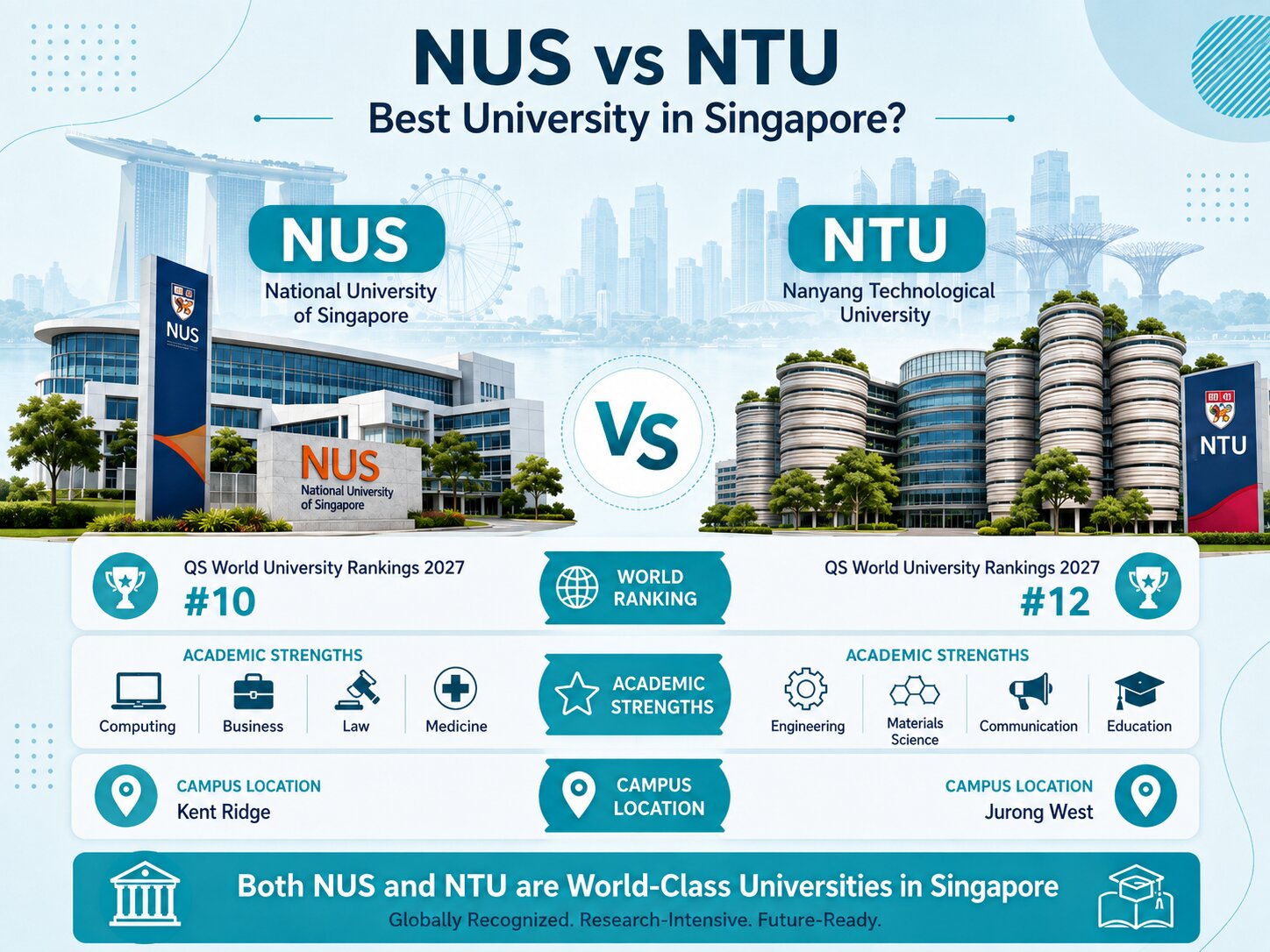
Singapore may be a small country, but it is home to two of the finest universities in the world. The National University of Singapore (NUS) and Nanyang Technological University (NTU) both rank comfortably inside the global top 15, and for many students, choosing between them is one of the biggest decisions they will make. It is natural to feel torn between two universities this good. The honest truth is that there is no single best university here, only the one that fits your subject, your goals, and the kind of student life you want. This NUS vs NTU comparison breaks down the rankings, subjects, admissions, campus, careers, and cost so you can decide with confidence.
Here is a quick snapshot of both universities before we go deeper.
| Feature | NUS | NTU |
|---|---|---|
| Founded | 1905 | 1991 |
| QS World Rank (2027) | 10th | 12th |
| Students | Just over 50,000 | Around 35,000 |
| Main campus | Kent Ridge, central-south Singapore | Jurong West, on the outskirts |
| Best known for | Broad excellence across Computing, Law, Medicine, and Business | Engineering, Materials Science, and Communication |
NUS is Singapore's oldest and most comprehensive university, with more than a century of history. NTU, founded in 1991, is far younger but has risen fast to become one of the world's leading young universities.
In any NUS vs NTU comparison, rankings are usually the first thing students look at. In the most recent QS World University Rankings, the 2027 edition released in June 2026, NUS is placed 10th in the world and NTU 12th. Both sit among the global top 15 and are consistently ranked as two of Asia's very best universities.
So NUS holds a slight edge in the overall table, largely thanks to its long history and broad academic reputation. But the gap is small, and both universities score highly across the same indicators, including academic reputation, employer reputation, and research impact. One important point: rankings shift a little every year, and for choosing a course, the subject-level rankings below matter far more than the overall position.
Overall rankings tell only part of the story. For students choosing between NUS and NTU, subject-level performance is often more useful because the two universities have different academic strengths.
The latest subject comparison published by QS shows NUS performing strongly across a wider range of disciplines, while NTU stands out particularly in Communication and Media Studies, Education, engineering-related subjects and several science disciplines.
| Subject | NUS Global Rank | NTU Global Rank |
|---|---|---|
| Accounting and Finance | 10 | 14 |
| Anatomy and Physiology | 7 | Not ranked |
| Anthropology | 14 | 51–100 |
| Architecture and Built Environment | =7 | Not ranked |
| Art and Design | =19 | 32 |
| Art History | 5 | 26–75 |
| Arts and Humanities | 17 | =40 |
| Biological Sciences | 13 | 32 |
| Business and Management Studies | 8 | 14 |
| Chemistry | 6 | 8 |
| Communication and Media Studies | =10 | 2 |
| Computer Science and Information Systems | =4 | 9 |
| Data Science and Artificial Intelligence | 3 | 4 |
| Dentistry | =19 | Not ranked |
| Development Studies | 9 | =46 |
| Earth and Marine Sciences | Not ranked | =34 |
| Economics and Econometrics | =14 | 42 |
| Education and Training | Not ranked | 8 |
| Engineering – Chemical | 3 | 6 |
| Engineering – Civil and Structural | 2 | 6 |
| Engineering – Electrical and Electronic | 3 | 4 |
| Engineering – Mechanical | 3 | 5 |
| Engineering and Technology | 8 | 10 |
| English Language and Literature | =15 | 36 |
| Environmental Sciences | =7 | 14 |
| Geography | 4 | 40 |
| Geology | Not ranked | =42 |
| Geophysics | Not ranked | 38 |
| History | 9 | 51–100 |
| Law and Legal Studies | 6 | 71 |
| Library and Information Management | Not ranked | 5 |
| Life Sciences and Medicine | =14 | 84 |
| Linguistics | 6 | =13 |
| Marketing | 6 | 13 |
| Materials Sciences | 2 | =3 |
| Mathematics | =8 | =12 |
| Medicine | 17 | 85 |
| Modern Languages | 19 | =51 |
| Music | 26–50 | 26–50 |
| Natural Sciences | 13 | 18 |
| Nursing | =6 | Not ranked |
| Performing Arts | 27 | 50 |
| Pharmacy and Pharmacology | 9 | Not ranked |
| Philosophy | 25 | 33 |
| Physics and Astronomy | 11 | 17 |
| Politics | 9 | 24 |
| Psychology | =15 | 25 |
| Social Policy and Administration | 3 | 51–100 |
| Social Sciences and Management | 8 | 21 |
| Sociology | 10 | 48 |
| Sports-Related Subjects | 17 | 28 |
| Statistics and Operational Research | =7 | 21 |
The table shows why students should avoid deciding only on overall university rank. NUS has an advantage across many subjects, including Computer Science, Business, Law, Medicine, Economics and several engineering disciplines. NTU, however, is particularly strong in Communication and Media Studies, where it ranks 2nd globally, and Education, where it ranks 8th. It is also extremely competitive in Materials Sciences and Engineering.
So, rather than asking whether NUS or NTU is better overall, compare the two universities within the subject you actually intend to study.
Both NUS and NTU are highly selective, and admission is decided program by program rather than university-wide. There is no single cut-off that gets you in everywhere.
Local students usually apply with strong Singapore-Cambridge A-Level results, a polytechnic diploma, or the IB. International students can apply with strong high-school results and recognised qualifications such as A-Levels, the IB, or high school diplomas paired with SAT or ACT scores, along with proof of English proficiency. The most competitive programs, such as Medicine, Law, Computing, and Business, demand top grades and often an interview or additional test. Because exact requirements and indicative grade profiles change each year, always confirm the current criteria on each university's official admissions page for your specific course.
Both universities run world-class research with substantial funding, but their styles differ in a way that can shape your experience.
NUS leans toward academic and discovery-driven research, with deep collaborations across governments and leading universities worldwide. NTU is known for industry-driven research, partnering closely with major companies such as Rolls-Royce, BMW, and others on real-world engineering and technology projects. If you want strong industry exposure during your degree, NTU's model may appeal to you, while NUS may suit those drawn to academic research and a broader scholarly network.
Location can make a noticeable difference to everyday student life.
The main National University of Singapore campus is located at:
21 Lower Kent Ridge Road, Singapore 119077
NUS is based around Kent Ridge in the south-western/central-southern part of Singapore. Its location provides relatively convenient access to areas such as Queenstown, one-north, HarbourFront and central Singapore.
For students who want a university environment that remains well connected to Singapore's business, cultural and city districts, NUS may feel more convenient.
The main Nanyang Technological University campus is located at:
50 Nanyang Avenue, Singapore 639798
NTU is situated in western Singapore, close to Jurong West. Its large campus is more self-contained and considerably removed from the city centre compared with NUS.
The setting tends to appeal to students who prefer a traditional residential-campus experience with academic buildings, accommodation, recreation and student facilities concentrated within one large university environment.
The QS comparison similarly describes NUS as being in the central region around Queenstown and NTU as being in western Singapore.
For most students, this is the question that really matters, and here the two universities are remarkably close. In Singapore's joint Graduate Employment Survey, both NUS and NTU consistently report around nine in ten graduates employed within six months, with median starting salaries that are broadly similar and among the highest in the region.
The honest, data-backed bottom line is that employers in Singapore value NUS and NTU graduates equally. A slight reputation edge exists for NUS in some circles, but in practice, your degree subject, your skills, and your internships matter far more than which of the two names is on your certificate. For the latest exact figures, check the most recent Graduate Employment Survey.
Cost should be compared using actual numbers rather than simply describing one university as "more affordable."
Fees vary significantly according to citizenship, whether the student receives the Singapore Ministry of Education Tuition Grant, and the chosen degree programme.
For NTU students accepting an offer in 2026, annual subsidised fees for most undergraduate programmes are:
| Student Category | NTU Annual Tuition — Most Programmes |
|---|---|
| Singapore Citizens | S$8,300 |
| Singapore Permanent Residents | S$11,600 |
| ASEAN International Students | S$18,050 |
| Other International Students | S$21,400 |
| International students without Tuition Grant — lab-based | S$40,600 |
| International students without Tuition Grant — non-lab-based | S$36,350 |
Business-related programmes cost more. For example, subsidised annual tuition is S$20,700 for ASEAN international students and S$21,800 for other international students in several Accountancy and Business programmes. Medicine is considerably more expensive.
For NUS, the university's AY2026/27 international undergraduate prospectus gives a useful benchmark: an ASEAN international student studying Computing and receiving the MOE Tuition Grant would pay approximately S$18,050 per year in tuition fees.
Because fees differ by faculty and student category, students should compare the fee for their intended NUS and NTU programme rather than relying on one university-wide figure.
NUS estimates that a full-time international undergraduate may spend approximately:
S$6,000 per year on general living expenses
S$5,750 per year on accommodation
approximately S$11,750 combined for a 35-week academic period
For the example of an ASEAN international Computing student, NUS therefore estimates total annual tuition plus living and accommodation costs at approximately S$29,800 before financial aid.
Actual costs will depend on accommodation choice, lifestyle, meal spending and whether a student lives on or off campus.
Both NUS and NTU participate in Singapore's Ministry of Education Tuition Grant system.
The grant substantially reduces tuition fees. International students who receive it generally undertake a three-year work obligation with a Singapore entity after graduation. NUS specifically notes this requirement for international recipients in its AY2026/27 prospectus.
At NTU, international students and Singapore Permanent Residents must opt for the Tuition Grant during the admissions process if they want to be considered for subsidised fees.
Scholarships should also be compared by the amount of financial support offered.
For eligible international students, the NUS International Undergraduate Scholarship currently provides:
| Benefit | Amount |
|---|---|
| Subsidised tuition fees | 100% covered after MOE Tuition Grant |
| Living allowance | S$5,800 per year |
| Accommodation allowance | S$5,000 per year |
| Computer allowance | S$1,750 one-time |
Applicants must accept the MOE Tuition Grant to receive the tuition-fee component.
NUS also offers the ASEAN Undergraduate Scholarship to eligible citizens of ASEAN countries excluding Singapore. It provides full subsidised tuition coverage, a S$5,800 annual living allowance, S$3,000 annual accommodation allowance, and a S$1,750 one-time computer allowance.
The Nanyang Global Scholarship provides:
| Benefit | Amount |
|---|---|
| Subsidised tuition fees | 100% covered after Tuition Grant |
| Living allowance | S$6,500 per year |
| Accommodation allowance | Up to S$2,000 per year |
| Computer allowance | S$2,000 one-time |
| Overseas programme travel grant | Up to S$8,000 |
The scholarship itself carries no additional bond, although international students and Singapore Permanent Residents who use the MOE Tuition Grant remain subject to its applicable three-year obligation.
For scholarship recipients, the comparison can also shift substantially. For example, NUS's International Undergraduate Scholarship currently provides a larger annual accommodation allowance, while NTU's Nanyang Global Scholarship provides a higher annual living allowance and an overseas programme travel grant.
Students should therefore compare net annual cost after tuition grants and scholarships, rather than comparing only the universities' headline tuition fees.
When it comes to NUS vs NTU, the smartest approach is to stop asking which is better overall and start asking which is better for you. Here is a simple way to decide.
Start with your subject, and choose the university that ranks higher in it, since that is where you will spend your degree. Next, think about your career direction: NUS suits those leaning toward academic research, medicine, law, or a broad professional path, while NTU suits those drawn to engineering, technology, and industry-connected work. Then consider the setting, whether you prefer a campus close to the city or a green, self-contained one, and how much on-campus housing matters to you. Finally, trust your own fit.
The good news is that there is no wrong answer here. Both universities open doors that most students only dream of, so the real question is simply which one matches the life and career you want.
| Category | NUS | NTU |
|---|---|---|
| QS World Rank | 10th | 12th |
| Main location | Kent Ridge, 21 Lower Kent Ridge Road | Jurong West, 50 Nanyang Avenue |
| Academic profile | Strong across a very broad range of subjects | Particularly strong in engineering, communication, education and technology |
| Computer Science | =4 | 9 |
| Business & Management | 8 | 14 |
| Communication & Media | =10 | 2 |
| Electrical & Electronic Engineering | 3 | 4 |
| Materials Sciences | 2 | =3 |
| Law | 6 | 71 |
| Medicine | 17 | 85 |
| Campus environment | Better connected to central Singapore | Larger, greener, more self-contained western campus |
| Example subsidised international tuition | Varies by course; ASEAN Computing example S$18,050/year | Most programmes: S$18,050 ASEAN / S$21,400 other international students |
| International scholarship example | NUS International Undergraduate Scholarship | Nanyang Global Scholarship |
| Scholarship tuition coverage | 100% of subsidised fees | 100% of subsidised fees |
| Annual living allowance | S$5,800 | S$6,500 |
| Annual accommodation allowance | S$5,000 | Up to S$2,000 |
| Computer allowance | S$1,750 one-time | S$2,000 one-time |
The most useful comparison is therefore not simply NUS vs NTU overall, but NUS vs NTU for your intended subject, expected net cost, scholarship eligibility and preferred campus environment.
Whichever university you choose, the real challenge is getting in, because both are highly selective and admission is decided program by program. A strong academic profile and a well-prepared application are what open the door.
This is where Masterclass Space supports you. Its SAT preparation courses in Singapore help you achieve the strong scores these universities look for, while its admission consulting helps you build and present a profile that stands out. With the right preparation, a place at either NUS or NTU is a realistic goal rather than a distant hope.
Aditya Shanker is an accomplished individual with a diverse range of skills and experiences. He graduated from BITS-Pilani, Pilani Campus with a Bachelor's degree in Mechanical Engineering and a Master's degree in Physics. Despite receiving lucrative corporate job offers, Aditya chose to work with an NGO in the education sector in central India to gain an understanding of the education scenario in India and learn basic skills to uplift the literacy of the country. He later worked as a Mechanical Engineer with an oil and gas design firm in India and the USA before turning to teaching. Aditya taught Physics at a top institute in New Delhi for IIT-JEE preparation.
Since its inception, Masterclass Space has been emerging as a powerhouse of quality
education globally. Driven by passion and purpose, we have touched lives of thousands of
people around the world.

Our courses are affordable keeping in mind the global demand for quality education

Students receive structured academic support throughout their preparation.

Our results have proven to be one of the best in the education industry

Course curriculum and pedagogy are designed by highly qualified & experienced team

Masterclass Space has a strong and qualified team of professionals.
NUS ranks slightly higher overall, at 10th in the world versus NTU at 12th, and leads in more subjects. But NTU is stronger in areas like communication and materials science, so the better university depends entirely on your chosen course.
Both are highly selective, and difficulty depends on the specific program rather than the university. Competitive courses like Medicine, Law, and Computing demand top grades at either, so compare entry requirements course by course.
NTU is world-renowned for engineering and materials science and is an excellent choice. Interestingly, NUS often ranks a place or two higher in QS engineering subject tables, so both are elite, and either is a strong option for engineers.
In practice, employers in Singapore value both equally, and graduate employment rates and salaries are very similar. Your subject, skills, and internships influence your career far more than which of the two universities you attend.
There is no single cut-off, as requirements vary by program. Both expect strong A-Level, IB, or equivalent results, and international students typically need strong grades plus SAT or ACT scores and proof of English. Check the official page for your course.
Yes. Both universities welcome international students and accept qualifications such as A-Levels, the IB, and high school diplomas with SAT or ACT scores. International applicants also qualify for the MOE Tuition Grant and various scholarships.
Masterclass Space offers SAT practice tests in Singapore to help you reach the scores these universities expect, along with undergraduate admission consulting to strengthen your overall application. This focused support improves your chances at both NUS and NTU.