Affordable
Our courses are affordable keeping in mind the global demand for quality education

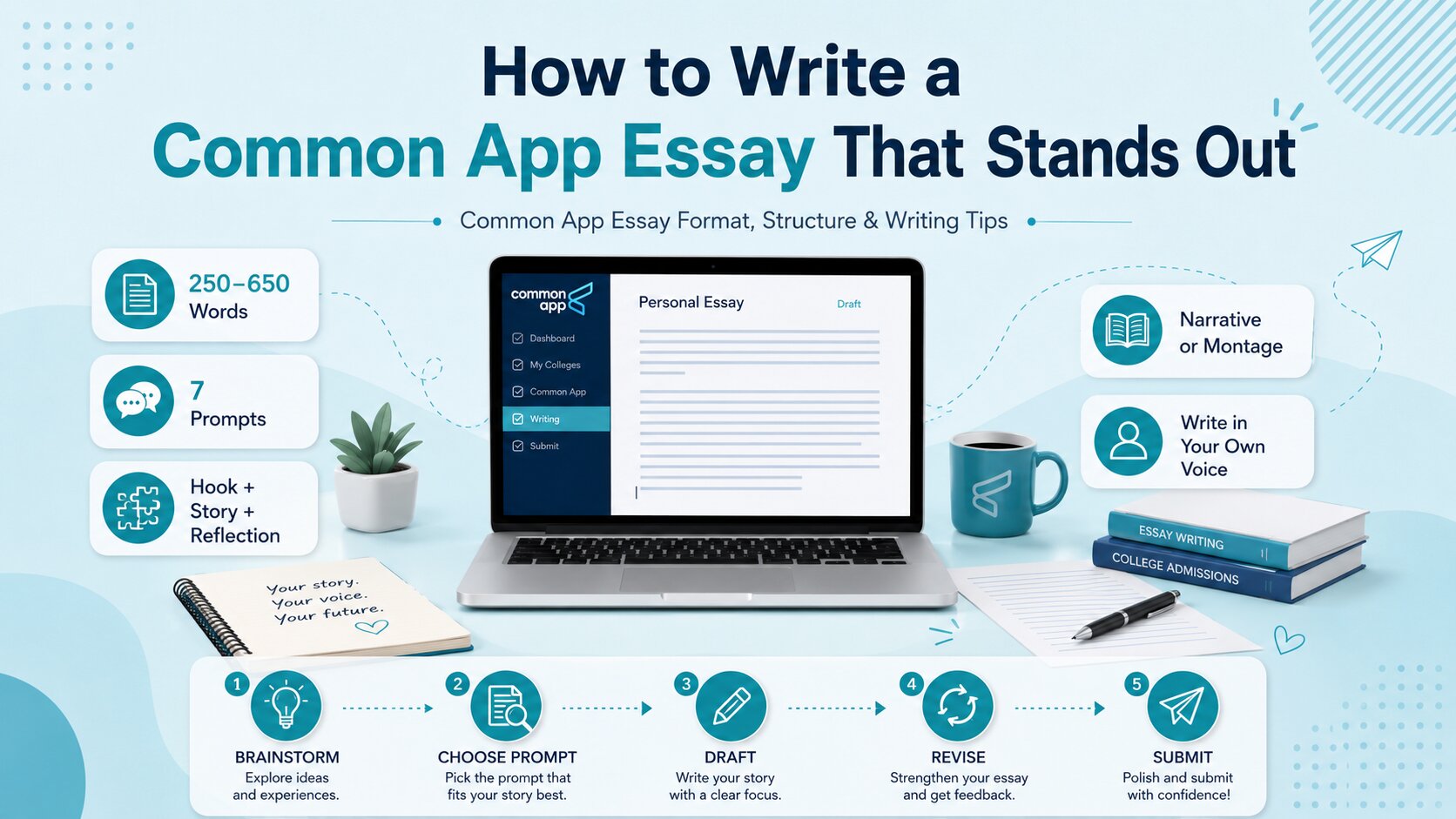
Strong grades and test scores are common among applicants, so they rarely set you apart on their own. The Common App essay does. At selective schools, this single personal statement can weigh as heavily in the decision as your grades, because it is the one place admissions officers hear your own voice. Standing out does not require a dramatic story or advanced vocabulary. It requires the correct Common App format and a real personal experience told clearly. This guide covers the essay only. For the full application process, see our Comprehensive Guide to the Common App.
Before you write a word, it helps to know exactly what you are working with. The Common App essay, also called the personal statement, follows a simple and fixed format.
You write one essay, and it is shared with every college on your Common App list, so it should be about you rather than any single school. The word limit is 650 words, with a minimum of 250, and the platform enforces both, so anything longer simply will not submit. There are seven prompts to choose from, and the Common App has confirmed they remain unchanged for the 2026-2027 cycle. One of them lets you write on a topic of your choice, so you are never boxed in.
Understanding this common app format early saves you time, because you can plan a focused story that fits the space instead of writing long and cutting later.
Once you know the format, the next step is shaping your story so a reader stays with it from the first line to the last.
Almost every strong essay follows a simple arc.
Open with a hook, a specific moment or scene that pulls the reader straight in, rather than a broad opening line. Develop that story through the middle, showing what happened and what you did. Then close with reflection, where you show how the experience changed you or what it revealed about who you are.
The ending is the part students most often waste. A strong conclusion does not simply repeat your introduction. It reflects on the story and shows growth, leaving the reader understanding you a little better than they did at the start.
There are two proven ways to build a personal statement, and choosing the right one for your experience makes writing far easier.
The narrative structure is built around one meaningful experience, such as a challenge, a turning point, or a moment that mattered. You tell that single story from beginning to end, focusing on what you did, what you felt, and what you learned. It suits students who have one strong, specific story to tell.
The montage structure threads several smaller moments together around one common theme, object, value, or activity. Instead of one event, you show different snapshots that each reveal a side of you, all connected by a single idea. It suits students who do not have one dramatic event but have several small experiences that together say something real. Pick the structure that matches your experience, not the one that sounds more impressive.
The format gives your essay its shape. Your personal experience is what makes it distinct. Use the four strategies below to make it stand out.
Many students read the prompts first and try to force a story to fit. Do the opposite. Think about your own experiences first, choose a specific moment that genuinely reveals something about you, and then pick the prompt it fits. Admissions officers rarely check which prompt you chose, so the story always matters more than the label.
It also helps to remember that small, everyday moments often stand out more than big, dramatic ones. A quiet conversation, a family routine, or a small personal habit can reveal more about who you are than a major award. What matters is that the moment is truly yours.
The strongest essays are about more than the event they describe. Your story should work as a window into something larger, a value, a way of thinking, or a part of your identity. For example, an essay about repairing old bikes might really be about your patience and your love of solving problems, and every detail should point back to that. Every paragraph should serve that one central idea, so the essay feels whole and intentional rather than a list of things that happened. Before you finish, ask yourself what you want the reader to understand about you by the end, and make sure every part serves it.
This is the single habit that separates memorable essays from forgettable ones. Instead of telling the reader you are curious or determined, show it through a real scene with concrete, sensory details. For example, instead of writing "I have always loved cooking," describe the Sunday mornings you spent learning your grandmother's recipes, flour across the counter and the radio playing. Details like these are what make a reader feel they actually know you, and they are far more convincing than any adjective you could use to describe yourself.
Your essay should sound like you, not like a thesaurus or an English textbook. Write the way you naturally speak, use words you would actually use, and let your personality come through. A genuine, honest voice, even an imperfect one, is far more memorable than a polished essay that could have been written by anyone. A little vulnerability helps too, because admissions officers are people, and they connect with real students.
A few common missteps quietly weaken strong essays. Watch out for these, with an example of each.
Choosing overdone themes. The winning goal in the big game, or the volunteer trip that taught you how lucky you are. Admissions officers read these hundreds of times, so they rarely stand out unless your angle is genuinely fresh.
Repeating your resume. Do not spend a paragraph restating that you were debate captain and won three trophies. That is already in your activities list, and it wastes the one space meant to show your personality.
Trying to sound impressive. Writing "I embarked on an intellectual odyssey" instead of "I got curious and started reading" makes you sound like someone else. Simple, honest language works better.
Writing what colleges want to hear. Claiming you have wanted to be a doctor since you were five, when you really got interested last year, reads as false. Write what is actually true for you.
Forgetting to reflect. Describing your whole summer job but never saying what it taught you leaves the reader with a story and no sense of who you are. Always end with what changed.
A standout essay is almost never the first draft. Start by writing freely, without worrying about the word count, to get your story down. Then cut and refine it to your strongest 620 to 650 words, since essays near the limit tend to feel complete without padding.
Once it reads well, do two things. Read it aloud, which is the fastest way to catch any line that does not sound like you. Then share it with one or two people who know you well, and ask whether it sounds like you, not whether it sounds impressive. Their honest reaction will tell you far more than another silent reread.
Because the essay carries real weight, expert feedback can be the difference between a good essay and one that stands out. Masterclass Space's admission consulting and college essay writing support help you choose the right story, structure it in the format that suits you, refine the draft, and keep the voice your own, while avoiding the common mistakes above. The result is an essay that clearly reflects who you are.
A standout Common App essay comes down to five things: get the Common App format right, build it on a real personal experience, tie that experience to one clear idea about who you are, write it in your own voice, and end with honest reflection. Done well, the essay shows a reader the person behind the grades, which is exactly its purpose.
Start with your own story, choose the structure that fits it, keep your writing clear and specific, and revise until it sounds like you. That is what makes an essay stand out.
Aditya Shanker is an accomplished individual with a diverse range of skills and experiences. He graduated from BITS-Pilani, Pilani Campus with a Bachelor's degree in Mechanical Engineering and a Master's degree in Physics. Despite receiving lucrative corporate job offers, Aditya chose to work with an NGO in the education sector in central India to gain an understanding of the education scenario in India and learn basic skills to uplift the literacy of the country. He later worked as a Mechanical Engineer with an oil and gas design firm in India and the USA before turning to teaching. Aditya taught Physics at a top institute in New Delhi for IIT-JEE preparation.
Since its inception, Masterclass Space has been emerging as a powerhouse of quality
education globally. Driven by passion and purpose, we have touched lives of thousands of
people around the world.

Our courses are affordable keeping in mind the global demand for quality education

Students receive structured academic support throughout their preparation.

Our results have proven to be one of the best in the education industry

Course curriculum and pedagogy are designed by highly qualified & experienced team

Masterclass Space has a strong and qualified team of professionals.
The Common App essay has a maximum of 650 words and a minimum of 250, and the platform enforces both. Most strong essays land close to the limit, around 620 to 650 words, which gives enough room for a complete story.
Not as much as students think. There are seven prompts for 2026-2027, and admissions officers rarely check which one you picked. Choose your story first, then select the prompt that fits it best.
A specific personal story, told in your own voice, with concrete details and genuine reflection on how you grew. The topic matters far less than how honestly and clearly you tell it.
Either a narrative built around one meaningful experience, or a montage that threads several small moments around one theme. Both open with a hook and end with real reflection, so pick the one that fits your experience.
Avoid overdone themes with no fresh angle, restating achievements already in your application, and writing what you think colleges want to hear. These make an essay blend in rather than stand out.
Masterclass Space's undergraduate admission consultants offer essay guidance that helps you find your story, choose the right structure, and refine your draft while keeping your voice. This focused support helps your essay feel personal and stand out.