Affordable
Our courses are affordable keeping in mind the global demand for quality education

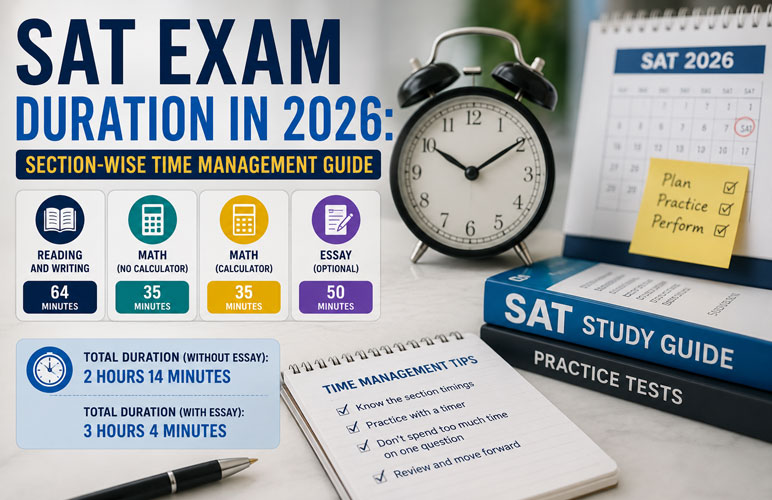
If you are preparing for the SAT, you already know how much this exam asks of you. The long study hours, the practice tests, and the quiet pressure to do well all add up. Understanding exactly how your time is divided on test day is one of the simplest ways to take some of that weight off your shoulders, because when you know what to expect, you can walk in feeling calm, steady, and in control. This guide breaks down the full SAT exam duration section by section, and shows you how to manage every minute well.
The digital SAT is now much shorter than the old paper test, which used to run for about 3 hours. The actual testing time today is 2 hours and 14 minutes.
It helps to think about the SAT exam duration in three simple layers, because this is where most students get confused:
Testing time is 2 hours and 14 minutes. This is the time you actually spend answering questions across both sections. Seated time is about 2 hours and 24 minutes, which is your testing time plus the one 10-minute break in the middle. Total time at the centre is around 3 hours, once you include check-in, ID verification, and setting up the exam on your device. So while the test itself is 2 hours and 14 minutes, it is smart to keep your full morning free.
The SAT exam duration is divided into two sections, Reading and Writing and Math, and each section is split into two equally timed modules. The table below shows exactly how the time and questions are shared.
The exam has two sections, and each section is scored between 200 and 800. Together they make up a total score out of 1600.
| Section | Number of Modules | Total Section Time | Number of Questions |
|---|---|---|---|
| Reading and Writing | 2 (32 minutes each) | 64 minutes | 54 |
| Math | 2 (35 minutes each) | 70 minutes | 44 |
| Total | 4 | 2 hours 14 minutes | 98 |
As you can see, you answer 98 questions in total, and the time is fixed for each section. You cannot carry spare minutes from one section into another, so planning your pace within each section is what really counts.
Each section has two modules, and they are timed separately. Reading and Writing gives you 32 minutes per module, and Math gives you 35 minutes per module.
Here is the important part. How well you do in the first module decides whether the second module is easier or harder. The test adapts to your performance. There is also one rule about time strategy for SAT that every student must remember: once a module's timer runs out, you move on to the next one and cannot go back. This is why steady pacing inside each module matters so much. You want to finish every module with your answers reviewed, not with questions left untouched because the clock ran out.

When you break the test down to a single question, it feels much more manageable. On average, you get around 82 seconds per question across the whole test, though it differs slightly by section.
| Section | Total Time | Number of Questions | Average Time Per Question |
|---|---|---|---|
| Reading and Writing | 64 minutes | 54 | About 71 seconds |
| Math | 70 minutes | 44 | About 95 seconds |
Treat these numbers as gentle benchmarks, not a strict clock to stare at. Their real purpose is to help you notice early when a single question is eating too much of your time, so you can flag it and move on without losing control of the module.
The SAT gives you one 10-minute break, and it comes right after the Reading and Writing section, before you begin Math. Use it well. Stand up, stretch, drink some water, and reset your focus so you start the Math section feeling fresh.
One thing to keep in mind is that the timer only pauses for this official break. If you step away at any other time, the clock keeps running, so save your break for when it is scheduled.
Even though the testing time is 2 hours and 14 minutes, your day at the test centre will be longer. You will need to arrive early for check-in, show your ID, and complete the exam setup on your device before the first module begins.
To avoid any last-minute rush, plan to be at the centre for around 3 hours. Reaching early and settling in calmly means you start the exam relaxed rather than flustered, and that calm start often shows up in your score.
For students taking the SAT in India, test-day timings usually follow a similar pattern. Check-in generally begins in the early morning, and the actual test starts a little later, often between 8:30 AM and 9:00 AM, though exact timings can vary by centre.
Knowing this helps you plan your morning routine so your energy peaks when the first module starts. A good night's sleep, a light breakfast, and reaching the centre early will help you feel your best right when it matters.
With about 71 seconds per question, the Reading and Writing section moves quickly, so a clear approach saves you valuable time. Read with a purpose by skimming for the main idea, tone, and structure of a passage rather than reading every single word slowly. Handle the faster question types, like grammar and vocabulary in context, first to bank quick marks. If you are stuck between two options, rely on the evidence in the passage instead of rereading the whole thing.
The Math section in SAT gives you around 95 seconds per question, which feels comfortable if you stay organised. Answer the quick, familiar questions first so you build speed and confidence early. Use the built in Desmos calculator wisely, letting it handle graphs and complex equations while you use quick mental math for simple steps. Keep your scratch work neat and numbered, so if you flag a question and return to it later, you can pick up exactly where you left off.
A few simple rules work across both sections and keep your timing on track. If you are stuck on a question for more than a minute, flag it and move on, because one hard question should never cost you easier marks later. Always finish the questions you find easy first. Use the Mark for Review option in the Bluebook app to flag tough questions and come back to them. And since there is no negative marking, never leave a question blank; a smart guess is always better than an empty answer.
It is completely normal to feel the clock pressing on you during the exam. Almost every student does. What helps in that moment is not trying harder, but trusting the pacing you have already practised and letting it carry you through.
Many students lose marks not because of what they do not know, but because of small timing habits. Here are the most common mistakes in SAT to watch out for:
Avoiding these keeps your pacing smooth from the first question to the last.
Reading about pacing is helpful, but real confidence comes from practising it. The best way to make the SAT exam duration feel natural is to take full length mock tests under the same timed conditions as the real exam, so test day feels familiar rather than new.
This is where Masterclass Space supports you. Its full length mock tests match the real digital SAT in timing and difficulty, and the detailed feedback after each test shows you exactly where your pace slips, so you can fix it well before exam day. The more you practise this way, the more the timer starts to feel like a rhythm you control rather than a pressure you fear.
Your SAT timing in 2026 is simple to remember: 2 hours and 14 minutes of testing, split into 64 minutes for Reading and Writing and 70 minutes for Math, with one 10-minute break in between. Understanding this breakdown, and practising your pacing until it feels natural, turns time from your biggest worry into one of your strongest advantages.
You are putting real effort into this exam, and that effort deserves to show on test day. When you know the SAT exam duration and have practised your timing, the clock stops feeling like a threat and starts feeling like a rhythm you control. Prepare steadily, stay calm, and trust the work you have put in. You are more ready than you think.
Aditya Shanker is an accomplished individual with a diverse range of skills and experiences. He graduated from BITS-Pilani, Pilani Campus with a Bachelor's degree in Mechanical Engineering and a Master's degree in Physics. Despite receiving lucrative corporate job offers, Aditya chose to work with an NGO in the education sector in central India to gain an understanding of the education scenario in India and learn basic skills to uplift the literacy of the country. He later worked as a Mechanical Engineer with an oil and gas design firm in India and the USA before turning to teaching. Aditya taught Physics at a top institute in New Delhi for IIT-JEE preparation.
Since its inception, Masterclass Space has been emerging as a powerhouse of quality
education globally. Driven by passion and purpose, we have touched lives of thousands of
people around the world.

Our courses are affordable keeping in mind the global demand for quality education

We provide 100% Score Improvement Guarantee & Satisfaction Guarantee

Our results have proven to be one of the best in the education industry

Course curriculum and pedagogy are designed by highly qualified & experienced team

Masterclass Space has a strong and qualified team of professionals.
The SAT exam duration is 2 hours and 14 minutes of actual testing time, made up of 64 minutes for Reading and Writing and 70 minutes for Math. With the single 10-minute break added in, you are seated for about 2 hours and 24 minutes.
Yes, there is one 10-minute break, and it comes right after the Reading and Writing section, before the Math section begins. The timer pauses only during this official break, so use it to rest and refocus.
You get about 71 seconds per question in Reading and Writing and about 95 seconds per question in Math, roughly 82 seconds on average. These are pacing benchmarks, so use them to sense when a question is taking too long.
No. Each module is timed separately, and once its time runs out, it closes and you cannot return to it. Within a module, though, you can move freely between questions and flag ones to revisit.
Yes. The old paper SAT ran for about 3 hours, while the digital SAT is just 2 hours and 14 minutes. Even though it is shorter, you actually get more time per question overall.
Although the testing time is 2 hours and 14 minutes, plan to be at the centre for around 3 hours. The extra time covers early check-in, ID verification, and completing the exam setup on your device.
Masterclass Space offers full length timed mock tests that mirror the real exam, along with detailed pacing feedback on each section. This helps you build steady timing and walk into the exam feeling prepared and confident.