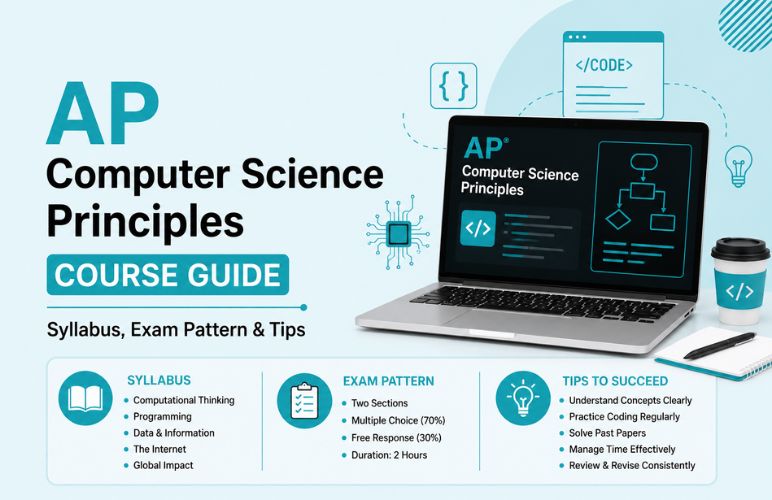
AP Computer Science Principles Course

AP Computer Science Principles Course Guide: Syllabus, Exam Pattern & Tips

Hasan Raja
Posted by Hasan Raja | Updated on May 28, 2026
AP Computer Science Principles Course AP Computer Science Principles is one of the best introductory courses for high-school students who want to understand coding, data, algorithms, cybersecurity, and the impact of technology. This guide is useful for students preparing for AP CSP, teachers planning the course, and parents who want to understand whether AP Computer Science Principles is a good academic choice.

The course is not limited to programming. It gives students a broad foundation in computer science and helps them build problem-solving, logical thinking, and technology awareness.

What Is AP Computer Science Principles?

AP Computer Science Principles, also called AP CSP, is an introductory college-level computing course offered by the College Board. The course introduces students to the wider field of computer science, including algorithms, programming, data, computing systems, the internet, and the social impact of technology.

Students learn how to design and evaluate solutions, develop algorithms and programs, use abstraction, and work with data to discover new insights. They also explore how computing innovations and internet-based systems work in real life.

AP CSP is suitable for beginners. Students do not need advanced coding experience before starting the course, which makes it a strong first step for learners interested in technology, engineering, business, design, data science, artificial intelligence, or research.

AP Computer Science Principles Syllabus Overview

The AP Computer Science Principles syllabus is built around five major “Big Ideas.” These Big Ideas help students understand computer science from a broad perspective instead of studying only one programming language.

The College Board organizes the AP Computer Science Principles course framework around five Big Ideas, and each Big Idea has an approximate weight in the multiple-choice section of the exam.

Big Idea Approx. Exam Weight
Creative Development 10%–13%
Data 17%–22%
Algorithms and Programming 30%–35%
Computer Systems and Networks 11%–15%
Impact of Computing 21%–26%

The highest-weighted area is Algorithms and Programming. Students should spend extra time learning sequencing, selection, iteration, lists, procedures, abstraction, and code analysis.

Data and Impact of Computing are also very important. Students must know how data is collected, represented, analyzed, and used, while also understanding privacy, bias, cybersecurity, intellectual property, and the digital divide.

AP Computer Science Principles Exam Pattern 2026

The AP Computer Science Principles exam pattern 2026 includes two scored sections: the end-of-course multiple-choice exam and the Create Performance Task with written responses. The multiple-choice exam is worth 70% of the final AP score, while the Create Performance Task section is worth 30%.

Section I: End-of-Course Multiple-Choice Exam

The multiple-choice exam has 70 questions and lasts 120 minutes. It is worth 70% of the final AP CSP score.

The question format includes:
Question Type Number of Questions
Single-select multiple-choice questions 57
Single-select questions with a computing innovation passage 5
Multiple-select questions where students select 2 answers 8
Total 70

This section tests the five Big Ideas, computational thinking, data interpretation, programming logic, internet concepts, cybersecurity, and the impact of computing.

Section II: Create Performance Task

The Create Performance Task is worth 30% of the final AP CSP score. Students develop a computer program of their choice and submit three components in the AP Digital Portfolio: program code, a video, and a student-authored Personalized Project Reference. College Board provides 9 hours of in-class time for this task.

The remaining written-response portion is completed during the end-of-course exam. Students answer 2 written-response questions in 60 minutes, using their Personalized Project Reference. These two questions include four prompts: Written Response 1, Written Response 2(a), Written Response 2(b), and Written Response 2(c).

A clearer way to understand the updated pattern is this:
Component Format Time / Requirement Score Weight
End-of-Course MCQ Exam 70 multiple-choice questions 120 minutes 70%
Create Performance Task Code, video, Personalized Project Reference 9 hours in class Part of 30%
Written Responses 2 questions connected to the student’s project 60 minutes during exam Part of 30%

Starting with the current AP CSP format, students do not simply submit written responses separately as a take-home task. They complete the project materials first, then answer written-response prompts during the end-of-course exam using their Personalized Project Reference.

Final 8-Week Study Plan Before the AP CSP Exam
  1. Week 1: Review all five Big Ideas and identify weak areas.
  2. Week 2: Practice algorithms, sequencing, selection, iteration, and pseudocode.
  3. Week 3: Revise data representation, data analysis, simulations, and visualizations.
  4. Week 4: Study internet concepts, networks, protocols, cybersecurity, and encryption.
  5. Week 5: Review computing impact, privacy, bias, digital divide, and intellectual property.
  6. Week 6: Complete one full-length timed multiple-choice practice test.
  7. Week 7: Revise the Create Performance Task and written-response categories.
  8. Week 8: Take final timed practice, review mistakes, and revise important vocabulary.

Key Topics Covered in the AP CSP Course

AP CSP gives students a broad understanding of computing. It does not focus only on one programming language or one technical skill.

Programming and Algorithms

Students learn how algorithms solve problems step by step. They study sequencing, selection, iteration, procedures, lists, variables, and abstraction.

This is the most important area by exam weight. Students should practice tracing code, predicting output, and explaining how a program works.

Data and Information

Students learn how computers represent, store, process, and analyze data. Topics may include binary, data compression, data patterns, metadata, simulations, and data visualization.

Data questions often test interpretation. Students should be comfortable reading charts, finding patterns, and understanding how data can support or mislead conclusions.

Computer Systems and Networks

This area explains how devices communicate through the internet. Students study packets, routing, protocols, scalability, fault tolerance, cybersecurity, and encryption.

Students should understand that the internet is a distributed system. It is designed to move information reliably even when some parts of the network fail.

Impact of Computing

Students study how computing affects individuals, businesses, governments, and society. Topics include privacy, security, bias, accessibility, intellectual property, digital divide, and ethical technology use.

This section is important because AP Computer Science Principles is not only a coding course. It also asks students to think deeply about how technology changes human behavior and decision-making.

Digital SAT Exam

How Difficult Is AP Computer Science Principles?

AP Computer Science Principles is generally beginner-friendly compared to AP Computer Science A. Students do not need advanced programming knowledge to start AP CSP.

However, the course still requires consistent study. Students must understand programming logic, data concepts, computing systems, cybersecurity, and social impact topics.

The main difficulty is balance. Many students focus too much on coding and ignore data, internet concepts, and impact-of-computing topics.

AP CSP vs AP Computer Science A

AP Computer Science Principles is broader and more conceptual. It introduces students to the full world of computing, including programming, data, networks, cybersecurity, and ethical issues.

AP Computer Science A is more programming-focused and mainly uses Java. It is better for students who want deeper coding practice and object-oriented programming.

For beginners, AP CSP is usually the better first course. Many students take AP CSP first and then move to AP Computer Science A later.

Best Study Resources for AP Computer Science Principles

1. College Board Course and Exam Description
This is the most important official document because it explains the AP CSP syllabus, exam structure, Big Ideas, and scoring expectations.

2. AP Classroom
AP Classroom provides official practice questions, progress checks, and teacher-assigned activities that match the AP CSP course framework.

3. Code.org AP CSP Course
Code.org offers a beginner-friendly curriculum with lessons, projects, coding practice, and classroom-ready resources for AP CSP learners.

4. Khan Academy Computer Science Resources
Khan Academy helps students strengthen basic programming, algorithms, internet concepts, and computational thinking through simple explanations.

5. Harvard CS50 Introductory Materials
CS50 is more advanced, but selected beginner lessons can help motivated students understand programming and computer science foundations.

6. Barron’s AP Computer Science Principles Prep Book
Barron’s is useful for structured review, practice questions, test-taking strategies, and quick revision before the AP CSP exam.

7. YouTube Channels like Code.org, CrashCourse, and CS50
These channels explain computing concepts visually, making algorithms, data, internet, and cybersecurity easier to understand.

8. Teacher Blogs and AP CSP Review Sites
Good AP teacher blogs can provide project examples, vocabulary review, exam reminders, and simplified explanations of difficult topics.

Sample Study Plan: 12-Week AP CSP Preparation Schedule
  1. Week 1: Understand the AP CSP course structure, exam format, Big Ideas, and scoring pattern.
  2. Week 2: Study Creative Development and learn how computing projects are planned and improved.
  3. Week 3: Learn data representation, binary, compression, and how computers process information.
  4. Week 4: Practice data analysis, charts, patterns, simulations, and real-world data interpretation.
  5. Week 5: Study algorithms, sequencing, selection, iteration, and pseudocode.
  6. Week 6: Practice programming logic using small coding exercises and output-prediction questions.
  7. Week 7: Learn procedures, lists, abstraction, and modular programming.
  8. Week 8: Study computer systems, internet structure, routing, protocols, and cybersecurity.
  9. Week 9: Review impact of computing, privacy, bias, digital divide, and intellectual property.
  10. Week 10: Begin or refine Create Performance Task project ideas, code, video plan, and Personalized Project Reference.
  11. Week 11: Take timed multiple-choice practice and review all incorrect answers carefully.
  12. Week 12: Final revision of vocabulary, project explanation, written-response categories, and weak topics.

Preparation Tips to Score High in AP CSP Exam
  1. Understand the five Big Ideas before memorizing small facts. The exam tests how computing concepts connect with real-world problems.
  2. Practice AP-style MCQs every week. Focus on why the wrong options are wrong, not only why the correct answer is correct.
  3. Learn to trace code step by step. Predicting program output is one of the most important AP CSP exam skills.
  4. Master selection and iteration. Conditionals and loops are essential for both MCQs and the Create Performance Task.
  5. Build a strong vocabulary list. Include terms such as abstraction, algorithm, protocol, encryption, metadata, simulation, and digital divide.
  6. Do not ignore data questions. Many students lose marks because they underestimate charts, patterns, data bias, and data interpretation.
  7. Start your Create Performance Task early. A simple, clear, well-explained project is better than a complicated project you cannot describe confidently.
  8. Make sure your program includes input, output, a list, a student-developed procedure, sequencing, selection, and iteration.
  9. Practice explaining your program in writing. You must be ready to describe your program’s purpose, function, algorithm, testing, and development process.
  10. Use official practice questions. College Board-style questions are the closest match to the actual AP CSP exam format.
  11. Review cybersecurity basics. Know authentication, encryption, phishing, malware, safe computing, and privacy protection.
  12. Take at least two timed practice tests. Time pressure can reduce accuracy even when students understand the concepts.
  13. Keep an error log. Write the topic, mistake type, correct concept, and your next action for every major mistake.
  14. Revise impact topics with real examples. Privacy, bias, accessibility, and digital divide questions become easier when linked to real technology.

Practice Project Ideas

1. Student Study Planner App
Create a simple app where users enter subjects, deadlines, and available study hours. The program can generate a weekly study recommendation using lists, conditionals, and user input.

2. Personal Budget Tracker
Build a program where users enter income and expenses. The app can categorize spending, calculate savings, and give simple financial suggestions.

3. Health Habit Reminder Tool
Create a tool that tracks water intake, sleep hours, or exercise habits. The program can use user input, lists, and logic to give personalized reminders.

Check Out Our Google Reviews

Common Mistakes to Avoid in AP CSP

One common mistake is treating AP CSP as only a coding course. The exam also tests data, networks, cybersecurity, computing impact, and ethics.

Another mistake is choosing an overly complex Create Performance Task project. Students should choose a project they can explain clearly under exam conditions.

A third mistake is ignoring the Personalized Project Reference. Students must prepare it carefully because they will use it while answering written-response questions during the end-of-course exam.

Students should also avoid last-minute project work. The Create Performance Task requires planning, testing, debugging, recording, and clear explanation.

Career and College Benefits of Taking AP Computer Science Principles

AP Computer Science Principles can help students earn college credit or placement, depending on the college’s AP credit policy. College Board states that more than 1,200 colleges and universities offer credit and placement policies for AP CSP.

The course can also strengthen a college application. It shows that a student has explored a rigorous, technology-focused subject and understands modern computing.

AP CSP builds foundational computer science skills. Students learn computational thinking, problem-solving, programming logic, data analysis, collaboration, and responsible technology use.

The course is useful across many fields. Students interested in business, economics, medicine, engineering, design, artificial intelligence, environmental science, finance, or social impact can benefit from computing knowledge.

AP CSP also helps students decide whether they want to study more advanced computer science. It gives them a safe and structured introduction before choosing deeper programming or software development courses.

Conclusion

AP Computer Science Principles is a strong starting point for students who want to understand computer science without jumping directly into advanced coding. The course gives learners a practical foundation in programming, algorithms, data, cybersecurity, internet systems, and the social impact of technology.

For 2026 preparation, students should focus on the updated AP Computer Science Principles exam pattern, the five Big Ideas, AP-style multiple-choice practice, and the Create Performance Task. A clear 8-week or 12-week study plan can help students stay consistent, avoid last-minute pressure, and prepare confidently for the AP CSP exam.

Start your AP CSP preparation by reviewing the official College Board Course and Exam Description, building a weekly study plan, and practicing with real AP-style questions. The earlier students begin, the easier it becomes to manage the syllabus, project work, and final exam revision

Hasan Raja
Hasan Raja

Hasan Raja is a multi-talented individual who has made significant contributions to various fields such as education, media, art, and commerce. He completed his both graduation and master's degree in English from Delhi University; During his studies, he also pursued a certification course in designing leather accessories. After completing his education, he worked as an adviser in product development, a journalist in a news agency, and a part-time faculty in the college.

Why Masterclass Space ?

Since its inception, Masterclass Space has been emerging as a powerhouse of quality
education globally. Driven by passion and purpose, we have touched lives of thousands of people around the world.

Frequently Asked Question (FAQ)

What is AP Computer Science Principles?

AP Computer Science Principles is an introductory college-level computer science course for high-school students. It covers programming, algorithms, data, the internet, cybersecurity, and the impact of computing on society.

Is AP Computer Science Principles good for beginners?

Yes, AP CSP is a good course for beginners. Students do not need advanced coding experience before starting, which makes it suitable for learners who are new to computer science.

What is included in the AP Computer Science Principles syllabus?

The AP Computer Science Principles syllabus includes five Big Ideas: Creative Development, Data, Algorithms and Programming, Computer Systems and Networks, and Impact of Computing. These areas help students understand both technical and real-world aspects of computing.

What is the AP Computer Science Principles exam pattern 2026?

The AP Computer Science Principles exam pattern 2026 includes a 70-question multiple-choice exam worth 70% of the score and a Create Performance Task section worth 30%. Students also answer written-response questions during the end-of-course exam using their Personalized Project Reference.

How many questions are there in the AP CSP exam?

The AP CSP multiple-choice exam has 70 questions. These include 57 single-select questions, 5 single-select questions based on a computing innovation passage, and 8 multiple-select questions.

How long is the AP Computer Science Principles exam?

The multiple-choice section is 120 minutes long. In addition, students get 60 minutes during the exam for written-response questions connected to their Create Performance Task.

Is AP CSP easier than AP Computer Science A?

For most beginners, AP CSP is easier than AP Computer Science A because it is broader and less focused on advanced programming. AP Computer Science A focuses more deeply on Java and object-oriented programming.

What programming language is used in AP CSP?

AP CSP does not require one fixed programming language. Students may use block-based or text-based programming languages, depending on their school, teacher, or chosen platform.

What is the Create Performance Task in AP CSP?

The Create Performance Task is a project where students develop a computer program, submit code, create a video, and prepare a Personalized Project Reference. Students later answer written-response questions related to their own project.

How should students prepare for AP CSP?

Students should review all five Big Ideas, practice AP-style multiple-choice questions, build programming logic, work carefully on the Create Performance Task, and revise cybersecurity, data, and computing impact topics.

Can AP Computer Science Principles help with college admissions?

Yes, AP CSP can strengthen a college application because it shows interest in technology, problem-solving, and college-level coursework. It is especially useful for students interested in STEM, business, data, design, engineering, or interdisciplinary fields.

Can students get college credit for AP CSP?

Many colleges and universities offer credit or placement for AP Computer Science Principles, but policies vary by institution. Students should check the AP credit policy of each college before applying.