Affordable
Our courses are affordable keeping in mind the global demand for quality education

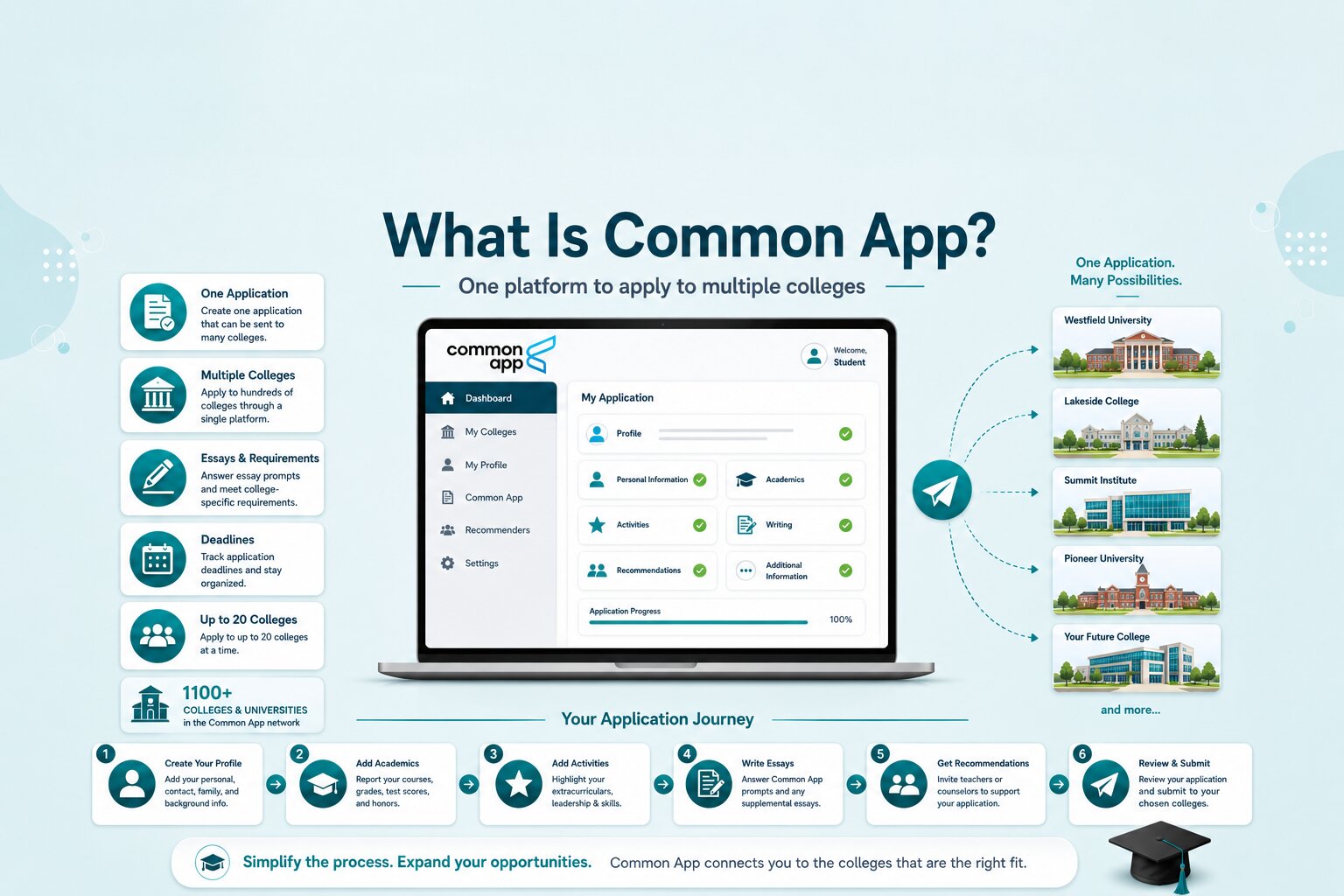
If you are planning to apply to several colleges, filling out a separate application for every institution can quickly become repetitive. The Common App solves much of that problem by letting you enter your core information once and use it to apply to multiple participating colleges.
For the 2026–27 application cycle, more than 1,100 colleges and universities participate in Common App. But using one platform does not mean every college has the same requirements. Essays, testing policies, recommendations, fees, portfolios and deadlines can still differ from one institution to another.
This guide explains what is Common App, how it works and what you should know before submitting your applications.
The Common Application, usually called the Common App, is an online college application platform. Instead of entering the same personal, academic and extracurricular information separately for every college, you complete the main application once and then add the institutions you want to apply to.
More than 1 million students use Common App each year to apply to over 1,100 member colleges worldwide. The platform supports both first-year and transfer applicants.
Common App is useful because it keeps your applications, college requirements and deadlines in one place. However, each college still decides what additional information it wants from applicants.
The process is fairly simple. You create an account, build your college list and complete the main Common App sections with information about yourself, your education, activities, testing and writing.
You then review the requirements for every college on your list. Some may ask for supplemental essays, teacher recommendations, test scores or portfolios, while others may not. Once all required sections are complete, you review and submit the application to each college individually.
Students can add up to 20 colleges to their Common App college list.
Having your information ready can make the application much easier to complete. Before starting, gather:
Your high-school transcript and current courses
Grades and GPA information, where applicable
SAT, ACT or other test details if you plan to report them
A list of activities, work, responsibilities and academic honours
Parent or legal guardian information
Counsellor and recommender contact details
Your college list and application deadlines
You do not need to finish the application in one sitting. Common App allows you to save your progress and return later.
The main application is organised into sections so colleges can understand your academic background, experiences and personal context.
This section covers basic information such as your name, contact details, citizenship, languages and family background. Common App may also ask about your parents' or guardians' education and employment.
Here, you provide information about your school, current courses, grades, GPA and class rank where your school reports one. Some colleges may also require you to self-report courses and grades.
You can report standardised test information such as SAT or ACT results where relevant. Testing requirements are set by individual colleges, so do not assume that every college on your list follows the same test policy. If the SAT is part of your application plan, review the Digital SAT 2026 requirements and preparation format before deciding when to test.
The activities section lets you show what you do outside the classroom. This can include clubs, sports, work, volunteering, hobbies, internships, family responsibilities and community involvement.
Focus on activities that genuinely mattered to you rather than trying to fill every available space. Academic awards and achievements can be reported separately as honours.
The Writing section includes the Common App personal essay and, where relevant, Additional Information. For the 2026–27 Common App, the seven personal essay prompts remain unchanged from the previous cycle, and the main essay response is 250 to 650 words.
Not every college requires the personal essay, so check the writing requirement for each institution before you apply. Students who want to understand structure, tone and presentation can also review this guide to the essay format for U.S. undergraduate applications.
One of the most important things to understand about Common App is that a common application does not mean common admission requirements.
For every college, check:
Supplemental essays or short-answer questions
SAT/ACT policy
Recommendation requirements
Portfolio or additional material requirements
Application fee
Application deadline
Supplemental questions often ask why you want to attend a particular college, why you chose your intended major, or how your experiences have shaped you. These responses should be written specifically for that institution rather than copied from one application to another.
Beyond completing each requirement, students should also understand how academics, activities, essays and overall positioning work together to improve college admission chances.
The 2026–27 Common App application opened on August 1, 2026. Students can create an account before the cycle opens, and information entered in the My Common Application section can roll over from one year to the next.
There is no single Common App deadline. Each college sets its own dates for application plans such as:
Early Decision
Early Action
Regular Decision
Rolling Admission
Many early deadlines fall around November and many regular deadlines fall around January, but these are not universal dates. Always follow the exact deadline shown for your chosen college.
Creating an account and using the Common App platform is free.
Individual colleges may charge their own application fees, while some colleges do not charge a fee at all. Eligible students can also request a Common App fee waiver through the Profile section of their application.
Financial aid is separate from submitting the Common App itself, so students should also check the financial-aid requirements and deadlines of every college they are considering.
Students researching funding options can separately explore fully funded scholarships in USA for international students 2026, while remembering that scholarship eligibility and application procedures vary by institution.
International students can also apply through Common App when their chosen colleges participate in the platform.
The main application process is similar, but requirements can differ based on the university and the student's school system. International applicants should pay particular attention to academic-document requirements, English-language proficiency, standardised testing, financial aid and college-specific instructions.
For students comparing the wider application process beyond Common App itself, this guide to admission to top universities abroad explains how university shortlisting, testing, application documents and deadlines fit together.
Do not independently convert your school results into a US-style GPA unless the application or university specifically asks you to do so. Report your academic information according to the instructions provided.
Here is the application process in simple terms:
Create your Common App account. Choose the correct applicant type and enter an email address you regularly check.
Add colleges to your list. Search for participating institutions and add the colleges you are considering.
Complete your main application. Fill in your profile, family, education, testing, activities and writing information.
Add your counsellor and recommenders. Recommendation requirements vary, so check what each college expects.
Complete college-specific requirements. Finish any supplemental essays, questions or additional materials requested by each institution.
Check fees and deadlines. Confirm the exact requirements before submitting.
Review your application carefully. Make sure names, academic information, activities and essays are accurate.
Submit each college application. Although you reuse much of the same Common App information, each college application is submitted separately.
Your Common App dashboard helps you see which parts of an application are complete and which still need attention.
A strong Common App is not only about completing every section. It is also about making sure your university choices, activities, essays and overall application tell a clear and consistent story.
Masterclass Space supports students through undergraduate admission consulting, including university selection, application strategy, profile positioning, Common App and supplemental essays, application reviews and deadline planning. The aim is to help students present their experiences accurately and effectively while meeting the specific requirements of each college.
Aditya Shanker is an accomplished individual with a diverse range of skills and experiences. He graduated from BITS-Pilani, Pilani Campus with a Bachelor's degree in Mechanical Engineering and a Master's degree in Physics. Despite receiving lucrative corporate job offers, Aditya chose to work with an NGO in the education sector in central India to gain an understanding of the education scenario in India and learn basic skills to uplift the literacy of the country. He later worked as a Mechanical Engineer with an oil and gas design firm in India and the USA before turning to teaching. Aditya taught Physics at a top institute in New Delhi for IIT-JEE preparation.
Since its inception, Masterclass Space has been emerging as a powerhouse of quality
education globally. Driven by passion and purpose, we have touched lives of thousands of
people around the world.

Our courses are affordable keeping in mind the global demand for quality education

Students receive structured academic support throughout their preparation.

Our results have proven to be one of the best in the education industry

Course curriculum and pedagogy are designed by highly qualified & experienced team

Masterclass Space has a strong and qualified team of professionals.
Yes. The Common App platform itself is free to use, although individual colleges may charge application fees.
You can add up to 20 colleges to your Common App college list.
Yes. International students can use Common App to apply to participating colleges. Admission, testing, English-language and financial-aid requirements should still be checked separately for each institution.
The application traditionally opens on August 1. The 2026–27 Common App opened on August 1, 2026 .
No. Every college sets its own application deadlines, so you need to check each institution individually.
For the 2026–27 application cycle, the Common App personal essay allows a response of 250 to 650 words .
You can continue updating certain parts of your Common App for applications you have not yet submitted. However, you cannot simply replace an application that has already been sent to a college. If important information changes after submission, follow that college's instructions for application updates.