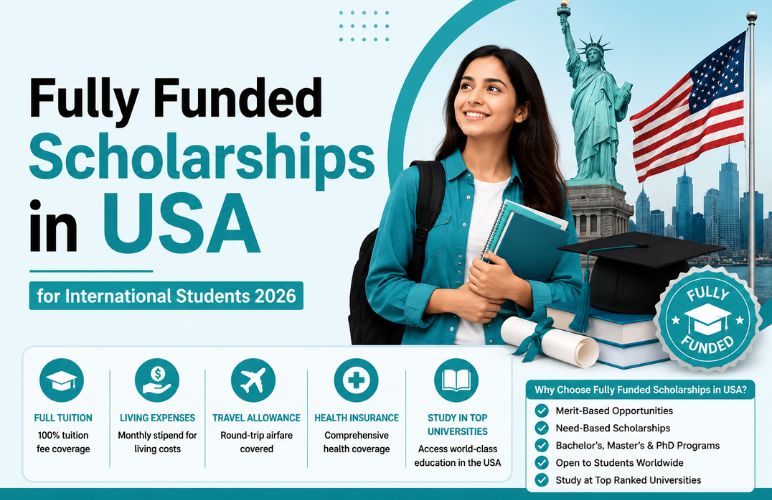
Study in USA Scholarships 2026

Fully Funded Scholarships in USA for International Students 2026

Hasan Raja
Posted by Hasan Raja | Updated on May 15, 2026
Study in USA Scholarships 2026 Fully funded scholarships in USA for international students 2026 can cover tuition, living expenses, health insurance, travel, books, and other academic costs. However, every scholarship has different rules. Some cover full tuition only, while others meet 100% of demonstrated financial need.

This guide covers the following steps:

What Are Fully Funded Scholarships in the USA?

A fully funded scholarship means the university, government, or private organization pays most or all of your study cost. For international students, this may include tuition fees, accommodation, meals, health insurance, travel allowance, books, and personal expenses.

In the USA, fully funded scholarships are usually of three types:
  1. Need-based scholarships – given according to your family’s financial condition.
  2. Merit-based scholarships – given for academic excellence, leadership, talent, or achievements.
  3. Government/private scholarships – offered by programs such as Fulbright, AAUW, Mastercard Foundation, and Knight-Hennessy.
For example, Harvard says foreign students receive financial aid on the same basis as American students, while Yale and Princeton meet 100% of demonstrated financial need for admitted international students.

Fully Funded Scholarships in USA for International Students 2026: Quick Answer

International students can get fully funded scholarships in the USA through universities such as Harvard, Yale, Princeton, MIT, Dartmouth, Stanford, and Clark University, and through programs like Fulbright Foreign Student Program, Knight-Hennessy Scholars, AAUW International Fellowships, Mastercard Foundation Scholars Program, and selected university-based full-tuition awards.

The strongest applicants usually have excellent academics, leadership experience, clear career goals, strong essays, recommendation letters, English proficiency, and a well-planned application timeline.

Why the USA Offers Major Scholarship Opportunities

The USA has some of the world’s most competitive universities and a strong culture of financial aid. Many top American universities do not want talented students to avoid applying only because of cost.

EducationUSA, the official U.S. Department of State advising network, supports international students through more than 430 advising centers in over 175 countries and territories. This makes it easier for students to access verified guidance about USA scholarships for international students.

Top Universities Offering Fully Funded Scholarships in 2026

1. Harvard University
Harvard offers need-based financial aid, and international students are considered on the same basis as U.S. students. Harvard states that financial need does not affect admission decisions and that it meets 100% of demonstrated financial need.

Best for: undergraduate students with outstanding academic records, leadership, and strong personal stories.

2. Yale University
Yale offers need-based financial aid to international students and says its aid can include housing, meals, and travel allowances. Yale also states that all students, regardless of citizenship or immigration status, are eligible for need-based financial aid.

Best for: high-achieving undergraduate applicants who need major financial support.

3. Princeton University
Princeton follows need-blind admission for international applicants and meets the full demonstrated need of admitted international students. Princeton also states that its aid is grant-based, not loan-based.

Best for: academically exceptional students applying for undergraduate programs.

4. MIT
MIT says it is need-blind and meets full demonstrated need. International students applying for aid generally submit the CSS Profile and parental income/tax documentation.

Best for: STEM-focused students with strong problem-solving, research, innovation, and academic excellence.

5. Dartmouth College
Dartmouth is need-blind for all applicants regardless of citizenship and meets 100% of demonstrated need. It also confirms that international students are eligible for financial aid.

Best for: students seeking liberal arts education with strong need-based support.

6. Stanford University – Knight-Hennessy Scholars
Knight-Hennessy Scholars is one of the most prestigious fully funded graduate scholarship programs in the USA. It provides up to three years of financial support for graduate study at Stanford and is open to citizens and residents of all countries.

Best for: graduate applicants with leadership, civic mindset, independent thinking, and a strong Stanford graduate program fit.

7. Clark University Presidential Scholarship
Clark University’s Presidential Scholarship covers full tuition, on-campus housing, and meals for four years. It is awarded to a small number of exceptional undergraduate applicants.

Best for: undergraduate applicants with strong academic performance and leadership potential.

US Admission

Best Government and Private Scholarships in the USA for 2026

Fulbright Foreign Student Program
The Fulbright Foreign Student Program allows graduate students, young professionals, and artists from abroad to study and conduct research in the United States. It operates in more than 160 countries, and around 4,000 foreign students receive Fulbright scholarships each year.
This is one of the strongest options for master’s, doctoral, and research-based applicants.

Knight-Hennessy Scholars Program
This Stanford-based program supports graduate study across Stanford’s seven schools. The application to join the 2027 cohort opens on June 1, 2026, and candidates must also apply separately to the relevant Stanford graduate degree program.

AAUW International Fellowships
AAUW International Fellowships support women who are not U.S. citizens or permanent residents and who are pursuing graduate study in the USA, especially in STEM fields. AAUW has supported women’s graduate education for decades and awarded over $5.3 million to 228 women scholars and community projects for 2025–2026.

Mastercard Foundation Scholars Program
The Mastercard Foundation Scholars Program supports talented, service-oriented young people and focuses on leadership, education, and social impact. Applications are generally submitted directly through partner universities.

EducationUSA Scholarship Database
EducationUSA lists many scholarships for international students, including full-tuition and partial awards. For example, the JWU Global Full Tuition Scholarship is listed for incoming non-U.S. citizen undergraduate students, with an Early Action 2 application deadline of January 4, 2026.

Eligibility Criteria for International Students Applying in the USA

Eligibility depends on the scholarship, university, degree level, and country. Still, most study in USA scholarships 2026 expect students to show the following:

Strong academic record is the first requirement. For undergraduate scholarships, universities look at school grades, curriculum difficulty, class rank where available, and standardized test scores if required. For graduate scholarships, universities review bachelor’s performance, research experience, professional exposure, publications, and academic fit.

English proficiency is usually required through IELTS, TOEFL, Duolingo English Test, or other accepted exams. Some universities may waive this requirement depending on your school curriculum or previous education.

Leadership and extracurricular profile are very important. Fully funded scholarships rarely go only to students with marks. They usually go to students who have shown initiative through community service, competitions, research, entrepreneurship, volunteering, sports, arts, student leadership, or social impact projects.

Financial need matters for need-based aid. Universities such as Harvard, Yale, Princeton, MIT, and Dartmouth assess family income, assets, expenses, and financial circumstances before deciding the aid amount.

For graduate scholarships, career clarity is essential. Programs like Fulbright and Knight-Hennessy expect applicants to explain why they want to study in the USA, how the program fits their goals, and how they will contribute after graduation.

Documents Required for USA Scholarship Applications

Most international students need to prepare these documents:
  1. Academic transcripts from school, college, or university.
  2. Passport or valid government identification.
  3. Standardized test scores such as SAT, ACT, GRE, GMAT, TOEFL, IELTS, or Duolingo, depending on the university and program.
  4. Statement of Purpose or personal essay explaining goals, background, motivation, and fit.
  5. Letters of recommendation from teachers, professors, counselors, employers, or mentors.
  6. Resume or activity list showing achievements, leadership, internships, projects, research, and volunteering.
  7. Financial documents such as income certificates, tax returns, bank statements, employer letters, or CSS Profile details.
  8. Portfolio, writing sample, or research proposal where required.
Universities may ask for the CSS Profile or their own financial aid forms. MIT, for example, uses the CSS Profile and parental tax/income documentation for international aid review.

Check Out Our Google Reviews

Step-by-Step Process to Apply for Fully Funded Scholarships

Step 1: Decide Your Degree Level
First, decide whether you are applying for undergraduate, master’s, MBA, PhD, or research programs. Undergraduate scholarships are usually university-funded. Graduate scholarships may come from universities, assistantships, fellowships, private foundations, or government programs.

Step 2: Shortlist Universities and Scholarships
Create three categories:
Dream universities with full-need aid, such as Harvard, Yale, Princeton, MIT, and Dartmouth.
Strong-fit universities with generous scholarships, such as Clark University or other EducationUSA-listed institutions.
External scholarships such as Fulbright, AAUW, Mastercard Foundation, and Knight-Hennessy.

Step 3: Check Scholarship Type
Do not confuse “full tuition” with “fully funded.” Full tuition means only tuition is covered. Fully funded may include tuition, housing, meals, insurance, travel, books, and living expenses.

Step 4: Prepare Tests Early
For undergraduate admissions, SAT or ACT may strengthen your profile where accepted or required. For graduate programs, GRE or GMAT may be required depending on the program. English proficiency should be planned early because score reporting can take time.

Step 5: Build a Strong Profile
Scholarship committees look for proof, not just promises. Build your profile through research, internships, Olympiads, social work, leadership roles, entrepreneurial projects, writing, coding, debate, sports, or community service.

Step 6: Write Powerful Essays
Your essay should not sound generic. It should answer:
  1. Why this university?
  2. Why this course?
  3. Why you?
  4. Why now?
  5. What impact will you create?

Step 7: Apply Before Deadlines
Many USA scholarships have early deadlines. For example, some undergraduate scholarship opportunities listed by EducationUSA have January deadlines, while Knight-Hennessy’s 2027 cohort application opens on June 1, 2026.

Step 8: Track Financial Aid Forms
Admission and scholarship applications are often separate. A student may complete the Common App but forget the CSS Profile or institutional aid form. This mistake can delay or weaken aid consideration.

Step 9: Prepare for Interviews
Some scholarships invite shortlisted students for interviews. Be ready to explain your academic interest, leadership journey, financial need, and future plan clearly.

Step 10: Compare Final Offers
Check what the scholarship actually covers: tuition, housing, meals, travel, insurance, books, visa cost, and personal expenses. Then calculate your real yearly cost.

Tips to Increase Your Chances of Winning a Scholarship in the USA

Start early. The best scholarship applications are not written in one week. Begin at least 12–18 months before intake.

Choose fit over fame. A strong fit at a slightly less famous university can win more aid than a weak application to a famous university.

Show measurable impact. Instead of writing “I helped students,” write “I mentored 35 students in English speaking and improved their confidence through weekly sessions.”

Write a personal story. Scholarship essays should feel human, specific, and honest.

Avoid copy-paste applications. Every university should feel that your application was written for them.

Get strong recommendation letters. A specific letter with examples is better than a generic letter from a famous person.

Explain financial need clearly. Do not hide financial challenges, but present them professionally with documents.

Apply to multiple scholarships. Never depend on one dream scholarship.

Use official sources. Scholarship information changes often, so always verify deadlines and eligibility from university pages, EducationUSA, and official scholarship websites.

Common Mistakes International Students Should Avoid

Many students apply only to Ivy League universities and ignore other generous colleges. This reduces their chances.

Some students misunderstand “scholarship available” as “scholarship guaranteed.” Most awards are highly competitive.

Some students submit weak essays filled with clichés such as “I want to change the world” without showing real evidence.

Some students miss financial aid deadlines even after submitting admission applications.

Some students do not calculate hidden costs such as insurance, books, visa fees, SEVIS fee, winter clothing, travel, and personal expenses.

Conclusion

Fully funded scholarships in the USA for international students in 2026 are competitive, but they are real. The students who win them usually start early, research carefully, build a strong profile, write authentic essays, and apply strategically.

For the best results, focus on three things: choose universities that genuinely fund international students, prepare your scholarship documents professionally, and tell a clear story of academic ability, leadership, financial need, and future impact.

Hasan Raja
Hasan Raja

Hasan Raja is a multi-talented individual who has made significant contributions to various fields such as education, media, art, and commerce. He completed his both graduation and master's degree in English from Delhi University; During his studies, he also pursued a certification course in designing leather accessories. After completing his education, he worked as an adviser in product development, a journalist in a news agency, and a part-time faculty in the college.

Why Masterclass Space ?

Since its inception, Masterclass Space has been emerging as a powerhouse of quality
education globally. Driven by passion and purpose, we have touched lives of thousands of people around the world.

Frequently Asked Question (FAQ)

Can international students get fully funded scholarships in the USA?

Yes. International students can receive fully funded or full-need scholarships from universities and external programs. Harvard, Yale, Princeton, MIT, and Dartmouth are examples of universities with strong need-based aid policies for international students.

Which scholarship is best for studying in the USA in 2026?

For undergraduate students, full-need universities such as Harvard, Yale, Princeton, MIT, and Dartmouth are among the strongest options. For graduate students, Fulbright and Knight-Hennessy are highly prestigious options.

Is SAT required for fully funded scholarships in the USA?

It depends on the university. Some universities require standardized testing, some are test-optional, and some have specific policies for international applicants. Always check the university’s official admissions page before applying.

Are fully funded scholarships only for toppers?

No. Academics matter, but scholarships also consider leadership, essays, recommendations, extracurriculars, financial need, research, and long-term goals.

Can I study in the USA for free?

It is possible if you win a fully funded scholarship or receive full-need financial aid that covers your demonstrated need. However, students should still plan for visa fees, documentation costs, test fees, and emergency expenses.