Six Strategies to Make the Most of SAT Practice Exams
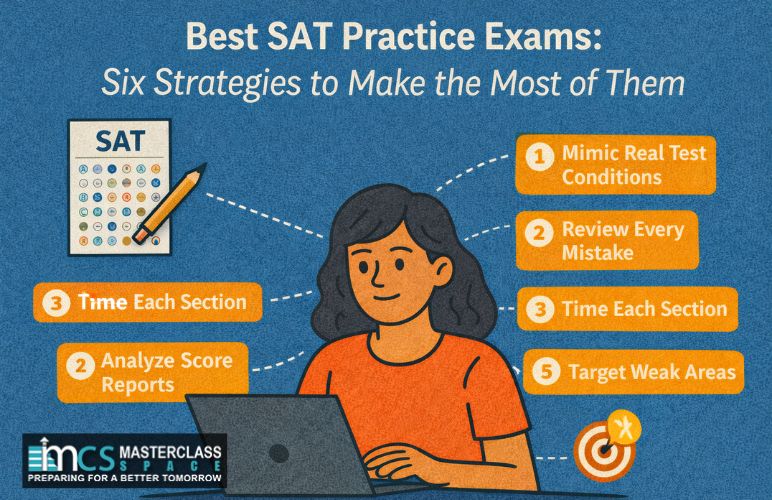
It's crucial to make the most of SAT practice exams as each one demands more than three hours of concentrated concentration. The six essential tactics listed below should be used every time you take a practice exam.
1. Take practice exams in the same format as the actual SAT.
Most students should use the Bluebook app to take their practice exams since the SAT is now entirely digital. Ultimately, though, you should adopt the same format and delivery for your practice exams as for the actual ones.
Therefore, start by taking the official, printed practice exams using the new digital SAT format if you have accommodations for taking the test on paper.
2. Adhere to Strict Timing for Every Section
It's crucial to adhere as closely as possible to the official SAT time limitations on practice exams, even if time pressure can be frightening.
Why? For instance, spending an additional two minutes on a section could increase your score by hundreds of points since you were able to answer more questions than you could have in the allotted time. Because of this, your practice SAT score is inflated and does not accurately reflect your actual ability to score.
There are two parts with two modules each on the digital SAT:
Writing and Reading
Each module takes 32 minutes.
Each module has 27 questions.
Each question takes 71 seconds.
Math
Each module takes 35 minutes.
Each module has 22 questions.
Each question takes 95 seconds.
3. Complete the Exam in a Single Sitting
Even though the digital SAT is shorter than previous iterations, it still takes more than two hours on a Saturday morning. Many of my pupils have shared with me how challenging it was to maintain concentration throughout and avoid making thoughtless errors in the conclusion.
SAT preparation is similar to training for a marathon in that you must make sure you have sufficient endurance to complete the test. Taking each practice test in one sitting, just like you would the real SAT, is the best method to accomplish this.
You can take a practice exam over a few days if you can't find the time to complete it all at once, as long as you follow the time constraints for each section. In the end, some SAT practice is preferable to none at all!
4. Examine Your Errors (and Correct Responses, Too)
Practice exams are excellent for learning from your mistakes as well as for familiarizing yourself with the format and parts of the SAT.
Spend some time going over the questions you answered correctly and incorrectly on each mock SAT exam you take. Don't just skip a question if you don't know why you missed it; if you do, you won't be able to identify the type of error you made, which makes you more likely to make it again. Your score may suffer significantly as a result of this habit.
Thus, remember to prioritize quality over quantity when preparing for the SAT. Three practice exams with thorough review are preferable than six practice exams without any review.
5. Prior to the actual SAT, take at least four practice exams.
Based on my experience with thousands of students, this magic number is the most effective way to help students become truly at ease with the SAT in all significant areas, including endurance and time.
Try taking more than four tests if you'd like, but make sure to balance your preparation with some concentrated study on your areas of weakness to accelerate your advancement.
6. Use Additional Resources If Required
Some students excel at mastering the SAT through practice exams alone; they are able to identify their errors, comprehend the reasons behind them, and steer clear of them going forward.
However, the majority of students require extra assistance in identifying their areas of weakness and learning the techniques and tactics required to succeed on the SAT.
Check Out Our Google Reviews
The New Digital Format for the SAT
The SAT will now be administered using a computerized program called Bluebook, which is the most obvious change. This, together with the logistical adjustments it both permits and necessitates, is the source of all other modifications.
The Bluebook app must be downloaded; the list of authorized devices that can be used for testing is as follows:
- Desktops and laptops running Mac and Windows
- Note that only school-issued Chromebooks are allowed; personal Chromebooks are not.
- iPads. The keyboard on iPads must be detached.
- You can utilize a detached mouse instead of a disconnected keyboard if the device is a laptop.
- Your gadget needs to be able to establish a wifi connection. Students can either borrow a device from their school or use their own. Students who would not otherwise have access to a gadget for this test can borrow one through a program run by the College Board.
There will be no remote access to the new SAT. Despite being digital, it will still be given at testing facilities or in schools. Your gadget must be fully charged, and you should pack a charger. Every testing facility will have a technician available to help and troubleshoot technical issues during every exam.
The SAT registration procedure remains the same. Because they now permit staggered start times and wider testing windows in schools, the testing structure has slightly changed. Although testing centers do not yet have this, we anticipate its implementation in the near future.
Accommodations
The SAT will still provide students with all of the prior adjustments despite the new format.
A paper test that more closely resembles the present SAT format will be administered to students who need accommodations that are not available digitally, such as braille tests. Only students who require these adjustments will receive them. Masterclass Space is a Digital SAT Preparation Company Located in New York City. The same procedure applies to requests for accommodations.
What Content Has Changed in the Digital SAT?
The digital SAT's content has undergone substantial revision. modifications that affect the exam overall will be covered first, followed by section-specific content modifications. The test's overall duration is the first and biggest adjustment.
The digital SAT is little over two hours long and includes the following portions, whereas the present format is nearly three hours long:
- 34 minutes to read and write Section 1, 27 questions
- 34 minutes to read and write Section 2, 27 questions
- 22 questions in Section 1 of Break Math in 35 minutes
- 22 problems in Section 2 of Math in 35 minutes
By making the test adaptable, the College Board has achieved this. Your performance determines the questions you are given for the following segment once you finish the first of the two sections—math and reading/writing. You are given a significantly easier set of questions for the second segment if your performance falls below a certain threshold.
There is a combination of easy, medium, and hard difficulty questions in every segment that is presented; however, each portion's second section contains two versions: one with slightly easier questions and the other with significantly harder questions. Additionally, this has altered the scoring process. The ratio of correct to incorrect answers is no longer sufficient for scoring because different students are given different questions.
Rather, an algorithm gives each question a variable weight, so answering a more difficult question correctly is valued proportionately more than answering an easier question correctly. To be eligible for the second, more difficult section of the new digital SAT, you must perform as well as you can in the first segment. A perfect score may only be obtained in this manner.
The experimental area, where they tested new questions, has also been eliminated by the College Board. Rather, there are two unmarked, unscored experimental questions in each section. These won't affect your tests, and you have no way of knowing which they are.
Notably, a slightly different version of the test will be given to each student. Each student receives a unique test when they download it for the first time, and the digital format enables the College Board to have a very wide pool of possible questions, ordered by difficulty. This is intended to increase test security and lessen issues brought on by student collaboration attempts and test leaks.
This modification also implies that after the test is over, you won't get a copy of the questions you were asked. Rather, the majority of the questions will remain in the shared pool and be utilized in subsequent exams. The College Board has declared that four complete practice exams will be released annually, and those questions will no longer be available.
Scoring
Each section of the SAT is still graded on a 200–800 range, giving a final score of 400–1600. In order for a score on the existing SAT to be the same as a score on the digital SAT, College Board also wants the scores to be contiguous. We do not expect changes in scoring trends, even though their approach will be less transparent.
Scores will now be available considerably sooner, in days rather than weeks, according to the College Board. We do believe that the new format will enable a quicker return on scores, albeit it is unclear if they will be able to accomplish this.
Modifications to Writing and Reading
The unification of the writing and reading sections is the first modification. You will be asked questions from both in the two reading and writing areas of the digital test, although the current paper SAT has these sections as distinct sections. Questions will typically go from simpler to difficult throughout each segment. This is a trend rather than a strictly linear increase. Each of the two sections will have reading questions in the first half and writing questions in the second.
Masterclass Space is a Philadelphia-based digital SAT preparation program. Each section has a different level of difficulty; not all writing questions are more difficult than reading questions.
The paragraphs you examine undergo the next significant alteration. There are currently four to five lengthy paragraphs, each with ten to eleven questions. Every question in the new format has a little paragraph of its own. The new portions are between 25 and 150 words long, whilst the existing ones are between 500 and 750 words.
There are several other small adjustments. The "No change" response option will no longer be available for writing questions. For the new format, questions pertaining to graphics (such tables and graphs) have been made simpler. Lastly, many students who would prefer not to commit hundreds or thousands of phrases to memory were frustrated that writing problems would no longer cover idiomatic expressions or frequently confused vocabulary.
Modifications to Math
The first modification is that you can now use a calculator in both math test portions. You have two options: either utilize the built-in calculator by Desmos, which is accessible through the Bluebook app, or bring in an authorized calculator that meets the same requirements as the SAT.
Questions requiring graphs and tables will still need to be answered, albeit they can be made simpler to make sure they appear properly on digital devices. Each picture will only relate to one question, just like reading passages. Although it is no longer a grid-in, the test will still consist of a combination of multiple-choice and written responses. Lastly, questions will no longer contain complicated or imaginary numbers.
Why is the SAT being made digital by the College Board?
We are positive that the Covid-19 pandemic and the subsequent increase in test-optional college admissions are the primary causes, even though there is no way to definitively address this question. The College Board wants to make sure that both colleges and students continue to see the SAT as an essential part of the admissions process even as schools become test-optional.
The College Board provided their own justifications, which include a wish to make the test more equitable and accessible while lowering the stress it causes students. We do think that many kids will benefit from the adjustments made to adaptive testing, schedule flexibility, and start times for school-administered exams, which will enhance their test scores overall.
Additionally, the new format helps avoid any recurrence of previous errors made by College Board, such as test leaks or mail delays that prevented exams from being administered or resulted in scores not being counted. The test's overall reputation will rise as a result of this improvement in honesty and dependability.
Conclusion
For more information about Princeton Digital SAT Prep, visit www.masterclassspace.com. Masterclass Space is a New York City-based digital SAT prep.