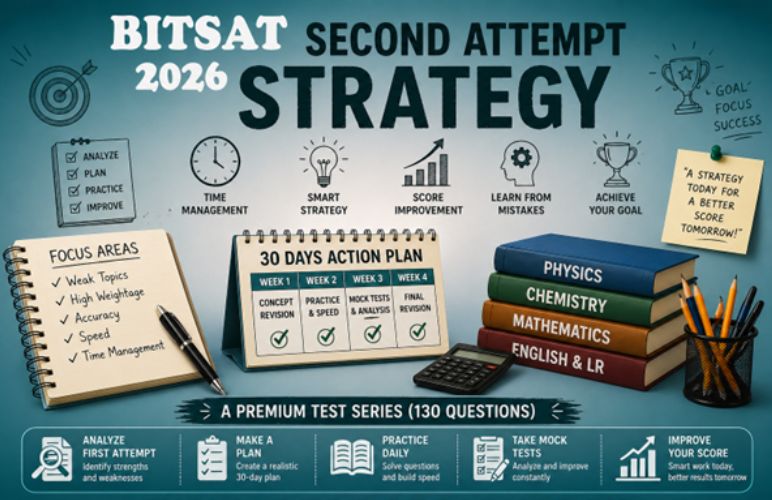
BITSAT 2026 Second Attempt 30 Days Strategy

BITSAT 2026 Second Attempt Strategy: How to Improve Your Score in 30 Days

Atul Verma
Posted by Atul Verma | Updated on April 30, 2026
BITSAT 2026 Second Attempt Strategy Improving your BITSAT score in 30 days is absolutely possible with a focused and strategic approach. Instead of modifying the whole syllabus, you need to assess your previous effort, analyse your strong and weak points, and prepare yourself well through the process of testing and revision. In the next attempt, you will be able to boost your grade through a 30-day program with defined objectives for each day.

This guide covers the following steps:

Why the Second Attempt in BITSAT 2026 Is a Golden Opportunity

The second attempt gives you another chance to score high through practical experience. With proper preparation, you are able to improve performance within a relatively short period of time.

Advantage of Multiple Attempts

BITSAT offers you the luxury of taking the test multiple times, lowering the risk of a poor performance. You have experience with the examination. You know the format, level of difficulty and time constraints. This allows you to study smarter. You know what to do, not guess.

Score Improvement Chances

Your second attempt is the golden opportunity to increase your score since you know where you went wrong. You can focus on the weaker areas instead of the whole syllabus. And just improving accuracy will boost your marks. There's a clear improvement in marks for many students. This makes the second attempt a strong chance to get into a better college.

Reduced Exam Pressure

Once you have given the first attempt, apprehension is replaced with familiarity. The layout of the exam and time are no longer unknown factors. This makes you feel relaxed and confident. This reduces stress, enhancing your concentration and accuracy. Stress can also impact performance.

Smart Strategy vs Long Preparation

The second time is all about working smart, not necessarily working hard. You can use the knowledge that you have accumulated to improve your strategy. Focus on weak areas, take mock tests, and manage your time better. Short bursts of study will give better results compared to long stretches of study without purpose.

Analysing Your First Attempt: Identify Weak Areas

The first attempt serves as a report card showing where you lost marks. Concentrate only on the areas where you made mistakes in the first attempt to improve your second attempt.

Review Scorecard and Section-wise Performance

First, go through the details of your BITSAT scorecard. Examine your performance in Physics, Chemistry, Mathematics and English individually. Take note of the section that scored the lowest. And, check if the attempts were serious and the accuracy was poor. This will tell you whether it was a knowledge or execution problem. Section-wise analysis provides the starting point for improvement

Identify Strong vs Weak Topics

Divide each subject into topics and classify them as strong and weak. Strong topics are those in which you were confident in your answer. Weak topics are those where you missed questions or skipped them. This is valuable for study scheduling. You need to focus on bringing up your weak points while not neglecting your strengths. This ensures growth in your overall score.

Common Mistakes (Time, Accuracy, Silly Errors)

It's not that students don't understand concepts, but they make mistakes because of time or carelessness. Look out for too much time lost on hard questions. See if negative marking was a factor from guessing. Check if there were any calculation or reading mistakes. Recognising these trends will help you prevent them. Eliminate these errors to greatly boost your score.

Build a Personalised Improvement Plan

Once you know all your weaknesses, you can then come up with a study schedule. Work on your weaknesses while still giving attention to your strengths. Make sure that your study plan incorporates mock tests and error analysis. Your study schedule should not be rigid but flexible enough so that you will effectively utilise your time.

bitsat

30-Day Study Plan for BITSAT 2026 Second Attempt

A 30-day plan can help you improve your score remarkably if followed diligently. It ensures you're not swamped with revision, practice or tests.

Week 1: Concept Revision & Weak Topics Focus

Revise your notes, especially those areas where you performed poorly in your first attempt. Instead of revising the whole concept, focus on weaker areas only. You should be familiar with all the basic aspects of the topic. Make mini notes and formula sheets to help with revisions.

Week 2: Practice & Speed Improvement

After being thorough with all the concepts, start practising questions. Practice topic-wise every day. Also, keep a time limit while solving the problems since BITSAT is a speed test.

Week 3: Full-Length Mock Tests + Analysis

This is the most crucial step in your preparation. Attempt full-length mock tests in exam-like conditions. However, this is not just about attempting tests but also finding out where you lack and working on those areas.

Week 4: Revising & Being Accurate

In the last week, do not attempt any new topic. Instead, revise from your short notes, formulas, and previous question papers. Repeat crucial topics two to three times and attempt two to three easy mock tests. Concentrate on being accurate rather than attempting many things.

Subject-Wise Preparation Strategy (Physics, Chemistry, Mathematics/English)

Every subject of BITSAT requires different preparation techniques, so there is no generic approach. Subject-wise preparation guarantees the right balance and helps you score well.

Physics Strategy

BITSAT physics is all about formulas and concepts. Practice applying formulas in numerals. Memorise formulas every day and solve different types of problems to enhance your formula application skills. Key topics are Mechanics, Modern Physics, Current Electricity, Magnetism and Optics. These topics are often weighty and scoring if you know them well.

Chemistry Strategy

Chemistry is the easiest and scoring section. Emphasise the NCERT, particularly for Inorganic and Organic Chemistry. Questions are asked from the NCERT facts and concepts. For Inorganic, be prepared with reactions and trends. For Organic, revise reactions and mechanisms. For Physical Chemistry, practice the numbers and solve lots of problems.

Mathematics Strategy

Maths needs practice and good time management. Prioritise important topics such as Calculus, Algebra, Coordinate Geometry and Probability. Solve different types of questions and focus on developing speed while maintaining accuracy. Know tricks if they are applicable, but only after you grasp the concept.

English & Logical Reasoning Strategy

This part may not receive much attention, but it has great potential to enhance your marks. Learn vocabulary, grammar, and comprehension through reading. As far as Logical Reasoning goes, practice daily questions to increase efficiency. Twenty to thirty minutes per day would do wonders.

Check Out Our Google Reviews

Best Books and Resources for Quick Revision

It's important to pick and choose resources carefully when you're short of time, as too many books can be overwhelming. Go with reliable sources that are clear, accurate, and provide relevant practice.

Subject Resource
Physics NCERT + Practice Questions
Chemistry NCERT (Essential)
Mathematics Previous Year Questions
English Grammar and Vocabulary Books

  1. NCERT is the most important, particularly for Chemistry.
  2. Solve past papers to get a feel for the question types and level of difficulty.
  3. Take online mock tests to get a feel for the exam and practice time management.
  4. Make brief notes and formula sheets for the last-minute revision; they will save you a lot of time in the last week.

Time Management & Mock Test Strategy for Maximum Score

To get a good score in BITSAT, you must be as efficient with time and mock tests as you are with concepts. Strategising lets you attempt more questions accurately and with minimal stress.

Section-Wise Time Allocation
Section Ideal Time
Physics 30–35 minutes
Chemistry 25–30 minutes
Mathematics 40–45 minutes
English & LR 15–20 minutes

Ideal mock test frequency:

Begin with 2-3 full-length mock tests a week to get used to the exam format. In the lead-up to the exam, take 4-5 mocks per week. But don't take tests every day - mocks are meant to be analysed. The key is quality, not quantity.

How to analyse mocks:

Test analysis is the most effective way to improve your score. For every test, take time to review all questions. Look at wrong answers (conceptual error), guessed answers (not clear) and unanswered questions (time problem). Look for trends (conceptual gaps, calculation mistakes, etc). Keep an error log and update it periodically to avoid making the same mistake again and again.

Section-wise time allocation:

BITSAT does not have any fixed time limit for sections, so develop your own tactic. It is best to start with a section you are most comfortable with to build confidence. Some students start with Chemistry as it is the fastest, then Physics and finally Mathematics, as it might take time. Be mindful of time and avoid spending too long on a section.

Accuracy vs attempts strategy:

Many students think attempting more questions is the key. But accuracy is more important due to negative marking. Attempt easy and certain questions first, followed by moderate questions. Attempt difficult questions only if you can eliminate options logically. Moderate attempts with high accuracy will always give you a better score than serious attempts with low accuracy.

Last 7 Days Revision Plan and Exam-Day Tips

The last 7 days before BITSAT must be a time of smart study, building confidence and minimising stress. This is the time for revising and reinforcing what you have learned and improving your accuracy.

Last Week's Strategy

Last week, you were revising, being consistent and staying calm. Having a flexible schedule will allow you to revise everything without feeling stressed.

Daily revision plan:

Break your study time into short sessions (2-3 hours per day). In the first session, study theory from your notes. In the second, revise formulas, reactions, and important points (in Physics and Chemistry). In the third session, practice a few questions or take small mock tests to familiarise yourself with the exam pattern. Ensure that your study sessions are productive and not tiring, and take regular breaks.

Important topics checklist:

Create a list of important and frequently asked questions for each subject. Give importance to formulas in physics, facts/reactions in chemistry from NCERT books, and tricks/concepts in mathematics. Study your notes and mistake book again and again. This way, you can improve your confidence level for the upcoming exam.

Exam-Day Tips

Despite all the hard work that you have done before, the manner in which you conduct yourself during the exam will greatly affect your score. It is therefore crucial that you are relaxed, confident and alert.

Exam strategy:

Start off with the subject you understand well in order to create confidence. Begin with the easiest questions, then proceed to the medium ones, followed by the difficult ones. This will guarantee you full marks for the easier questions.

Time management in the exam hall:

Be conscious of time, but do not be in a panic mode. Do not concentrate too much on any particular question; you can always return to it after you are through with the rest. Allocate approximately the same time to each part, but be flexible depending on the difficulty of the examination.

Avoid panic and negative marking:

During the examination, it is normal that at some points you may encounter difficult questions. However, do not allow this to affect your performance. Instead, breathe deeply, regain composure and continue answering questions. Do not guess because of negative marking.

What is the biggest advantage of the BITSAT second attempt?
The most significant benefit of having previous exam experience is that it will help you not make common mistakes and improve time management. You have already understood the format, level of difficulty, and your weaknesses. It will help you prepare more effectively and confidently.

How should I divide my 30 days for BITSAT preparation?
You need to break your 30 days for preparing for BITSAT into different stages, like revising concepts, practising, taking mock tests, and revising once again. For the first seven days, you should revise concepts, then practice for the next seven days, take mock tests in the third week, and revise in the last week.

What role does accuracy play in BITSAT score improvement?
Accuracy is important due to the presence of negative marking in BITSAT. A few wrong responses might end up lowering your score to a great extent. Concentrating more on accurate responses rather than the maximum responses is a good approach.

Key Takeaways
  1. The second attempt is your best chance to improve your score
  2. Analyse your first attempt thoroughly
  3. Follow a structured 30-day study plan
  4. Practice mock tests regularly
  5. Focus on revision and accuracy
  6. Maintain consistency and discipline

Final Thoughts

Increasing your BITSAT score in the second attempt does not mean re-learning everything, but rather adopting a smart strategy to get better. With only 30 days left for you, the best way to improve your BITSAT score will be by revising and practising regularly. The candidates who are able to utilise this time in an effective manner usually have a huge improvement in their BITSAT scores.

Your second attempt will allow you to get clarity on several aspects related to the BITSAT examination, like the pattern of the examination, problems faced during the first attempt, and how you cope with stress. All you need to do now is follow up on your analysis with a plan that works and the execution of that plan.

For better guidance and structured preparation, platforms like Masterclass Space can help you stay on track with expert strategies and mock test support. Stay focused, stay consistent, and make this attempt count.

BITSAT
Atul Verma
Atul Verma

Atul Verma is a highly qualified and experienced educator, dedicated to helping students achieve their goals in competitive exams. A graduate in Biochemical Engineering and Biotechnology from IIT Delhi, Atul has been actively involved in teaching for the past 8 years. His passion for educating children led him to join a renowned institute for IIT JEE coaching where he has mentored countless students during their college entrance exam preparation.

Why Masterclass Space ?

Since its inception, Masterclass Space has been emerging as a powerhouse of quality
education globally. Driven by passion and purpose, we have touched lives of thousands of people around the world.

Frequently Asked Question (FAQ)

Can I crack BITSAT Session 2 in 30 days?

Yes, with proper planning, practice, and analysis of mock tests, you can definitely raise your BITSAT score within 30 days.

Which is the best 30-day study plan for BITSAT 2026?

A well-planned approach should include revision of concepts, practice, mock tests, and revision during the last week.

How many hours should I study daily for BITSAT in 30 days?

A study time of 6–8 hours a day is sufficient for most students if they study effectively. There is no need to increase study hours beyond that.

How many mock tests do I need to give before the BITSAT Session 2?

Try to solve 10–15 mock tests before the examination date. However, analysing the tests thoroughly plays a key role in identifying and rectifying your errors.

Is it possible to score well in BITSAT on the second attempt?

Yes, you can get a good score on the second attempt, as you will be aware of your weaknesses and strengths.