
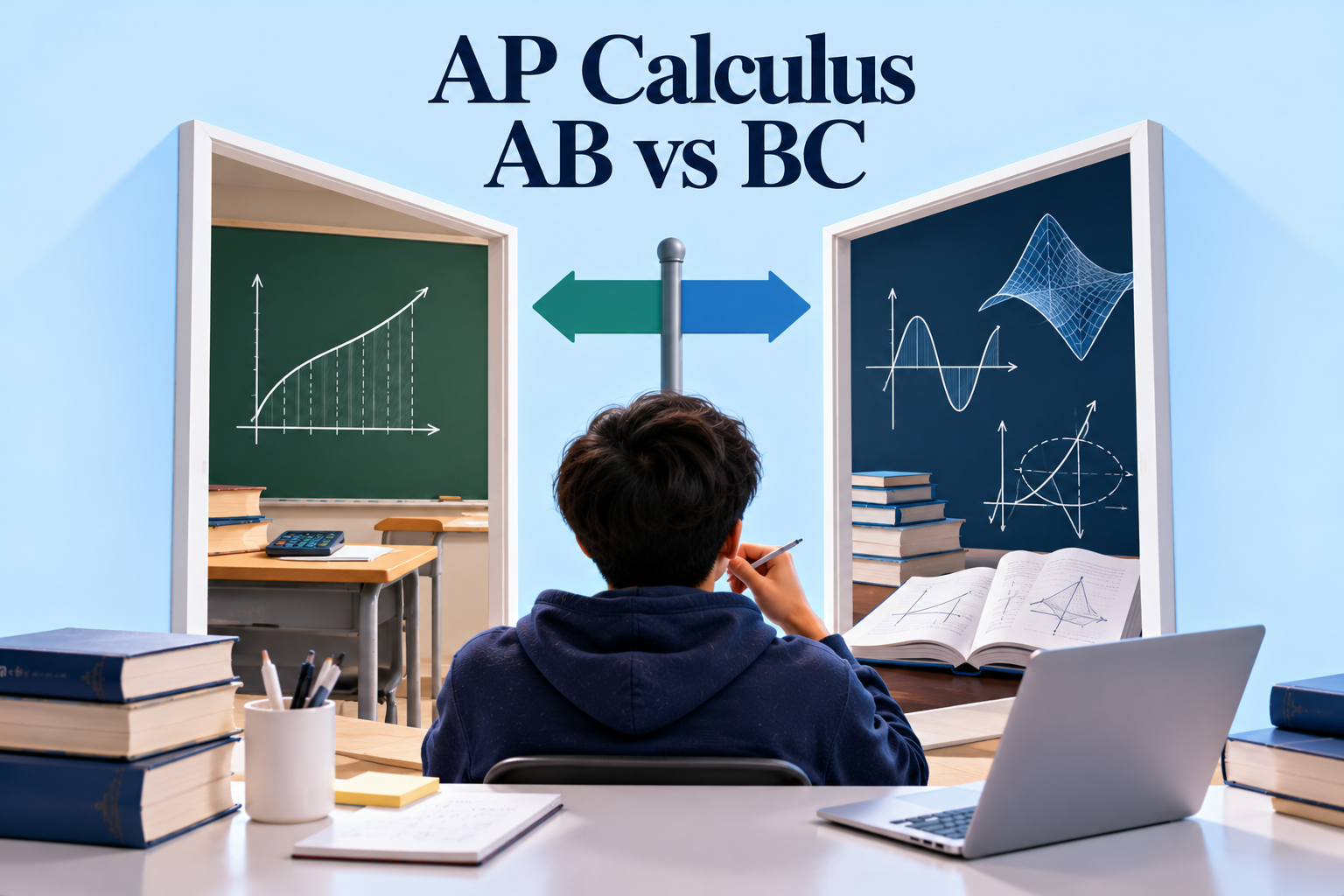
As the saying goes, the devil is in the details. At first glance, AP Calculus AB and BC can look like two versions of the same course, with BC simply being the harder one. The actual difference is more useful to understand before you choose.
AP Calculus BC includes everything taught in AB, then adds more calculus and usually moves through the shared material at a faster pace. So the decision is not simply about whether you are “good at maths.” It depends on how strong your algebra, trigonometry and precalculus foundations are, how quickly you are comfortable learning new material and what level of calculus makes sense for you next.
This guide compares AP Calculus AB vs BC using the latest 2026–27 College Board information, including the updated May 2027 exam format, so you can understand what changes between the two and choose with more confidence.
What Is the Main Difference between AP Calculus AB vs BC
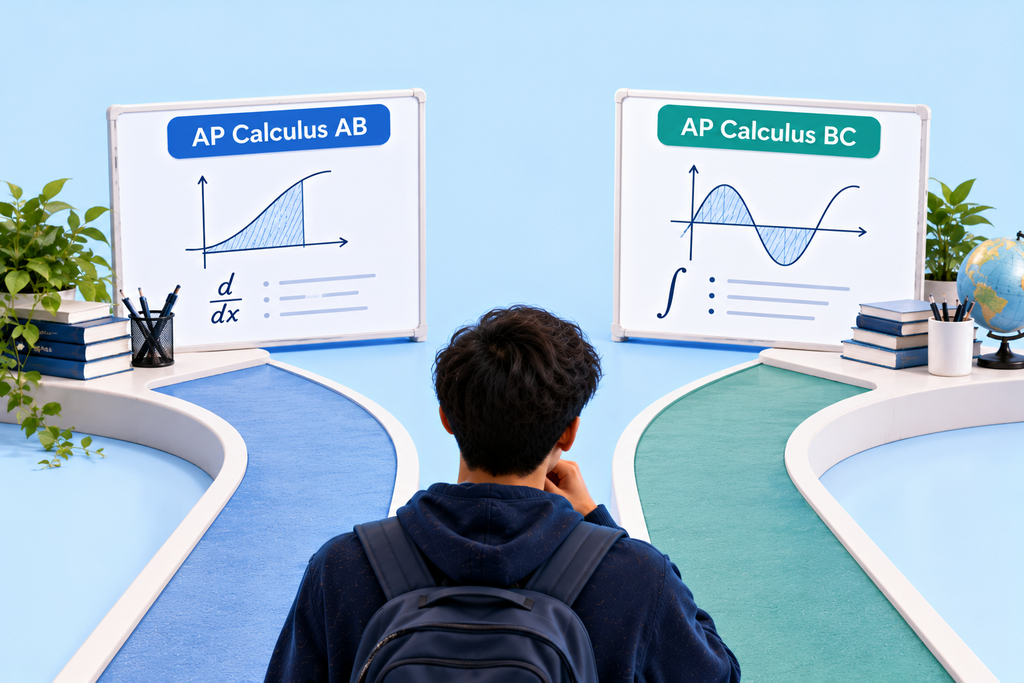
The simplest way to understand the difference is that AP Calculus AB covers the foundation of college-level calculus, while AP Calculus BC covers that foundation and then goes further.
College Board describes AP Calculus AB as equivalent to a first-semester college course in differential and integral calculus. AP Calculus BC covers that first-semester material plus the subsequent single-variable calculus course. Every topic in the eight AB units appears in BC, but BC also includes extra material in Units 6–8 and two additional units.
| Difference | AP Calculus AB | AP Calculus BC |
| College-course equivalent | First-semester calculus | First semester plus subsequent single-variable calculus |
| Main course units | 8 | 10 |
| Includes AB material | Yes | Yes |
| Additional BC topics | No | Yes |
| Typical pace | More time on core calculus | More material in the academic year |
| AB subscore | No | Yes |
| 2027 exam length | 3 hr 10 min | 3 hr 10 min |
| 2027 exam questions | 42 MCQ + 6 FRQ | 42 MCQ + 6 FRQ |
This is why thinking of AB as “easy calculus” and BC as “hard calculus” is not quite accurate. Both require you to understand calculus properly. BC simply asks you to cover a broader syllabus on top of the AB foundation.
What Topics Are the Same in AP Calculus AB and BC?
There is a lot more overlap between AB and BC than the course names might suggest.
Both courses cover the same first eight units:
- Limits and Continuity
- Differentiation: Definition and Fundamental Properties
- Differentiation: Composite, Implicit and Inverse Functions
- Contextual Applications of Differentiation
- Analytical Applications of Differentiation
- Integration and Accumulation of Change
- Differential Equations
- Applications of Integration
All eight AB units are included in AP Calculus BC.
This matters if you are worried that taking BC means jumping over the basics. It does not. You still learn limits, derivatives, integrals, differential equations and applications of calculus. The difference is that the course has to move beyond them as well.
What Extra Topics Do You Learn in AP Calculus BC?
This is where the real difference starts to become clear.
AP Calculus BC includes additional material within some of the shared units and then adds Unit 9 and Unit 10, which are BC-only.
The additional BC content includes topics such as:
- additional techniques of integration;
- Euler’s method and logistic models;
- arc length;
- parametric equations;
- polar coordinates;
- vector-valued functions;
- infinite sequences and series;
- convergence and divergence;
- power series;
- Taylor and Maclaurin series.
College Board specifically identifies extra BC content in Units 6–8, followed by Unit 9: Parametric Equations, Polar Coordinates, and Vector-Valued Functions and Unit 10: Infinite Sequences and Series.
The challenge is therefore not just that some of these topics are new. BC students also need to reach them after covering all the calculus that AB students study.
If you understand new mathematical ideas quickly and already have strong foundations, that pace may feel manageable. If you normally need more time to become confident with a new concept before moving on, AB may give you more room to build that understanding.
Is AP Calculus BC Actually Harder Than AB?
In most cases, BC is the more demanding course, but not because every BC question is automatically harder.
The main difference is scope and pace.
Both courses require strong conceptual understanding. An AB student still needs to explain derivatives, work with integrals, interpret graphs and tables, justify reasoning and solve unfamiliar problems. BC students need those same skills while also covering additional integration methods, parametric and polar calculus, vector-valued functions and sequences and series.
That means BC can become difficult when the foundation underneath it is not secure. If you are still spending a lot of time remembering algebraic manipulation, trigonometric identities or how different functions behave, the faster pace can make calculus itself feel harder than it needs to be.
For a student with a very strong precalculus foundation, however, BC may feel like a natural next step rather than an unreasonable jump.
The better question is therefore not simply “Is BC harder?” It is whether the additional content and faster pace are appropriate for where you are mathematically right now.
Why Does AP Calculus BC Have a Higher 3+ Rate Than AB?
This statistic often confuses students.
According to College Board’s latest 2026 AP score distributions, 65% of AP Calculus AB test takers earned a score of 3 or higher, compared with 82% of AP Calculus BC test takers. BC also had a much larger percentage of students earning a 5.
| 2026 AP Score | Calculus AB | Calculus BC |
| 5 | 20% | 46% |
| 4 | 28% | 22% |
| 3 | 17% | 14% |
| 2 | 24% | 14% |
| 1 | 11% | 4% |
| 3 or higher | 65% | 82% |
That does not mean BC is easier.
The students who choose BC are not necessarily the same type of students who choose AB. BC students are often further ahead in their mathematics sequence and may enter the course with particularly strong mathematical preparation.
So score distributions should give you context, not make the decision for you. Choosing BC because “more people get a 5” ignores the preparation that many of those students bring into the course.
What Does the AP Calculus Exam Look Like in 2027?
This is particularly important for students preparing during the 2026–27 school year, because the AP Calculus exam format has been updated for May 2027.
College Board confirms that the course content itself has not changed, but the number of multiple-choice questions and exam timing have changed beginning with the May 2027 exams. Both AP Calculus AB and BC are now hybrid digital exams. Students complete the multiple-choice section and view free-response questions in Bluebook, while writing their FRQ answers by hand in paper exam booklets.
The new format is the same for AB and BC:
| Section | Questions | Time | Exam Weight |
| MCQ Part A | 29 | 62 min | 35% |
| MCQ Part B | 13 | 38 min | 15% |
| FRQ Part A | 2 | 30 min | 16.7% |
| FRQ Part B | 4 | 60 min | 33.3% |
| Total | 42 MCQ + 6 FRQ | 3 hr 10 min | 100% |
A graphing calculator is not permitted in MCQ Part A or FRQ Part B. It is required for MCQ Part B and FRQ Part A.
Both the AP Calculus AB and BC Exams are scheduled for Monday, May 10, 2027, in Session 1.
This change is worth paying attention to if you are using older prep books, videos or practice guides. Many resources still describe the previous 45-question multiple-choice format and older timings. Your preparation for 2027 should be based on the current format.
Is the Exam Format Different for AB and BC?
Structurally, no.
Both exams have 42 multiple-choice questions, six free-response questions and a total testing time of 3 hours 10 minutes. Both also split calculator and non-calculator work in the same way.
The difference is what can appear within those questions.
BC students can be tested on all the shared AB material as well as the additional BC-only content. This means the exam may look similar on paper, but the range of mathematics you are responsible for is broader in BC.
What Is the AP Calculus BC AB Subscore?
If you take the AP Calculus BC Exam, you receive more than your overall BC score.
College Board also reports an AP Calculus AB subscore from 1 to 5, based on how you performed on the portion of the BC Exam covering AB topics. Approximately 60% of the BC Exam is devoted to AB-level material.
College Board recommends that colleges treat this subscore in the same way they would treat an AP Calculus AB Exam score because the shared material is tested at the same conceptual level.
However, this does not mean every university will automatically award credit in the same way. Colleges and universities set their own AP credit and placement policies, so you should check the policies of institutions you may eventually attend.
Do You Need to Take AP Calculus AB Before BC?
Not necessarily.
College Board does not list AP Calculus AB itself as a prerequisite for BC. Instead, students are expected to arrive with a strong background in algebra, geometry, trigonometry, analytic geometry and elementary functions. For BC, the recommended preparation also includes familiarity with sequences, series and polar equations.
This is why some schools allow mathematically prepared students to move directly from precalculus into BC, while others structure the sequence as AB followed by BC.
Your school’s policy therefore matters.
More importantly, skipping AB only makes sense if you already have the mathematical foundation needed to learn its content at the pace BC requires. Moving directly into BC should not mean skipping AB concepts; it means learning those concepts as part of the BC course.
Can You Take AP Calculus AB and BC Exams in the Same Year?
No.
College Board states that students may not take both the AP Calculus AB and AP Calculus BC Exams within the same year.
If you are taking BC, remember that the exam already includes all the AB material and provides an AB subscore. You do not need to sit a second AB Exam simply to show your performance on those topics.
Are You Ready for AP Calculus BC?

This is the part of the decision that matters more than comparing course names.
College Board recommends that students entering either AP Calculus course already have experience with algebra, geometry, trigonometry, analytic geometry and elementary functions. BC preparation goes further, including familiarity with sequences, series and polar equations.
You are likely to be better prepared for BC if algebraic manipulation feels natural, you can work comfortably with functions and graphs, your trigonometry foundation is secure and you do not need extensive review every time an older concept reappears.
This matters because many students discover that their difficulty in calculus is not actually caused by derivatives or integrals. The problem often appears one step earlier. They understand the calculus method but lose time simplifying an expression, working with logarithms, interpreting a trig function or manipulating an equation.
BC gives you less room for those foundational gaps because the course has more ground to cover.
If those foundations are already strong and you are comfortable learning mathematics at a faster pace, BC may be a sensible challenge. If they are still developing, AB can give you more time to understand the calculus itself rather than constantly catching up on earlier maths.
Should You Take AP Calculus AB or BC?
There is no universally “better” choice. The stronger choice is the course that matches your current preparation and gives you the right level of academic challenge.
AP Calculus AB may be a better fit if:
- you want more time to develop the core ideas of calculus;
- precalculus has required consistent effort;
- your school’s mathematics sequence naturally leads into AB;
- you would benefit from mastering derivatives and integrals before moving into additional calculus topics.
AP Calculus BC may be a better fit if:
- algebra, functions and trigonometry are already strong;
- you are comfortable with a faster-paced mathematics course;
- your school allows you to move directly into BC;
- you are ready to study calculus beyond the first-semester level;
- you expect to continue into a mathematically intensive field and want the additional preparation.
Do not choose BC simply because the course title appears more advanced on a transcript. At the same time, do not avoid it simply because it contains more material.
The right level should stretch you without forcing you to spend the entire year repairing foundations you were expected to have before calculus began.
For parents helping with the decision, this is also a better way to think about course rigor. The most advanced option is useful only when the student is prepared to benefit from it.
Does Your Future Major Matter When Choosing AB or BC?
It can, but your intended major should be one factor rather than the only factor.
AP Calculus BC provides additional mathematical preparation that may be useful for students interested in fields such as mathematics, engineering, physics, computer science or quantitatively intensive economics. College Board itself notes that BC helps prepare students for further study in areas including engineering, computer science and economics.
That does not mean every future STEM student must take BC.
If AB is the appropriate course based on your school’s mathematics sequence or your current preparation, building a strong calculus foundation is more useful than moving into BC before you are ready.
Students should also avoid treating an AP course as a universal university-admissions requirement. Expectations differ across institutions, programmes, schools and education systems.
Will AP Calculus BC Give You More College Credit Than AB?
Potentially, but not automatically.
Since College Board describes AB as equivalent to a first-semester college calculus course and BC as covering that course plus the subsequent single-variable calculus course, BC may lead to additional credit or more advanced placement at some colleges.
The important phrase is at some colleges.
Each institution sets its own AP credit policy, including the score required and the course or placement awarded. The same AP Calculus BC score can therefore produce different outcomes at different universities.
If college credit matters to your decision, check the policies of the universities you are considering rather than assuming BC will automatically remove two semesters of calculus everywhere.
AP Calculus AB or BC: A Final Decision Check
If you are still undecided, bring the choice back to your actual mathematical preparation rather than the reputation of the course.
| If this sounds like you… | Consider |
| Algebra and trigonometry are already strong | BC |
| You need more time to become comfortable with new maths | AB |
| You enjoy fast-paced mathematical problem-solving | BC |
| You want to build the core calculus foundation first | AB |
| Your school requires AB before BC | Follow your school sequence |
| You are choosing BC mainly because it “looks better” | Reconsider your reason |
| BC is the natural next course in your maths sequence | BC may be appropriate |
The decision does not need to become more complicated than this. BC covers more mathematics and moves further. AB gives you more space to build the core calculus foundation. Neither course is a poor choice when it is the right level for the student taking it.
How Can Masterclass Space Help With AP Exam Preparation?
Knowing the AP Calculus syllabus is one thing; knowing where you are actually losing marks is another.
At Masterclass Space, AP exam preparation is built around the student’s current level rather than a standard study plan. The focus is on strengthening concepts, identifying weak areas and developing the accuracy and exam awareness needed for both multiple-choice and free-response questions.
For AP Calculus AB and BC, preparation can include targeted concept revision, timed MCQ and FRQ practice, calculator and non-calculator strategy, BC-specific topic support where required and structured preparation leading into the exam.
For students, this makes preparation more focused. For parents, it provides greater clarity on where the student currently stands and what still needs attention before exam day.
The goal is not simply to finish more questions. It is to help students understand the mathematics well enough to recognise what a question is asking, choose the right approach and communicate the solution clearly under exam conditions.
Frequently Asked Questions
Is AP Calculus BC much harder than AB?
BC is generally more demanding because it covers all AB material plus additional topics and usually moves at a faster pace. However, the shared AB concepts are not automatically tested at a harder conceptual level simply because you take BC.
Does AP Calculus BC include everything taught in AB?
Yes. College Board states that all topics across the eight AP Calculus AB units are included in BC. BC then adds extra content in Units 6–8 and two additional units.
Can I take AP Calculus BC without taking AB first?
Yes, depending on your school. College Board does not require AP Calculus AB as a prerequisite for BC, but you should already have a strong background in algebra, geometry, trigonometry, functions and other precalculus concepts.
Can I take both AP Calculus AB and BC Exams in the same year?
No. College Board does not allow students to take both AP Calculus AB and AP Calculus BC Exams in the same year.
Why is the AP Calculus BC 3+ rate higher than AB?
In 2026, 82% of BC test takers earned 3 or higher compared with 65% for AB. This does not prove that BC is easier. The students who choose BC are often a more mathematically advanced group before the course begins.
Do AP Calculus AB and BC have the same exam format in 2027?
Yes. Both have 42 multiple-choice questions and six free-response questions, with a total exam duration of 3 hours 10 minutes. Both are hybrid digital exams beginning with the May 2027 administration.
What changed for the AP Calculus exam in 2027?
College Board updated the number of multiple-choice questions and exam timing beginning with the May 2027 AB and BC Exams. The course content itself did not change for 2026–27.
Does AP Calculus BC give you an AB subscore?
Yes. BC students receive an AB subscore from 1 to 5 based on performance on the approximately 60% of the BC Exam devoted to AB topics.
Is AP Calculus AB enough for engineering or computer science?
AB can provide a strong foundation in calculus, but BC covers additional material that may be useful preparation for mathematically intensive university study. The right choice still depends on your current mathematical preparation, your school’s course sequence and the universities or programmes you may eventually consider.
Which gives more college credit: AP Calculus AB or BC?
BC may qualify for more credit or more advanced placement at some colleges because it covers additional calculus. However, every university sets its own AP credit and placement policy, so there is no universal amount of credit attached to either exam.