How to Choose Between Physics 1, Physics 2, and Physics C in AP Physics for Pre Med
Pre-Med AP Physics: The Easy Guide
The AP Physics decision may seem unanticipated and significant if you or your child is considering a career in medicine. Developing conceptual clarity, quantitative reasoning, and the self-assurance to tackle college-level science are more important than simply obtaining a high AP score to impress college admissions. Which AP Physics course—Physics 1, Physics 2, or Physics C—is correct? In a nutshell, it depends. The lengthier, more helpful response, which includes precise comparisons, practical guidance, and study techniques designed for prospective pre-med students, is provided below. One of Boston's Top AP Physics Classes is Masterclass Space.
Why AP Physics Is Important for Pre-Med Medical Colleges value your capacity for scientific thought. While physics isn't often a rigorous prerequisite for medicine, it does improve problem-solving skills, quantitative reasoning, and the mental habits used by physicians, such as estimating, modeling systems, and analyzing data. They also want you to be an expert in chemistry and biology. In addition to saving time and improving your transcript, AP Physics classes can help you determine whether you are interested in the physical aspects of health sciences (think medical imaging, biomechanics, or physiology modeling).
Three Paths, Three Encounters
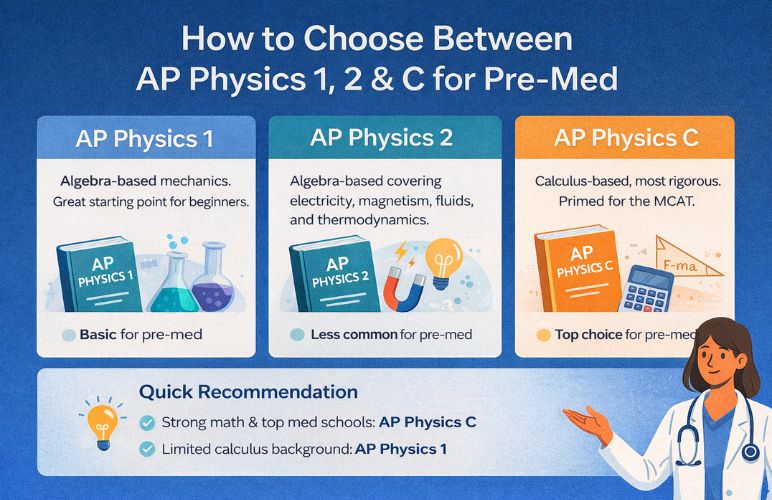
The AP Physics 1 is an excellent introduction to mechanics and fundamental waves that is conceptual and algebra-based. emphasis on comprehending concepts and conducting research in the lab.
The AP Fluids, thermodynamics, electricity, magnetism, optics, and contemporary physics subjects are all covered at an introductory level in Physics 2, an algebra-based course. more extensive and in-depth lab work than Physics 1.
The AP Calculus-based Physics C is sometimes divided into two distinct courses or tests: Mechanics and Electricity & Magnetism. For majors, it is the most similar to basic college physics; it is demanding and math-intensive.
How Pre-Med Advisors and Colleges View These Courses
Medical schools never give an advantage based solely on AP results, and colleges differ in how they accept AP credit. Advisors stress two things when it comes to pre-med planning: (1) finish the college prerequisites, which often include a year of general physics for majors; and (2) cultivate academic habits, such as critical reading, lab abilities, and math fluency. If your future college grants credit, taking AP courses can either complete or expedite the first goal; in any case, performing well in AP Physics indicates that you are capable of handling challenging science material. The Best AP Physics Classes in Chicago Are at Masterclass Space
Which AP Physics Are Typically Selected by Pre-Med Students?
Patterns vary depending on the arithmetic preparation of the students and the school:
Because AP Physics C (Mechanics and/or E&M) closely resembles college-level physics and offers more proof of quantitative aptitude, students who are comfortable with calculus frequently select it.
Students may take Physics 1 and then Physics 2 over the course of two years if they prefer algebraic reasoning or want to be exposed to a wider range of topics.
Physics 1 is a very good introductory alternative if you can only take one AP physics course in high school and are unsure about calculus. This is especially true if you have a solid background in chemistry and biology.
Useful Advice: Which Should You Select?
Before making a decision, ask yourself a few sincere questions:
- How at ease are you with calculus this year or next year?
- In college, do you intend to major in engineering or physical science?
- Is AP Physics C taught at your high school, and if so, is the instructor qualified?
- Before attending college, do you prefer breadth (1 & 2) or depth (C) in physics?
Overarching suggestions:
AP Physics C (both Mechanics and E & M) is a great option if you appreciate math and are taking calculus or intend to. It is the most demanding and provides selected colleges with the best indication of quantitative readiness.
Take Physics 1 in the tenth or eleventh grade and Physics 2 later if you want a comprehensive introduction to physics before college and prefer an algebraic approach. Strong conceptual reasoning and laboratory abilities are developed in this course.
Physics 1 is a safe and beneficial choice if you can only fit in one physics AP and your timetable doesn't include calculus, especially if you'll build chemistry and biology around it.

How These Courses Fit into a Normal Pre-Med Schedule
One useful method that families can use to schedule classes during the high school years is as follows:
Honors Chemistry with Algebra II/Trig in the tenth grade
11th grade: AP Biology, AP Physics 1 (or AP Physics C Mechanics if studying Calculus concurrently),
12th grade: Advanced science electives or college courses, if available, in addition to AP Physics 2 or AP Physics C E&M
Being adaptable is essential. In high school, you don't have to check every box. Moving from Physics 1 to Physics C or enrolling in Physics C after completing calculus is a significant signal to colleges, which are looking for an upward trajectory and challenge.
Physics 1, Physics 2, and Physics C in a clear comparison table
A feature of AP Physics I,
Level of Math: Basic trigonometry and algebra
Key Subjects: Newton's laws, energy, momentum, rotation, kinematics, basic circuits, and waves
Emphasis on Laboratories: Inquiry-based labs with an emphasis on research
Placement/College Credit varies; frequently, intro labs result in placement or partial credit.
Ideal If You Desire a strong intellectual basis and proficiency in the lab
AP Physics II, AP Physics C
Basic trigonometry and algebra are necessary (or concurrent).
Thermodynamics, E&M, optics, contemporary physics, fluids, and circuits Calculus-level mechanics (and/or electricity and magnetism)
Thermodynamics and E&M experiments in inquiry labs - Calculus simplifies derivations; laboratory proficiency is required.
varies; occasionally, credit for subjects covered in the second semester - High exam scores increase the likelihood of receiving college credit or direct placement.
More exposure to physics is beneficial for transdisciplinary interests - Strong quantitative pre-med profiles, engineering, and physics majors' preparation.
Effective Study Techniques for AP Physics (and Beyond)
Active problem solving is more rewarding in physics than passive reading. The following behaviors lead to higher AP scores and more robust scientific reasoning:
Work on targeted issue sets. Quantity is inferior to quality. Workplace challenges that need you to convert physical circumstances into mathematics, diagrams, and spoken interpretations.
Put science into practice. Create brief experiments, including thought experiments, evaluate the results, and provide succinct conclusions. AP assignments frequently assess scientific thinking in addition to answers.
Dimensional analysis and master units. When you regularly inspect units, a lot of faults disappear.
Develop your sketching skills. Frequently, a clear circuit diagram or free-body diagram leads directly to the solution.
mimic the pace of an exam. Time management is a skill that must be taught; complete entire portions on time and go over each error.
Make use of spaced repetition. To transfer comprehension into long-term memory, go over difficult subjects again over the course of several weeks.
Study Resources and Assistance
When you're stuck, think about specialized tutoring in addition to textbooks and classroom assistance. By combining knowledgeable tutors with AI-driven insights to monitor progress, personalized tutoring—such as Masterclass Space one-on-one guidance—can assist you in identifying your areas of weakness, adjusting to your learning speed, and creating a customized study plan. Such tailored assistance frequently makes the difference between comprehension and accomplishment for students striving for high grades while juggling demanding course loads.
How to Get Ready for the Format of the AP Exam
Although AP exam formats vary, the fundamentals are the same: multiple-choice and free-response questions that assess experimental reasoning, quantitative abilities, and conceptual comprehension. Calculus abilities are specifically examined for Physics C, and you'll need to use integrals and derivatives in real-world situations. Algebraic manipulation, proportional reasoning, and lab interpretation are highlighted in Physics 1 and 2.
Checklist for Exam Preparation
Examine the units and course structure to determine where to concentrate your study time.
Take a number of timed past-style test portions and assign rigorous grades. Examine each error.
Develop your ability to express your ideas succinctly and effectively by practicing free-response responses that include steps, diagrams, and units.
Simulate the logistics of test day, including the timing for each section, the allowed formulas, and the calculator policy.
The Medical School Application and AP Physics
Medical schools look for proof that you can handle science education in your transcript and recommendation letters. Quantitative strength can be demonstrated by a strong performance in AP Physics, particularly Physics C. However, keep in mind that medical admissions are complex. Your GPA, research, clinical experience, MCAT, and interpersonal skills are all very important. Make strategic use of AP Physics to bolster your scientific background without exhausting you or keeping you from enrolling in necessary biology and chemistry classes.
Examples of Routes for Various Student Profiles
Take AP Calculus AB/BC and then AP Physics C (Mechanics and E&M) if you're a math-strong student. For those interested in MCAT physics and biophysics, this route offers solid evidence of quantitative proficiency and college-level physics preparedness.
The balanced student would double down on AP Biology and AP Chemistry while taking AP Physics 1 in their junior year and AP Physics 2 in their senior year. This results in solid lab experience and extensive scientific preparation.
The Time-Constrained Student: Take one AP Physics course (often Physics 1) and devote more time to learning biology and chemistry if you have a limited number of classes. Remedial or accelerated college physics is always an option.
When to Think About Getting Additional Assistance (and How to Select It)
Targeted tutoring can produce immediate results if you're having trouble with calculus topics while taking Physics C or if your lab write-ups consistently lose points. Seek assistance that provides:
customized study schedules that identify areas of weakness and recommend targeted practice.
knowledgeable tutors with subject-matter expertise who are able to communicate ideas in a variety of ways.
Tools to monitor development so you and your parents can observe growth over time.
Personalized services, like Masterclass Space personalized tuition, combine one-on-one instruction with timed practice and adaptive insights; many students find that this combination helps them advance more quickly than studying alone.
An example of a 12-week study schedule for an AP Physics exam
The following approach is predicated on the assumption that you have already completed the course and are studying for the test.
Weeks 1-2: Audit principles, including free-body diagrams, kinematics, and units. Determine your math or calculus weaknesses and address them right away.
Weeks 3–6: Depending on the course, extensive practice in work/energy, momentum, circuits, thermodynamics, or E&M.
Weeks 7–9: One part of timed practice exams for each study session. Examine errors in detail and note prevalent error kinds.
Weeks 10–11: Concentrate on free-response; write coherent, well-organized responses using units and illustrations.
Week 12: Rest, test logistics, and light review. Prioritize sleep and stress reduction; do one timed chunk early in the week and then taper off.
Breakdown of Weekly Sessions (2–3 hours)
30 minutes for a quick problem set and topic review.
Focused problem solving on a single unit, alternating between conceptual and quantitative tasks, takes 60 to 90 minutes.
30 minutes—Reflection and error log: note what went wrong, why, and how to avoid it.
Lab Techniques That Make an Impact (and Help You on the Test)
Lab science is emphasized in AP Physics. Both your classroom grade and free-response performance will benefit from writing clear, hypothesis-driven lab reports and knowing how to evaluate experimental uncertainty. Important lab practices consist of:
recording unprocessed data in an understandable and reliable manner.
use graphs to identify patterns and, when necessary, computing uncertainty.
Linking facts to conclusions and acknowledging limits are key components of making evidence-based claims.
Concluding Remarks: Be Strategic, Avoid Overwhelm
There isn't a single AP Physics option that is right for every pre-med student. While Physics 1 and 2 offer breadth, solid conceptual underpinnings, and useful lab experience, Physics C is the most demanding and exhibits strong quantitative skills—helpful for elite institutions and specific clinical specializations. Select the course that best suits your academic objectives, timetable, and level of math readiness.
Recall that quality is more important than quantity. You will benefit much more from a single, well-mastered AP Physics course combined with strong chemistry, biology, research, and clinical exposure than from a haphazard attempt to accumulate AP titles. Personalized tutoring, such as one-on-one instruction with customized study plans and knowledgeable tutors, can be an effective strategy to increase comprehension and test readiness without burning out if you want to speed up learning or strengthen weak areas.
A Brief Checklist Prior to Enrollment
Verify the math requirements: if you choose Physics C, are you ready for calculus?
Discuss course sequencing and workload with your physics teacher and school counselor.
Since your junior year is sometimes the most crucial academic year for college admissions, make sure you plan it wisely.
Choose between taking a single AP in physics or a series, and make sure to set out time for preparation in biology and chemistry.
If you want to maintain a balanced application profile while achieving high results, think about personalized study plans or focused tutoring.
Final Words of Encouragement
Although studying physics can be scary, it's also a very fulfilling method to develop the kind of scientific mindset that will benefit future doctors. Select the course that best suits your abilities, make a commitment to consistent practice, and don't be scared to seek assistance when you need it. In addition to being prepared for your AP exam, you'll be better equipped to handle the scientific demands of medical school and beyond with careful preparation, concentrated study, and the appropriate resources.
To find out more about Jersey City's Top AP Physics Classes, visit www.masterclassspace.com. One of Boston's Top AP Physics Classes is Masterclass Space.