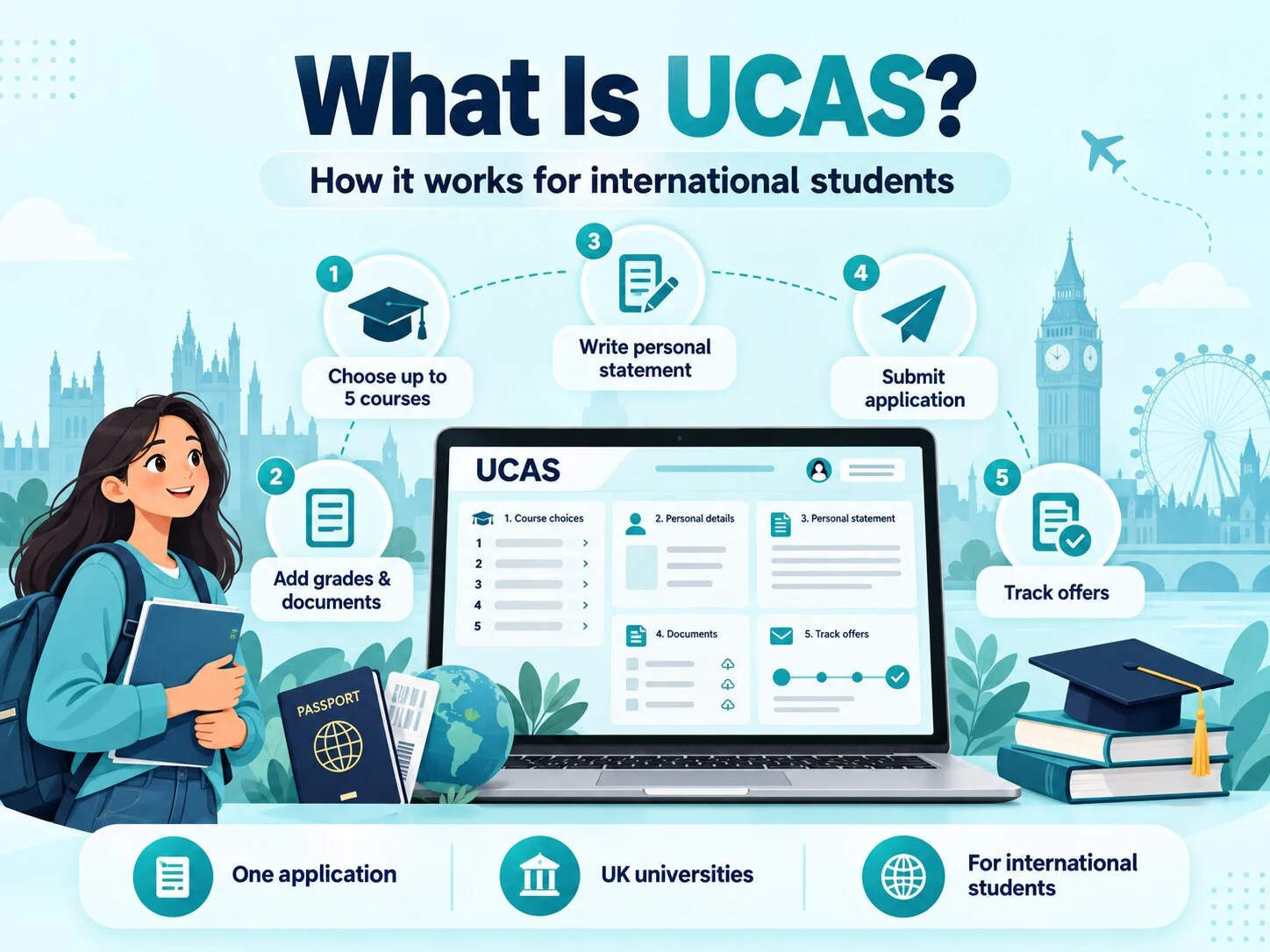
UCAS stands for Universities and
Colleges Admissions Service. It is the UK’s shared admissions
service used for most undergraduate university applications.
International students generally use the same UCAS system as UK
applicants and can apply to up to five course choices through one
application. UCAS collects the application and sends it to the selected
universities, but the universities themselves decide whether to
make an offer. For 2027 entry, students also need to understand
the new three-question personal statement format, supporting-document
uploads, current deadlines and what happens after university decisions
arrive.
UCAS for
International Students at a Glance
| UCAS Question | What Students Need to Know |
|---|---|
| What does UCAS stand for? | Universities and Colleges Admissions Service |
| Who uses it? | UK and international undergraduate applicants |
| Main purpose | Applying to undergraduate courses in the UK |
| Maximum choices | Up to 5 course choices |
| Application fee for 2027 | £34.50 |
| Personal statement | 3 structured questions |
| Main 2027 deadline | 13 January 2027 for most undergraduate courses |
| Earlier deadline | 15 October 2026 for Oxford, Cambridge and most Medicine, Dentistry and Veterinary courses |
| Who decides admission? | Individual universities |
| Extra opens | 25 February 2027 |
| Clearing opens | 2 July 2027 |
| Does UCAS issue a visa? | No |
For the 2027 cycle, the £34.50 undergraduate application fee covers
up to five course choices and access to UCAS services such as the Hub,
Extra and Clearing.
What Does
UCAS Do and What Does It Not Do?
Understanding UCAS becomes much easier once students separate the
application platform from the university
decision-making process.
| UCAS Does | UCAS Does Not |
|---|---|
| Collect and process undergraduate applications | Decide who gets admitted |
| Send applications to selected universities | Set course entry requirements |
| Allow students to apply to up to five course choices | Decide whether an international qualification is equivalent to a UK qualification |
| Show university decisions and offers | Set tuition fees or fee status |
| Provide Extra and Clearing | Issue a CAS |
| Allow students to track their application | Approve Student visas |
UCAS itself states that it does not make admissions decisions, assess
international qualifications or determine tuition fee status. Those
decisions are made by the individual universities and colleges.
This distinction is important for international applicants. If you
want to know whether your school qualification is accepted, what grades
you need or whether you meet English-language requirements, you should
check the university’s own course and country-specific pages.
How
Does UCAS Work for International Students? Step by Step
The UCAS process is easier to manage when students understand the
sequence before they begin.
Step
1: Research UK Universities and Undergraduate Courses
Start with the course, not only the university name
or ranking.
Compare course content, entry requirements, subject prerequisites,
teaching structure, tuition fees, location, English-language
requirements and any additional admissions tests, interviews or
portfolios.
International students should also check whether the university
accepts their national or international qualification.
Step 2: Create Your
UCAS Hub Account
Students manage their undergraduate application through the
UCAS Hub.
For 2027 entry, applications opened on 12 May 2026,
although completed applications could only begin being submitted from
1 September 2026.
International students can apply through their school, a UCAS
registered centre or independently. An admission consultant or adviser
is optional rather than a requirement for using UCAS.
Step 3: Choose Up to
Five Courses
Students can usually add up to five course choices.
These can be at different universities or multiple courses at the same
university.
Your choices are not treated as a preference ranking when
universities receive the application.
There are some important restrictions. Applicants can select a
maximum of four courses in any one of Medicine, Dentistry,
Veterinary Medicine or Veterinary Science, leaving the fifth
choice available for another subject if they wish. Students also usually
cannot apply to both Oxford and Cambridge in the same undergraduate
admissions cycle.
Step 4:
Enter Your Education and Qualifications
UCAS asks students to enter their education history and
qualifications, including both completed qualifications and those still
being studied.
If an examination result is still pending, it should be entered as
pending. Predicted grades are then normally supplied by the student’s
school, counsellor or referee where applicable. Universities use
predicted grades alongside other application information when deciding
whether to make a conditional offer.
International students should enter their qualification accurately
rather than trying to convert it themselves into A Levels or UCAS
points.
Step 5:
Upload Supporting Documents Where Applicable
A major update for 2027 entry is the introduction of
supporting-document uploads for all applicants.
UCAS says students may be able to upload documents such as:
English-language certificates
Passport or immigration-status evidence
Universities can still ask for additional documents separately, so
uploading documents to UCAS does not replace checking the requirements
of each institution.
Step 6:
Complete the UCAS Personal Statement
The UCAS
personal statement is now divided into three structured
questions rather than one continuous essay.
All three answers are considered together, with a total limit of
4,000 characters including spaces.
The full questions are explained later in this guide.
Step 7: Add Your
Reference
A UCAS undergraduate application requires one
reference.
Students currently in education will normally use a teacher, school
counsellor or another person who knows them academically. Independent
applicants should choose someone who knows them in an academic or
professional capacity. A family member, friend or partner cannot provide
the reference.
If qualifications are still pending, the referee may also be
responsible for providing predicted grades.
Step 8: Pay and
Submit Your Application
The UCAS undergraduate application fee for 2027 entry is
£34.50. One payment covers up to five choices.
Students applying through a school or centre should remember that
their institution may have an internal deadline earlier than the
official UCAS deadline so that staff have time to review the
application and complete the reference.
Step 9:
Universities Review Your Application
Once UCAS receives the completed application, it sends it to the
selected universities.
Each university evaluates the application according to its own
admissions criteria. The decision can depend on academic results,
predicted grades, the personal statement, reference, admissions tests,
portfolio, interview or other programme requirements.
UCAS does not choose which university should admit the student.
Step 10: Track
Your University Decisions
Students can monitor university responses through their UCAS
application.
A university may issue:
Conditional offer
You have been offered a place if you meet specified
conditions.
Unconditional offer
You have already met the required academic conditions,
although there may still be administrative requirements.
Unsuccessful decision
The university has decided not to offer a place.
Universities may also request an interview, audition or additional
information before making a final decision.
Step 11:
Choose Your Firm and Insurance Offers
Once students have received decisions from all their choices, UCAS
allows eligible applicants to respond to their offers.
Firm choice is the university and course you most
want to attend.
Insurance choice is your backup if your firm offer
is conditional and you do not meet its conditions but do meet the
conditions of your insurance offer.
Your insurance option should ideally have conditions that are
realistic compared with your firm offer, while still being somewhere you
would genuinely be comfortable studying.
Step 12: Meet Your
Offer Conditions
Students holding a conditional offer need to satisfy the requirements
stated by the university.
These may include final academic results, English-language scores or
other course-specific conditions.
Once the university confirms that you have met its requirements, your
place becomes confirmed.
For international students who need a UK Student visa, the next stage
then moves from UCAS to the university and immigration
process.
What
Do International Students Need Before Starting a UCAS
Application?
Preparing the key information before opening the application can make
the process much easier.
| Information | Why It Matters |
|---|---|
| Passport and personal details | Used for identity and residency information |
| Education history | UCAS asks for previous and current education |
| Completed qualifications | Universities review achieved results |
| Pending qualifications | Must be entered if you are still studying them |
| Predicted grades | Used by universities when results are not yet available |
| Up to five course choices | Forms the core of the application |
| Personal statement responses | Helps universities understand your preparation for the subject |
| Referee details | Needed before the application can be submitted |
| English-language evidence | Required by some universities/applicants |
| Supporting documents | Can be uploaded for the 2027 cycle where applicable |
Students should check university entry requirements
before finalising their five choices. A course
appearing in UCAS does not automatically mean that your qualification,
grades or subjects meet that university’s requirements.
UCAS Personal
Statement for 2027
The old single-block UCAS personal statement has been replaced by
three structured questions.
The overall limit remains 4,000 characters, and each
response must contain at least 350 characters. Universities review the
three answers together as one part of the application.
Question
1: Why do you want to study this course or subject?
This is where students explain their motivation and interest in the
subject.
A useful answer should show more than “I have always been interested
in this subject.” Students can discuss ideas, experiences, books,
projects, academic interests or future goals that helped them understand
why they want to study the field further.
Question
2: How have your qualifications and studies helped you prepare for this
course or subject?
This section focuses on academic preparation.
Students can explain how particular school subjects, assignments,
research, projects or academic skills have prepared them for
undergraduate study.
The strongest responses connect previous learning directly to the
course rather than simply listing subjects and grades.
Question
3: What else have you done to prepare outside formal education, and why
are these experiences useful?
Students can use this section for relevant experience outside
school.
This might include work experience, volunteering, independent
learning, competitions, projects, employment, extracurricular activities
or personal responsibilities.
The important part is explaining why the experience is
relevant, not simply listing everything the student has
done.
UCAS Deadlines for 2027
Entry
International students follow the same core undergraduate UCAS
deadlines as other applicants.
| Date | 2027 UCAS Stage |
|---|---|
| 12 May 2026 | 2027 applications opened |
| 1 September 2026 | Completed applications could start being submitted |
| 15 October 2026 | Oxford, Cambridge and most Medicine, Dentistry and Veterinary courses |
| 13 January 2027 | Equal-consideration deadline for most other undergraduate courses |
| 25 February 2027 | UCAS Extra opens |
| 2 July 2027 | Clearing opens |
The 15 October 2026 deadline is at 18:00 UK time,
and the main 13 January 2027 equal-consideration deadline is
also at 18:00 UK time.
“Equal consideration” means universities must consider applications
received by that deadline fairly alongside other on-time applications.
Universities may still consider later applications if spaces remain, but
this is not guaranteed.
Students should therefore avoid treating January as the date to begin
an application. Course research, qualification checks, the personal
statement and reference should ideally be prepared well before the
deadline.
What Do UCAS
University Decisions Mean?
Understanding the terminology makes the post-application stage much
less confusing.
Conditional Offer
A conditional offer means the university wants to offer you a place,
but you still need to satisfy specified requirements.
These commonly involve final academic grades, although
English-language tests or other conditions may also apply.
Unconditional Offer
An unconditional offer means the university considers the main entry
requirements satisfied and is offering you a place without further
academic conditions.
Students should still read the offer carefully because
administrative, financial, health or documentation requirements can
remain.
Unsuccessful
Decision
This means the university has decided not to offer a place for that
particular choice.
One unsuccessful application does not affect the decisions of the
other universities on the UCAS application.
What Are UCAS Extra
and Clearing?
Students still have options if their original five choices do not
result in the right offer.
UCAS Extra
UCAS Extra opens on 25 February 2027.
Extra is generally available to students who have used all five
choices and are not holding an offer. It allows students to apply to an
additional eligible course one at a time without paying
another application fee.
This gives students another opportunity before Clearing begins.
UCAS Clearing
Clearing opens on 2 July 2027.
Clearing allows universities to advertise remaining undergraduate
vacancies and gives eligible students another route to find a university
place. International students can use Clearing in the same way as UK
students.
Clearing can be relevant if a student:
has no confirmed university place
applies later in the admissions cycle
does not meet the conditions of an existing offer
decides to look for another available course
Clearing should not be viewed as a failure route. It is simply
another part of the UK undergraduate admissions system.
How Do
International Qualifications Work in UCAS?
International qualifications can be entered into UCAS, but students
need to understand one important distinction:
UCAS records the qualification. The university decides
whether that qualification satisfies its entry
requirements.
UK universities accept many different international qualifications,
and each institution is responsible for deciding which qualifications
and grades it accepts for a particular course.
The practical process is:
Enter your qualification accurately in UCAS.
Mark qualifications still being studied as pending.
Make sure predicted grades are supplied where required.
Check each university’s official international or country-specific
admissions page.Do not independently convert your grades unless the university
specifically asks you to.
Do
International Students Need UCAS Tariff Points?
Not necessarily.
The UCAS Tariff converts selected qualifications into numerical
points, but not every international qualification has a Tariff
value and not every university uses Tariff points for
admission.
A qualification having no UCAS Tariff score does not mean the
qualification is invalid or automatically unacceptable.
For international students, the university’s published
country-specific requirement is generally more useful than trying to
calculate a UCAS points equivalent.
What
Happens After You Accept a University Offer?
Once an international student has a confirmed undergraduate place,
the process starts moving beyond UCAS.
A typical sequence is:
Meet the offer conditions → university confirms the place →
complete any required deposit or documentation → receive CAS → apply for
Student visa → arrange travel and enrolment
A Confirmation of Acceptance for Studies (CAS) is
issued by the university or college, not by UCAS. Students who require a
visa use the information in the CAS when applying for their UK Student
visa.
Universities may also request final certificates, financial
documents, English-language evidence or other information before
completing the CAS process.
UCAS helps manage the admissions stage, but the university and UK
immigration system manage what follows.
Do
All UK Undergraduate Applications Go Through UCAS?
Most full-time UK undergraduate degree applications are made through
UCAS, but there can be exceptions depending on the provider or
course.
Students should therefore check the university’s official application
instructions before assuming that every undergraduate route uses exactly
the same process.
UCAS Conservatoires also uses a separate application route for
participating performance-based music, dance, drama and screen
programmes.
This guide is focused specifically on undergraduate
university admission, rather than postgraduate
applications.
How
Masterclass Space Undergraduate Admission Consulting Can Support Your
UCAS Application
Masterclass Space can support international students through the
undergraduate UCAS application process, beginning with
university and course selection rather than only reviewing the final
form. The undergraduate
admission consulting process can help students build a balanced
shortlist based on academic profile, subject interests, entry
requirements and long-term goals. Students can also receive guidance
with profile
development, the three-part UCAS personal statement, application
planning, references, predicted-grade coordination and
university-specific admissions requirements. Where a course requires an
admissions test, interview or portfolio, those stages can be planned
alongside the wider application timeline. After decisions arrive,
students can also receive guidance in understanding conditional offers,
firm and insurance choices and the next steps towards confirming their
undergraduate place. Universities make all final admission decisions
independently, and admission
consulting cannot guarantee an offer.
Frequently Asked Questions
What does UCAS stand for?
UCAS stands for Universities and Colleges Admissions Service. It is the UK’s shared admissions service used for most undergraduate applications.
Can international students use UCAS?
Yes. International students use UCAS to apply to undergraduate courses at UK universities and generally follow the same central application process and deadlines. Universities may have additional international qualification or English-language requirements.
How many universities can I apply to through UCAS?
UCAS allows up to five course choices. These may be at five different universities or include multiple courses at the same university. Medicine, Dentistry, Veterinary Medicine and Veterinary Science applicants can use a maximum of four choices in one of those subjects.
What is the UCAS application fee for 2027?
The 2027 undergraduate application fee is £34.50, covering up to five choices.
What is the UCAS deadline for 2027 entry?
The deadline for Oxford, Cambridge and most Medicine, Dentistry and Veterinary courses is 15 October 2026 at 18:00 UK time. The equal-consideration deadline for most other undergraduate courses is 13 January 2027 at 18:00 UK time.
What are the three UCAS personal statement questions?
Students answer why they want to study the subject, how their qualifications and studies have prepared them, and what they have done outside formal education to prepare. All three answers share a total limit of 4,000 characters.
What is the difference between a conditional and unconditional offer?
A conditional offer requires the student to satisfy specified conditions before the place is confirmed. An unconditional offer means the academic conditions have already been satisfied, although other administrative requirements can remain.
What is a firm choice in UCAS?
Your firm choice is the university and course you most want to attend. If it is conditional and you meet the conditions, that is normally where you will study.
What is an insurance choice?
The insurance choice is a backup to a conditional firm offer. If you do not meet your firm conditions but meet your insurance conditions, you may be placed at the insurance university instead.
Do international students need UCAS Tariff points?
Not always. Many international qualifications do not have a UCAS Tariff value, and universities can still accept them. International students should check the qualification and grade requirements published by each university rather than assuming they need a particular Tariff score.
Can international students use UCAS Clearing?
Yes. International students can use Clearing if they are eligible and a suitable course still has places available. Clearing for 2027 opens on 2 July 2027.
Does UCAS issue the CAS for a Student visa?
No. The university or college issues the Confirmation of Acceptance for Studies after the student has secured and accepted an eligible place and completed the university’s required steps. UCAS does not issue visas or CAS documents.