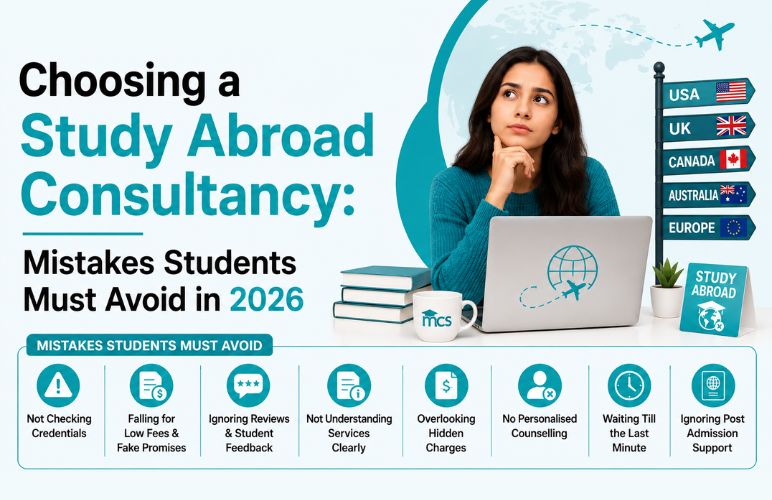
Study Abroad Consultant Mistakes to Avoid

Choosing a Study Abroad Consultancy: Mistakes Students Must Avoid in 2026

Hasan Raja
Posted by Hasan Raja | Updated on May 16, 2026
Study Abroad Consultant Mistakes to Avoid Choosing a study abroad consultancy is one of the most important decisions a student makes before applying to universities abroad. The best study abroad consultancy does not simply “send students overseas”; it helps them choose the right country, university, course, budget, scholarship options, visa pathway, and long-term career direction. In 2026, students must be extra careful because visa rules, post-study work options, financial requirements, and university compliance checks are stricter than before.

Many students and parents start their study abroad journey with excitement: Which country is best? Which university will accept me? Can I get a scholarship? Will I get a visa? Can I work after graduation? These are valid questions. But the quality of answers depends heavily on the consultant you choose.

A good consultant can save you time, money, and stress. A poor consultant can push you toward the wrong course, an unsuitable country, a low-quality institution, or even a risky visa application. That is why students must understand the most common study abroad consultant mistakes to avoid before paying any counselling fee or signing any agreement.

This guide covers the following steps:

Why Choosing the Right Study Abroad Consultancy Matters

Studying abroad is no longer just about getting admission. It is a complete decision involving academics, finances, employability, immigration rules, family planning, and long-term career outcomes.

In 2026, countries such as Canada, the UK, Australia, and the US continue to attract international students, but the application environment has become more regulated. Canada has introduced international student caps and provincial/territorial allocation systems for study permit applications. For 2026, IRCC states that 309,670 study permit application spaces are available under the cap for PAL/TAL-required students. Australia continues to assess student visa applicants under the Genuine Student requirement, which applies to applications lodged on or after 23 March 2024. The UK also has specific rules around dependants, especially for postgraduate students, government-sponsored students, and course eligibility.

This means students cannot rely only on generic advice such as “Canada is best,” “UK visa is easy,” or “Australia has high PR chances.” Such statements are incomplete and sometimes misleading.

The right study abroad consultant should help you answer questions such as:
  1. What course matches my academic profile and career goals?
  2. Which countries are realistic for my budget and background?
  3. Which universities have strong outcomes in my field?
  4. What are the visa risks in my case?
  5. What documents do I need to prepare carefully?
  6. What happens after graduation?
  7. What are the real costs, not just tuition fees?
  8. Is the consultant giving unbiased advice or pushing a partner institution?
A strong consultancy works like a strategic advisor. It should not force a student into a ready-made list of universities. Instead, it should understand the student’s academic record, English test score, entrance test plan, financial background, career intention, family situation, preferred country, and risk tolerance.

Common Mistakes Students Make While Selecting a Consultancy

Mistake 1: Choosing a Consultancy Only Because It Is Popular

Many students assume that the biggest or most visible consultancy is automatically the best study abroad consultancy. Popularity may indicate reach, but it does not always indicate personalized counselling quality.

A large consultancy may have strong university partnerships, but students should still check whether they will receive individual profile evaluation, university shortlisting support, SOP guidance, visa documentation help, and post-offer support.

A good question to ask is: Will I get a dedicated counsellor who understands my academic and career goals, or will I be passed from one executive to another?

Mistake 2: Trusting Guaranteed Visa Claims

No genuine consultant can guarantee a student visa. Visa decisions are made by official immigration authorities, not by consultants.

A consultant may improve your application quality by helping with documentation, financial clarity, statement preparation, and interview readiness. But if someone says, “Pay us and your visa is 100% guaranteed,” it is a warning sign.

In 2026, visa officers are paying closer attention to genuine study intent, financial capability, course relevance, immigration compliance, and future plans. Australia’s Genuine Student requirement, for example, asks whether the applicant is a genuine student and whether studying is the primary reason for entering Australia.

Mistake 3: Not Checking Whether the Consultant Is Trained or Certified

Students often forget to check whether the counsellor has professional training. For UK-bound students, the British Council states that agents and counsellors supporting students should have completed UK-certified counsellor training and committed to ethical practice. The British Council also maintains a database of UK knowledge-trained counsellors.

Similarly, ICEF offers agent training and ethical standards for international student recruitment. The ICEF Agent Training Course covers areas such as ethics, student client management, destination countries, education systems, regulatory systems, and legal requirements.

Certification alone does not guarantee perfect service, but it is a useful credibility signal.

Mistake 4: Selecting a Consultant Based Only on “Free Counselling”

Free counselling is common in the study abroad industry because many consultants receive commissions from partner universities. This is not automatically wrong. However, students must understand whether the consultant is recommending a university because it is genuinely suitable or because the consultancy has a commercial tie-up.

A student should ask: Are you recommending this university because it matches my profile, or because it is your partner institution?

The best consultancies maintain transparency. They explain which services are free, which are paid, and whether they receive commission from universities.

Mistake 5: Applying to Universities Without Understanding Course ROI

Many students focus only on country and university name. They do not evaluate the return on investment of the course.

A course with high tuition but weak employability outcomes can become a financial burden. Students should compare:
  1. Tuition fees
  2. Living costs
  3. Scholarship possibilities
  4. Internship options
  5. Graduate employability
  6. Post-study work rules
  7. Industry demand
  8. Location advantage
  9. Alumni outcomes
  10. Course accreditation
  11. Long-term career relevance
In 2026, this is especially important because students and parents are more sensitive to visa uncertainty, employability, and post-study return on investment. ICEF Monitor reported in May 2026 that visa concerns are influencing international student decision-making earlier than before.

Mistake 6: Ignoring Visa Rule Updates

One of the biggest study abroad consultant mistakes to avoid is choosing someone who is not updated with current immigration rules.

Visa policies can change quickly. Canada has caps and PAL/TAL-related requirements for many students. The UK has specific dependant eligibility conditions for student visa holders. Australia replaced the older GTE approach with the Genuine Student requirement for student visa applications lodged from 23 March 2024 onward.

A consultant who gives outdated advice can damage your application. Before hiring, ask the consultant: What are the latest 2026 updates for my target country?

Mistake 7: Believing Every University Tie-Up Is Good

Some consultancies promote universities where admission is easy, not necessarily where outcomes are strong. A student may receive quick admission, but the course may not match their long-term goals.

Students should check whether the institution is accredited, recognized, financially stable, and suitable for their field. For Canada, students should verify whether the institution is a Designated Learning Institution because a study permit is issued for study at DLIs. For the US, students can use EducationUSA, a US Department of State network that provides accurate, comprehensive, and current information about accredited US higher education opportunities.

Mistake 8: Not Reading the Service Agreement

Before paying, students should read the consultancy agreement carefully. Many disputes happen because students do not understand refund rules, service scope, application limits, document support, or responsibility boundaries.

Check whether the agreement clearly mentions:
  1. Counselling services included
  2. University shortlisting support
  3. Number of applications
  4. SOP/LOR support
  5. Scholarship assistance
  6. Visa guidance
  7. Refund policy
  8. Timeline
  9. Payment terms
  10. Extra charges
  11. Ownership of student login credentials
  12. Data privacy terms
Never pay only based on verbal promises.

Mistake 9: Sharing Original Documents Too Early

Students should be careful while sharing passports, academic documents, financial statements, and login credentials. A reliable consultancy should explain why each document is needed and how it will be used.

Avoid giving full control of your email, university portal, or visa portal without understanding the process. You should always have access to your own application accounts.

Mistake 10: Not Checking Reviews Properly

Reviews can help, but students must read them intelligently. A consultancy may have many positive reviews, but you should check whether reviews mention specific outcomes: admission support, visa support, SOP quality, responsiveness, transparency, refund behaviour, and post-admission help.

Do not rely only on star ratings. Read negative reviews too. Look for patterns such as “poor communication after payment,” “wrong guidance,” “hidden charges,” or “fake promises.”

How to Check the Credibility of a Study Abroad Consultant

Checking credibility is not about doubting everyone. It is about protecting your future.

1. Check Training and Certifications

Ask whether the counsellor has completed destination-specific training. For the UK, check British Council training or database recognition. For broader international recruitment, ICEF-trained counsellor credentials can be a useful sign because ICEF training covers ethics, student care, education systems, and regulatory requirements.

2. Verify University Partnerships

A consultant may claim to represent hundreds of universities. Ask for proof. Many universities list official representatives or agents on their websites. If a consultant says they are an official representative, verify it from the university.

3. Ask for Transparent Counselling Logic

A credible consultant should explain why a university is being recommended. The explanation should include academic fit, course fit, budget fit, career fit, visa fit, and location fit.

Weak counselling sounds like this:
“This university is best. Apply now.”

Strong counselling sounds like this:
“Based on your marks, IELTS score, budget, work experience, and career goal, these universities are realistic, these are ambitious, and these are safe options. Here are the risks and advantages of each.”

4. Check Their Knowledge of Visa Requirements

Ask specific questions. For example:
  1. What is the latest student visa rule for my target country?
  2. What are the common refusal reasons?
  3. What financial documents are required?
  4. How do I prove genuine study intent?
  5. How should I explain a study gap?
  6. How does course relevance affect visa success?
A credible consultant will answer carefully and avoid fake guarantees.

5. Review Their SOP and Application Quality

Many consultancies use generic SOP templates. This is risky. A strong SOP should reflect the student’s background, academic journey, course motivation, career goal, and country choice.

Ask whether they provide customized SOP support or simply fill templates.

6. Check Communication Quality

Before payment, observe how the consultant communicates. Are they patient? Do they answer questions clearly? Do they explain risks honestly? Do they push you to pay immediately? Do they give written information?

Good communication before payment usually indicates better support after payment.

7. Check Whether They Discuss Alternatives

A reliable consultant does not force one country or one university. They should compare options. For example, if Canada is risky due to cap, budget, or course mismatch, they should explain alternatives such as the UK, Australia, Ireland, Germany, New Zealand, or the US depending on the student profile.

US Admission

Questions Students Should Ask Before Hiring a Consultancy

Before selecting a study abroad consultancy, students should ask direct and practical questions.

Profile Evaluation Questions
What countries are suitable for my academic profile?
Which courses match my long-term career goals?
Am I eligible for top universities in my field?
What are my ambitious, moderate, and safe university options?
Should I improve my IELTS, TOEFL, PTE, SAT, GRE, or GMAT score before applying?

University Shortlisting Questions
Why are you recommending these universities?
Are these universities your official partners?
Can I apply to non-partner universities through you?
What is the ranking, accreditation, and employability record of these universities?
What are the total costs, including tuition, living expenses, insurance, deposits, and visa fees?

Scholarship Questions
Which scholarships am I eligible for?
Are scholarships automatic or application-based?
What profile improves scholarship chances?
Can I get scholarship support for essays or documents?

Visa Questions
What are the latest 2026 visa updates for my target country?
What are common visa refusal reasons for students like me?
How will you help me prepare financial documents?
Will you help me prepare for visa interviews, if required?
Can you guarantee a visa?
A reliable consultant should say no to the last question.

Fee and Agreement Questions
What is your counselling fee?
Which services are included?
Are there hidden charges?
What is your refund policy?
Do you receive commission from universities?
Will I get written confirmation of services?

Post-Admission Questions
Will you help with offer acceptance?
Will you guide me on education loans?
Will you help with accommodation?
Will you guide me after visa approval?
Will you help with pre-departure preparation?

Warning Signs of Fake or Unreliable Abroad Consultants

Choosing the wrong consultant can lead to financial loss, wrong admission decisions, and visa complications. Here are major warning signs.

1. 100% Visa Guarantee
This is the biggest red flag. No consultant controls embassy or immigration decisions.

2. Pressure to Pay Immediately
Statements like “Pay today or your chance is gone” should make you cautious. Deadlines are real, but pressure tactics are not professional.

3. No Written Agreement
If the consultant avoids written terms, refund policies, or service details, do not proceed.

4. Fake University Claims
Some unreliable agents promote low-quality or unrecognized institutions. Always verify the university from official sources.

5. No Clear Counsellor Assigned
If no one is responsible for your case, your application may suffer.

6. Generic SOP and LOR Templates
A weak SOP can make your profile look artificial. It can also create visa problems if your goals are unclear.

7. Hidden Charges
Be careful if the consultant gives one fee initially and later adds charges for SOP, visa file, courier, application support, or appointment booking.

8. Poor Knowledge of 2026 Rules
If a consultant is unaware of Canada’s study permit cap, Australia’s Genuine Student requirement, UK dependant conditions, or US accredited institution checks, they may not be fit to guide you.

9. Asking Students to Misrepresent Facts
Never work with a consultant who suggests fake documents, false work experience, wrong financial records, or misleading statements. Immigration systems take misrepresentation seriously.

10. No Data Privacy Practices
Your academic records, passport, financial documents, and family information are sensitive. A consultant should handle them responsibly.

Check Out Our Google Reviews

How the Best Study Abroad Consultancy Supports Students

The best study abroad consultancy provides end-to-end, ethical, and personalized support.

1. Career-Based Counselling
Good counselling starts with career clarity. The consultant should understand what you want after graduation: job, research, immigration pathway, entrepreneurship, academic growth, or return to India with international exposure.

2. Country Selection Based on Reality
A good consultant does not say one country is best for everyone. Canada may suit one student, while the UK may suit another. Australia may work for students with strong genuine study intent and relevant documentation. The US may be best for students seeking research depth, flexibility, and wide university choice. Europe may be suitable for students focused on affordability and specialized programs.

3. University Shortlisting
A strong shortlist should include:
  1. Ambitious universities
  2. Moderate universities
  3. Safe universities
  4. Budget-friendly options
  5. Scholarship-friendly options
  6. Career-aligned options
The consultant should explain each category clearly.

4. Test Preparation Guidance
For many students, admission quality improves with stronger test scores. Depending on destination and program, students may need IELTS, TOEFL, PTE, Duolingo English Test, SAT, ACT, GRE, GMAT, AP, or other exams.
A good consultancy should not rush weak profiles into applications. It should advise whether improving a score can help with better universities, scholarships, or visa confidence.

5. SOP, LOR, and Resume Support
A strong application is not only about marks. It also includes narrative quality. The consultant should help students present their academic background, achievements, career goals, motivation, and course fit clearly.

6. Scholarship and Financial Planning
The best consultants help students estimate the total cost of education, not just tuition. This includes accommodation, food, insurance, visa costs, travel, deposits, books, and emergency funds.

7. Visa Documentation Support
Visa support should be ethical and evidence-based. The consultant should guide students on financial documents, academic documents, explanation letters, study gaps, previous refusals, and interview preparation where applicable.

8. Pre-Departure Guidance
A complete consultancy also supports students after visa approval. This includes accommodation guidance, travel checklist, forex, health insurance, arrival planning, cultural orientation, part-time work rules, and academic expectations.

Tips to Choose the Right Consultancy for Your Career Goals

Tip 1: Start With Your Goal, Not the Country
Do not begin with “I want Canada” or “I want UK” only because friends are going there. Start with your career goal. Then choose the country, university, and course accordingly.

Tip 2: Compare at Least Three Consultants
Before paying, speak to multiple consultancies. Compare their knowledge, transparency, university options, pricing, communication, and honesty.

Tip 3: Ask for a Written Roadmap
A good consultant should be able to give you a clear process:
  1. Profile evaluation
  2. Country selection
  3. University shortlisting
  4. Test planning
  5. Application timeline
  6. Document checklist
  7. Scholarship plan
  8. Visa preparation
  9. Pre-departure support

Tip 4: Check Whether Advice Is Personalized
If the consultant gives the same university list to every student, avoid them. Your profile is unique.

Tip 5: Verify Everything
Use official sources. For the US, EducationUSA provides accurate and current information about accredited US higher education opportunities. For Canada, check IRCC guidance on study permits and DLIs. For the UK, check official GOV.UK visa information. For Australia, check the Department of Home Affairs student visa and Genuine Student guidance.

Tip 6: Understand the Commercial Model
Ask whether the consultant charges the student, receives university commission, or both. Transparency is essential.

Tip 7: Do Not Chase Only Easy Admission
Easy admission is not always the best admission. Choose a course and university that support employability, learning, and future growth.

Tip 8: Keep Control of Your Application
Your consultant can guide you, but you should know where you are applying, what documents are submitted, what your SOP says, what the deadlines are, and what your visa file contains.

2026 Study Abroad Consultancy Checklist for Students

Before finalizing a consultant, use this checklist:
  1. The consultant explains current 2026 rules.
  2. The consultant does not guarantee visas.
  3. The consultant provides written service details.
  4. The consultant explains total cost clearly.
  5. The consultant discusses course ROI.
  6. The consultant verifies university suitability.
  7. The consultant supports non-partner options if needed.
  8. The consultant customizes SOP and documents.
  9. The consultant is transparent about fees and commissions.
  10. The consultant protects your data.
  11. The consultant explains risks honestly.
  12. The consultant supports you after admission.
  13. If a consultancy fails most of these points, reconsider your decision.

Conclusion

Choosing a study abroad consultancy is not a small decision. It can shape your university admission, visa preparation, financial planning, and career direction. In 2026, students must be more careful because international education has become more competitive, more regulated, and more outcome-driven.

The best study abroad consultancy is not the one that gives the fastest admission. It is the one that gives honest advice, updated information, transparent pricing, ethical documentation support, realistic university options, and career-focused guidance.

Before hiring any consultant, ask questions, verify claims, read agreements, check credentials, and compare options. A reliable consultant will never fear your questions. In fact, the right consultant will welcome them because informed students make better decisions.

Final advice: Do not choose a consultancy only because it is popular, cheap, nearby, or aggressive in follow-ups. Choose the one that understands your future.

Hasan Raja
Hasan Raja

Hasan Raja is a multi-talented individual who has made significant contributions to various fields such as education, media, art, and commerce. He completed his both graduation and master's degree in English from Delhi University; During his studies, he also pursued a certification course in designing leather accessories. After completing his education, he worked as an adviser in product development, a journalist in a news agency, and a part-time faculty in the college.

Why Masterclass Space ?

Since its inception, Masterclass Space has been emerging as a powerhouse of quality
education globally. Driven by passion and purpose, we have touched lives of thousands of people around the world.

Frequently Asked Question (FAQ)

What is the most important factor while choosing a study abroad consultancy?

The most important factor is honest, personalized, and updated guidance. A good consultant should understand your academic profile, career goals, budget, country preference, and visa risk before recommending universities.

How do I know if a study abroad consultant is genuine?

Check certifications, reviews, written service terms, university partnerships, counsellor experience, and transparency. For UK counselling, students can check British Council-trained counsellor resources.

Can a study abroad consultant guarantee a visa?

No. A consultant cannot guarantee a visa because visa decisions are made by immigration authorities. A consultant can only help prepare a stronger and more complete application.

Should I choose a free study abroad consultancy?

Free counselling can be useful, but students must check whether advice is unbiased. Some free consultants may recommend only partner universities. Always ask whether the consultancy receives commission from institutions.

What are the biggest study abroad consultant mistakes to avoid?

The biggest mistakes include trusting guaranteed visa claims, not checking consultant credibility, ignoring hidden charges, applying to unsuitable universities, using generic SOPs, and not verifying visa updates.

What questions should I ask a study abroad consultant?

Ask about university shortlisting logic, total cost, scholarships, visa risks, service fees, refund policy, documentation support, counsellor experience, and whether they receive university commissions.

Is it better to apply directly or through a consultant?

Students with strong research skills can apply directly. However, a good consultant can help with country comparison, university shortlisting, SOP strategy, scholarship planning, visa documentation, and timeline management.

How can I avoid fake abroad consultants?

Avoid consultants who promise guaranteed visas, ask for fake documents, hide fees, pressure you to pay quickly, refuse written agreements, or recommend universities without explaining why.