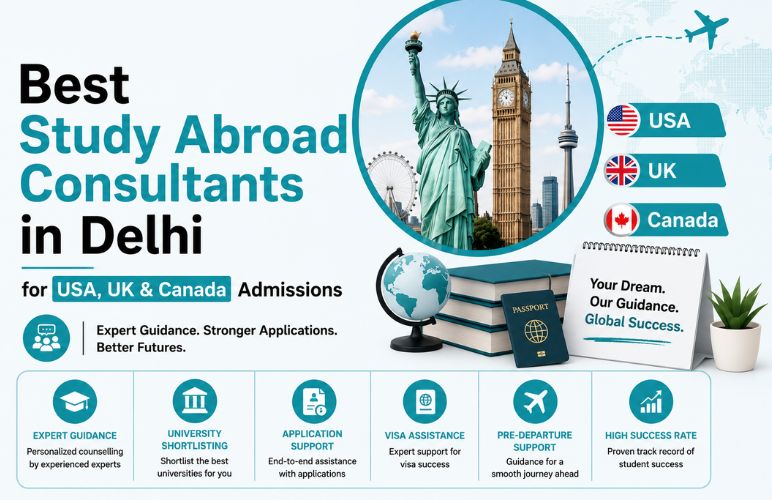
Best study abroad consultants in Delhi

Best Study Abroad Consultants in Delhi for USA, UK & Canada Admissions

Hasan Raja
Posted by Hasan Raja | Updated on May 20, 2026
Best study abroad consultants in Delhi

Why Studying Abroad Is a Smart Choice in 2026

For many Indian students and parents, studying abroad is no longer just a dream; it is a serious career investment. In 2026, countries like the USA, UK and Canada continue to attract Indian students because of their globally ranked universities, practical learning systems, research opportunities, international exposure and strong post-study career pathways.

But the study abroad journey has become more competitive than before. Universities are evaluating students more carefully. Visa rules are stricter. Financial documentation matters more. Application timelines are tighter. Scholarships are selective. Parents want clarity on return on investment, safety, employability and long-term immigration possibilities.

This is where the role of the best study abroad consultants in Delhi becomes important.

A good consultant does not simply “apply on your behalf.” The right consultant helps you choose the right country, shortlist realistic universities, build a strong profile, prepare documents, write impactful statements of purpose, plan finances, apply for scholarships, prepare for visas and avoid costly mistakes.

For students in Delhi, Noida, Gurugram, Faridabad and nearby regions, choosing the right guidance partner can make a major difference between a confused application and a well-planned international admission journey.

In this guide, you will learn how to choose the best study abroad consultants in Delhi, what services they offer, what documents you need, how admissions work for the USA, UK and Canada in 2026, and how students can improve their chances of admission to top universities.

This guide covers the following steps:

Why Students Need Study Abroad Consultants for International Admissions

Direct answer: Students need study abroad consultants because international admissions involve university selection, profile evaluation, SOPs, LORs, test planning, scholarships, visa documentation and financial proof. A good consultant helps students avoid mistakes and apply strategically.

Many students think study abroad admission is only about filling application forms. In reality, the process is much deeper.

A student applying to universities in India usually follows a relatively familiar path: entrance exam, application form, counselling and admission. But international admissions work differently. Every country, university and course may have different requirements.

For example, a student applying for a master’s in the USA may need GRE or GMAT depending on the program, TOEFL or IELTS, academic transcripts, statement of purpose, letters of recommendation, resume, financial documents and later an I-20 for the visa process. The U.S. Department of State notes that students need admission to a SEVP-approved school, SEVIS registration and Form I-20 before applying for an F or M student visa.

A student applying to the UK through UCAS may need to understand UCAS deadlines, personal statements and course-specific requirements. For 2026 entry, UCAS lists key application dates, including the opening of undergraduate applications and the main equal-consideration deadline.

For Canada, students must be careful about study permits, proof of funds, Designated Learning Institutions and, in many cases, Provincial Attestation Letters or Territorial Attestation Letters. IRCC states that a PAL/TAL is usually required for a study permit and is issued through the institution.

Because of these complexities, students often need professional support.

A good study abroad consultant helps with:
  1. Choosing the right country based on budget, course, career goal and visa pathway
  2. Shortlisting universities according to academic profile and admission chances
  3. Understanding application timelines for fall, spring or winter intakes
  4. Planning tests such as IELTS, TOEFL, PTE, Duolingo, SAT, GRE or GMAT
  5. Preparing SOPs, essays, resumes and recommendation strategy
  6. Reviewing financial documents for visa readiness
  7. Preparing students for visa interviews where applicable
  8. Guiding parents on cost, safety, accommodation and career outcomes
For parents, consultants also bring structure. Instead of relying on random YouTube videos, relatives, agents or outdated information, parents get a clear roadmap.

However, not every consultant is equally reliable. Some focus only on partner universities. Some push students toward countries or colleges that may not fit their profile. Some provide excellent admission help but weak visa guidance. That is why students must know how to evaluate consultants properly.

How to Choose the Best Study Abroad Consultants in Delhi

Direct answer: The best study abroad consultants in Delhi are transparent, country-specialized, admission-focused, ethical, experienced with USA, UK and Canada applications, and capable of guiding students through university shortlisting, documentation, SOPs, scholarships and visas.

Delhi has many overseas education consultants. You will find offices in areas like South Delhi, Connaught Place, Rajouri Garden, Laxmi Nagar, Pitampura, Janakpuri, Nehru Place and nearby NCR locations. But location alone should not decide your choice.

The right consultant should be selected based on expertise, transparency and student outcomes.

1. Check whether they understand your academic profile

A good consultant should first evaluate your profile before recommending universities.

They should ask questions such as:
  1. What is your academic percentage or CGPA?
  2. Which board or university are you from?
  3. Do you have backlogs?
  4. What course do you want to study?
  5. What is your budget?
  6. Which country are you targeting?
  7. Do you want post-study work options?
  8. Are you applying for undergraduate, master’s, MBA or diploma programs?
  9. Do you have IELTS, TOEFL, PTE, GRE, GMAT or SAT scores?
If a consultant recommends universities without understanding your profile, be careful.

2. Look for country-specific expertise

The phrase study abroad consultants in Delhi for USA UK Canada is important because these three destinations have different admission systems.

The USA is highly profile-driven and essay-driven. UK admissions are course-focused and often faster. Canada is heavily influenced by program relevance, financial documentation and study permit requirements.

A consultant who is strong in Canada may not automatically be strong in US admissions. Similarly, a UK-focused consultant may not be the best choice for Ivy League, M7 MBA or top US STEM applications.

Ask them directly:
  1. How many students have you guided for USA admissions?
  2. Which UK universities have your students received offers from?
  3. How do you handle Canada study permit documentation?
  4. Do you help with scholarship applications?
  5. Do you help with SOP editing or only basic formatting?

3. Ask about university shortlisting methodology

The best study abroad consultants in Delhi should divide universities into categories:
  1. Ambitious universities: Difficult but possible with a strong profile
  2. Target universities: Realistic based on academic and test scores
  3. Safe universities: Higher admission probability
This balanced approach prevents students from applying only to dream universities or only to low-fit options.

For example, a student with 75% academics, IELTS 7.0 and a moderate budget should not apply randomly to only top 50 universities. A strong consultant will create a realistic list based on course fit, employability, tuition, location, scholarships and visa chances.

4. Check whether they offer genuine SOP and essay support

Your Statement of Purpose is not a formality. It is one of the most important documents in international admissions.

A weak SOP says:
“I want to study abroad because I want global exposure and a bright future.”

A strong SOP explains:
  1. Why this course?
  2. Why this university?
  3. Why this country?
  4. What is your academic background?
  5. What skills have you developed?
  6. What are your short-term and long-term goals?
  7. How does the program connect with your career plan?
  8. Why are you a suitable candidate?
For the USA, essays can be even more personal and strategic. For Canada, SOPs and study plans must also demonstrate academic progression and genuine intent. For the UK, the personal statement should show strong course motivation and academic fit.

5. Verify transparency in fees and services

Before paying any consultant, ask for a clear service list.

You should know whether their fee includes:
  1. Profile evaluation
  2. University shortlisting
  3. Application submission
  4. SOP editing
  5. LOR guidance
  6. Resume editing
  7. Scholarship guidance
  8. Visa documentation
  9. Visa interview preparation
  10. Accommodation support
  11. Pre-departure guidance
Avoid vague promises like “guaranteed admission” or “100% visa.” No ethical consultant can guarantee a visa because final decisions are made by universities and immigration authorities.

6. Read reviews carefully

Reviews can help, but do not rely only on star ratings. Look for detailed student stories.

Strong reviews usually mention:
  1. Course and country
  2. University admits
  3. Scholarship support
  4. Visa experience
  5. Counselor responsiveness
  6. Document quality
  7. Honesty in guidance
Also ask the consultant for real case studies. Serious consultants should be able to explain examples of students they helped, without exposing private student data.

7. Check whether they guide parents too

For Indian families, study abroad is a family decision. Parents usually want answers to practical questions:
  1. What is the total cost?
  2. Is the country safe?
  3. Can the student work part-time?
  4. What is the job market?
  5. What happens after graduation?
  6. Can the student get a post-study work visa?
  7. What are the risks?
The best overseas education consultants in Delhi should be able to explain these points clearly, not emotionally pressure families.

Services Offered by Overseas Education Consultants

Direct answer: Overseas education consultants in Delhi typically offer profile evaluation, country selection, university shortlisting, test guidance, application support, SOP/LOR/resume help, scholarship guidance, visa documentation, financial planning, accommodation support and pre-departure briefing.

A professional study abroad consultant should offer end-to-end support, but the quality of each service matters.

1. Profile Evaluation

This is the starting point.

The counselor evaluates:
  1. Academic records
  2. Test scores
  3. Work experience
  4. Internships
  5. Projects
  6. Extracurricular achievements
  7. Career goals
  8. Budget
  9. Preferred countries
  10. Admission gaps or weaknesses
For example, a student with average academics but strong projects may still have good chances in applied programs. A student with high academics but no clarity of goals may need better SOP positioning.

2. Country and Course Selection

Many students begin with a country in mind, but sometimes the best country depends on the course.

For instance:
  1. USA may be excellent for STEM, business analytics, computer science, engineering, finance and research-heavy programs.
  2. UK may be attractive for one-year master’s, law, management, public policy, finance and creative fields.
  3. Canada may be suitable for students seeking practical education, co-op programs, affordability and long-term settlement possibilities.
A consultant should not force the same country on every student.

3. University Shortlisting

University shortlisting should consider:
  1. Course curriculum
  2. Ranking and reputation
  3. Faculty and research
  4. Tuition fees
  5. Scholarships
  6. Location
  7. Internship opportunities
  8. Graduate employability
  9. Admission requirements
  10. Visa risk
  11. Return on investment
The best study abroad consultants in Delhi should create a personalized university list instead of using a common list for everyone.

4. Test Planning

Depending on the country and course, students may need:
  1. IELTS
  2. TOEFL
  3. PTE
  4. Duolingo English Test
  5. SAT
  6. ACT
  7. GRE
  8. GMAT
Many universities are test-optional for certain programs, but “test-optional” does not always mean “test-irrelevant.” A strong SAT, GRE or GMAT score can still improve admission chances or scholarship competitiveness.

5. SOP, Essays, LOR and Resume Support

This is where strong consulting makes a visible difference.

Consultants help students develop:
  1. Statement of Purpose
  2. Personal statement
  3. Common App essays
  4. University-specific essays
  5. Letters of Recommendation strategy
  6. Academic resume or CV
  7. Scholarship essays
  8. Gap explanation letters
Documents must sound authentic. Universities can easily detect generic or AI-generated writing. The best approach is to use the student’s real experiences, achievements and goals in a structured and polished way.

6. Application Submission

A consultant helps students avoid technical errors while submitting applications.

Common application tasks include:
  1. Creating university portal accounts
  2. Uploading documents
  3. Filling academic history
  4. Entering test scores
  5. Paying application fees
  6. Tracking deadlines
  7. Responding to university emails
  8. Submitting additional documents
Missing a small requirement can delay or weaken an application.

7. Scholarship Guidance

Scholarships may be merit-based, need-based, country-specific, university-specific or course-specific.

A consultant can help identify:
  1. Automatic scholarships
  2. Separate scholarship applications
  3. Early deadline scholarships
  4. Assistantships
  5. Departmental awards
  6. External funding options
Students should remember that scholarships are competitive. Strong academics, test scores, essays and early applications improve chances.

8. Visa Guidance

Visa guidance is one of the most important services.

For the USA, students usually need Form I-20, SEVIS fee payment, DS-160, visa appointment and interview preparation. Students must present Form I-20 at the visa interview.

For the UK, students need a Confirmation of Acceptance for Studies, financial proof and student visa application. The UK government states that students applying from outside the UK can apply up to six months before the course starts, and the current student visa application fee is £558.

For Canada, students need a study permit application, proof of funds and, where required, PAL/TAL. IRCC also recommends a letter of explanation to explain why the student wants to study in Canada and understands their responsibilities.

9. Financial Planning

Study abroad planning is not complete without cost clarity.

Students and parents should calculate:
  1. Tuition fees
  2. Living expenses
  3. Health insurance
  4. Visa fees
  5. Travel cost
  6. Application fees
  7. Test fees
  8. Accommodation deposit
  9. Emergency fund
  10. Currency fluctuation buffer
Financial planning is especially important for visa approval because countries require proof that students can support themselves.

10. Pre-Departure Support

Good consultants also help after admission and visa approval.

Pre-departure support may include:
  1. Accommodation guidance
  2. Forex and banking tips
  3. Travel checklist
  4. Packing list
  5. Health insurance guidance
  6. Airport arrival advice
  7. Cultural adjustment tips
  8. Part-time work rules
  9. Academic expectations abroad
This helps students feel more confident before leaving India.

US Admission

Top Destinations for Students: USA, UK & Canada

Direct answer: The USA is best for research, technology, STEM, business and flexible education; the UK is strong for one-year master’s programs, global reputation and focused courses; Canada is popular for affordability, practical programs, co-op options and post-study pathways.

USA: Best for flexibility, research and global career opportunities
The USA remains one of the most popular destinations for Indian students because of its university ecosystem, academic flexibility and career opportunities.

Students choose the USA for:
  1. STEM programs
  2. Computer science and data science
  3. Engineering
  4. Business analytics
  5. MBA and management
  6. Finance
  7. Public policy
  8. Research programs
  9. Liberal arts
  10. High global university recognition
The U.S. application process usually requires early planning. EducationUSA advises students to begin the process around 12 to 18 months before departure.

For undergraduate applications, EducationUSA notes that U.S. deadlines commonly fall between November and January for students starting in the following September.

USA admission checklist for Indian students
  1. Academic transcripts
  2. Passport
  3. IELTS/TOEFL/Duolingo score
  4. SAT/ACT for undergraduate programs, where required
  5. GRE/GMAT for graduate programs, where required
  6. SOP or personal essays
  7. Letters of recommendation
  8. Resume
  9. Financial documents
  10. Application fee
  11. Portfolio for design, architecture or arts programs

USA visa considerations in 2026

Students should plan the visa stage early because appointment availability can vary. The U.S. Department of State says visa wait times are estimates and can change weekly depending on workload and staffing.

For Indian students, the F-1 visa process requires careful document preparation, confidence in the interview and clarity about academic intent, financial capacity and post-study plans.

UK: Best for focused degrees and shorter master’s programs

The UK is attractive for Indian students because of its globally respected universities, shorter degree duration and strong academic traditions.

Students choose the UK for:
  1. One-year master’s programs
  2. Business and management
  3. Finance
  4. Law
  5. Public policy
  6. International relations
  7. Data science
  8. Engineering
  9. Healthcare management
  10. Creative industries
The UK application system is relatively structured, especially for undergraduate programs through UCAS. For 2026 entry, UCAS lists January 14, 2026 as the equal consideration deadline for many undergraduate courses.

UK admission checklist
  1. Academic transcripts
  2. IELTS/TOEFL/PTE, if required
  3. Personal statement
  4. Academic references
  5. Resume for postgraduate courses
  6. Portfolio, where required
  7. Passport
  8. Work experience documents, if relevant

UK visa considerations in 2026

Students need to show enough money for tuition and living costs. The UK government lists living cost requirements of £1,529 per month for courses in London and £1,171 per month for courses outside London, for up to nine months.

The Graduate visa currently allows eligible students to stay in the UK after completing an eligible course; the official UK government page states it gives permission to stay for at least 18 months.

Canada: Best for practical education and long-term planning

Canada has been a popular destination for Indian students for many years because of its practical education system, multicultural society and post-study work options. However, Canada admissions and visas have become more documentation-sensitive in recent years.

Students choose Canada for:
  1. Diploma and postgraduate certificate programs
  2. Bachelor’s degrees
  3. Master’s programs
  4. Co-op education
  5. IT and computer science
  6. Business and management
  7. Healthcare-related programs
  8. Engineering technology
  9. Hospitality and supply chain
  10. Long-term settlement planning

Canada admission checklist
  1. Academic transcripts
  2. IELTS/PTE/TOEFL score
  3. Statement of Purpose or study plan
  4. Resume
  5. Letters of recommendation, where required
  6. Passport
  7. Financial documents
  8. Letter of acceptance
  9. PAL/TAL, where applicable
  10. Proof of tuition payment, if required

Canada study permit considerations in 2026

Canada has introduced tighter controls on international student numbers. IRCC says the international student cap limits the number of study permit applications accepted into processing each year.

IRCC also states that students must show proof of funds, and acceptable evidence may include proof of tuition and housing payment, a Canadian bank account, GIC, education loan or other official financial support documents.

This means Canada applicants must be extra careful about financial documents, course relevance and study intent.

Check Out Our Google Reviews

Documents Required for Study Abroad Applications

Direct answer: Common documents required for study abroad applications include academic transcripts, passport, SOP, LORs, resume, English test scores, entrance test scores, financial documents, certificates, work experience letters and country-specific visa documents.

Document requirements depend on the country, course and university. Still, most students should prepare the following:

Academic documents
  1. Class 10 marksheet
  2. Class 12 marksheet
  3. Bachelor’s marksheets
  4. Degree certificate
  5. Provisional certificate
  6. Backlog certificate, if applicable
  7. Medium of instruction certificate, if required
  8. Transcript from college or university

Test score documents
  1. IELTS scorecard
  2. TOEFL scorecard
  3. PTE scorecard
  4. Duolingo English Test score
  5. SAT or ACT score
  6. GRE score
  7. GMAT score

Application documents
  1. Statement of Purpose
  2. Personal statement
  3. University-specific essays
  4. Resume or CV
  5. Letters of Recommendation
  6. Portfolio, if required
  7. Research proposal for research programs
  8. Writing sample for some humanities or social science programs

Identity documents
  1. Valid passport
  2. Passport-size photographs
  3. Aadhaar or PAN for internal financial records, where needed
  4. Birth certificate, if required

Financial documents
  1. Bank statements
  2. Fixed deposit certificates
  3. Education loan sanction letter
  4. Income tax returns
  5. Salary slips of sponsor
  6. Sponsorship affidavit
  7. Scholarship letter
  8. Proof of tuition payment
  9. GIC for Canada, where applicable

Visa documents

For the USA:
  1. Form I-20
  2. DS-160 confirmation
  3. SEVIS fee receipt
  4. Visa appointment confirmation
  5. Academic documents
  6. Financial proof
  7. Passport

For the UK:
  1. CAS letter
  2. Financial proof
  3. Passport
  4. TB test certificate, if applicable
  5. Academic documents
  6. English language proof, if required

For Canada:
  1. Letter of acceptance
  2. PAL/TAL, where required
  3. Study permit application documents
  4. Proof of funds
  5. Letter of explanation
  6. Passport
  7. Medical exam, if required
  8. Biometrics
Students should keep scanned copies and physical copies of all important documents.

Common Mistakes Students Make While Applying Abroad

Direct answer: Common mistakes include applying late, choosing the wrong course, writing a generic SOP, ignoring visa requirements, weak financial documentation, relying only on rankings, missing deadlines and not preparing for interviews.

1. Applying too late

Many students start planning only 2–3 months before deadlines. This is risky. Strong applications require time.

For the USA, students should ideally begin 12–18 months before departure.

Late planning affects:
  1. Test preparation
  2. University shortlisting
  3. SOP quality
  4. Scholarship deadlines
  5. Visa appointment availability
  6. Financial documentation

2. Choosing a course only because friends are applying

This is one of the biggest mistakes.

A student from commerce may blindly choose business analytics because it is popular. A student from engineering may choose project management without understanding career outcomes. A student may choose a diploma in Canada without checking whether it matches previous education.

Course selection should match:
  1. Academic background
  2. Career goal
  3. Skill set
  4. Job market
  5. Visa logic
  6. Budget
  7. Long-term plans

3. Using a generic SOP

A generic SOP can damage an application.

Universities want clarity, not emotional clichés. Your SOP should explain your academic journey, motivation, skills, achievements and future goals.

Avoid lines like:
  1. “Since childhood, I wanted to study abroad.”
  2. “Your university is world famous.”
  3. “I want global exposure.”
  4. “I am hardworking and passionate.”
Instead, use specific examples from projects, internships, academic interests and career goals.

4. Ignoring financial planning

Parents often calculate only tuition fees. But total cost includes living expenses, insurance, travel, visa fees, deposits and emergency funds.

Weak financial documentation can also create visa problems.

5. Selecting universities only by ranking

Rankings are useful, but they are not everything.

Students should also check:
  1. Course structure
  2. Internship options
  3. Faculty
  4. Location
  5. Tuition
  6. Industry links
  7. Alumni outcomes
  8. Scholarship opportunities
  9. Class size
  10. Visa and employment outcomes
A lower-ranked university with a strong course and better scholarship may be a smarter choice than a higher-ranked university with poor fit.

6. Missing scholarship deadlines

Many scholarships have earlier deadlines than normal admission deadlines. Students who apply late often miss funding opportunities.

7. Not preparing for visa interviews

For the USA especially, visa interview preparation is important. Students should be able to clearly answer:
  1. Why this university?
  2. Why this course?
  3. Who is funding your education?
  4. What are your future plans?
  5. Why not study the same course in India?
  6. How does this program fit your background?

8. Trusting unrealistic promises

Be careful if someone promises:
  1. 100% visa guarantee
  2. Guaranteed scholarship
  3. Admission without documents
  4. Fake financial documents
  5. Backdoor admission
  6. “No need to show funds”
These shortcuts can create serious long-term problems.

Tips to Increase Your Chances of Admission to Top Universities

Direct answer: To increase your chances of admission, start early, choose the right course, build a strong profile, write a specific SOP, get strong recommendations, prepare for tests, apply before deadlines and align your goals clearly with the program.

1. Start early

Early planning gives you more options. Ideally:
  1. Start 12–18 months before intake for USA
  2. Start 9–12 months before intake for UK
  3. Start 8–12 months before intake for Canada
This allows enough time for tests, documents, applications and visas.

2. Build a strong academic and professional profile

Universities look for more than marks.

You can strengthen your profile with:
  1. Internships
  2. Research projects
  3. Online certifications
  4. Leadership roles
  5. Volunteering
  6. Competitions
  7. Portfolio work
  8. Relevant work experience
  9. Strong final-year projects
For example, a student applying for data science should show Python, statistics, machine learning projects or analytics internships. A student applying for finance should show financial modelling, investment analysis, accounting knowledge or internships.

3. Choose the right test strategy

Do not take IELTS, TOEFL, GRE, GMAT or SAT casually. A strong score can improve both admission and scholarship chances.

For English tests, aim higher than the minimum. If a university asks for IELTS 6.5, a 7.0 or 7.5 may still strengthen your profile.

For competitive business or STEM programs, GRE or GMAT can help even when optional.

4. Write a course-specific SOP

Your SOP should be written for the exact program.

Mention:
  1. Why the course matters to you
  2. Which modules attract you
  3. Which skills you want to build
  4. Which faculty, labs or learning opportunities are relevant
  5. How the program connects to your career goal
Avoid copying the same SOP for every university.

5. Get strong Letters of Recommendation

A good LOR should include specific examples.

Instead of saying:
“The student is hardworking.”

A strong LOR says:
“The student led a market research project, analyzed primary data from 120 respondents and presented insights that improved the team’s final recommendation.”

Specific details create credibility.

6. Apply to a balanced university list

A smart list includes ambitious, target and safe universities. This improves your chances while keeping dreams alive.

7. Apply early for scholarships

Many scholarships are limited. Early applicants often have better opportunities.

8. Prepare for visa from day one

Do not treat visa as the last step. Your course choice, financial documents and SOP should make sense from the beginning.

9. Keep communication professional

Use a professional email ID. Reply to university emails on time. Keep documents organized. Track deadlines in a spreadsheet.

10. Work with the right guidance partner

The right consultant helps you avoid confusion and plan strategically. But remember: the consultant guides the process; the student’s profile, effort and honesty decide the outcome.

Short CTA: Need Help With USA, UK or Canada Admissions?

Planning to study abroad in 2026?

A structured consultation can help you understand your best-fit country, course, universities, scholarship options, application timeline and visa readiness. Whether you are targeting the USA, UK or Canada, expert guidance can save time, reduce mistakes and improve your admission strategy.

Book a study abroad profile evaluation and get a clear roadmap before you apply.

Conclusion

Studying abroad in 2026 can be one of the most important decisions of a student’s life. The right university can shape your career, confidence, global exposure and future opportunities. But the journey requires planning, clarity and careful execution.

For students and parents in Delhi, choosing the best study abroad consultants in Delhi can make the process smoother and more strategic. The right consultant will not simply send applications; they will help you understand your profile, choose the right country, prepare strong documents, apply on time, plan finances and approach the visa process confidently.

Whether your goal is the USA, UK or Canada, start early, stay informed and seek guidance that is honest, practical and student-focused. A well-planned application is always stronger than a rushed one.

Hasan Raja
Hasan Raja

Hasan Raja is a multi-talented individual who has made significant contributions to various fields such as education, media, art, and commerce. He completed his both graduation and master's degree in English from Delhi University; During his studies, he also pursued a certification course in designing leather accessories. After completing his education, he worked as an adviser in product development, a journalist in a news agency, and a part-time faculty in the college.

Why Masterclass Space ?

Since its inception, Masterclass Space has been emerging as a powerhouse of quality
education globally. Driven by passion and purpose, we have touched lives of thousands of people around the world.

Frequently Asked Question (FAQ)

Who are the best study abroad consultants in Delhi?

The best study abroad consultants in Delhi are those who offer transparent guidance, personalized university shortlisting, strong SOP support, visa documentation help and country-specific expertise for the USA, UK and Canada.

Why should I choose study abroad consultants in Delhi for USA UK Canada admissions?

You should choose experienced consultants because the USA, UK and Canada have different admission systems, documents, deadlines and visa requirements. A consultant helps you apply correctly and avoid costly mistakes.

What services do overseas education consultants in Delhi provide?

Overseas education consultants in Delhi usually provide profile evaluation, country selection, university shortlisting, SOP and LOR support, application filing, scholarship guidance, visa documentation, financial planning and pre-departure support.

When should I start my study abroad application for 2026?

For USA admissions, start 12–18 months before your intake. For UK and Canada admissions, starting 8–12 months early is usually advisable, especially if you need tests, scholarships or visa preparation.

Which country is best for Indian students: USA, UK or Canada?

The USA is best for flexibility, research and STEM opportunities. The UK is good for shorter master’s degrees and globally recognized universities. Canada is popular for practical programs, affordability and long-term settlement planning.

Do study abroad consultants help with scholarships?

Yes, many consultants help students identify scholarship options, prepare scholarship essays and apply before deadlines. However, scholarships are competitive and depend on academic profile, test scores, achievements and application quality.

Can a consultant guarantee admission or visa approval?

No ethical consultant can guarantee admission or visa approval. Universities and immigration authorities make the final decision. A good consultant can improve your application quality and reduce errors, but cannot promise guaranteed outcomes.

What documents are required to study abroad?

Common documents include academic transcripts, passport, SOP, LORs, resume, English test scores, entrance test scores, financial documents, application forms and country-specific visa documents such as I-20 for the USA, CAS for the UK and study permit documents for Canada.