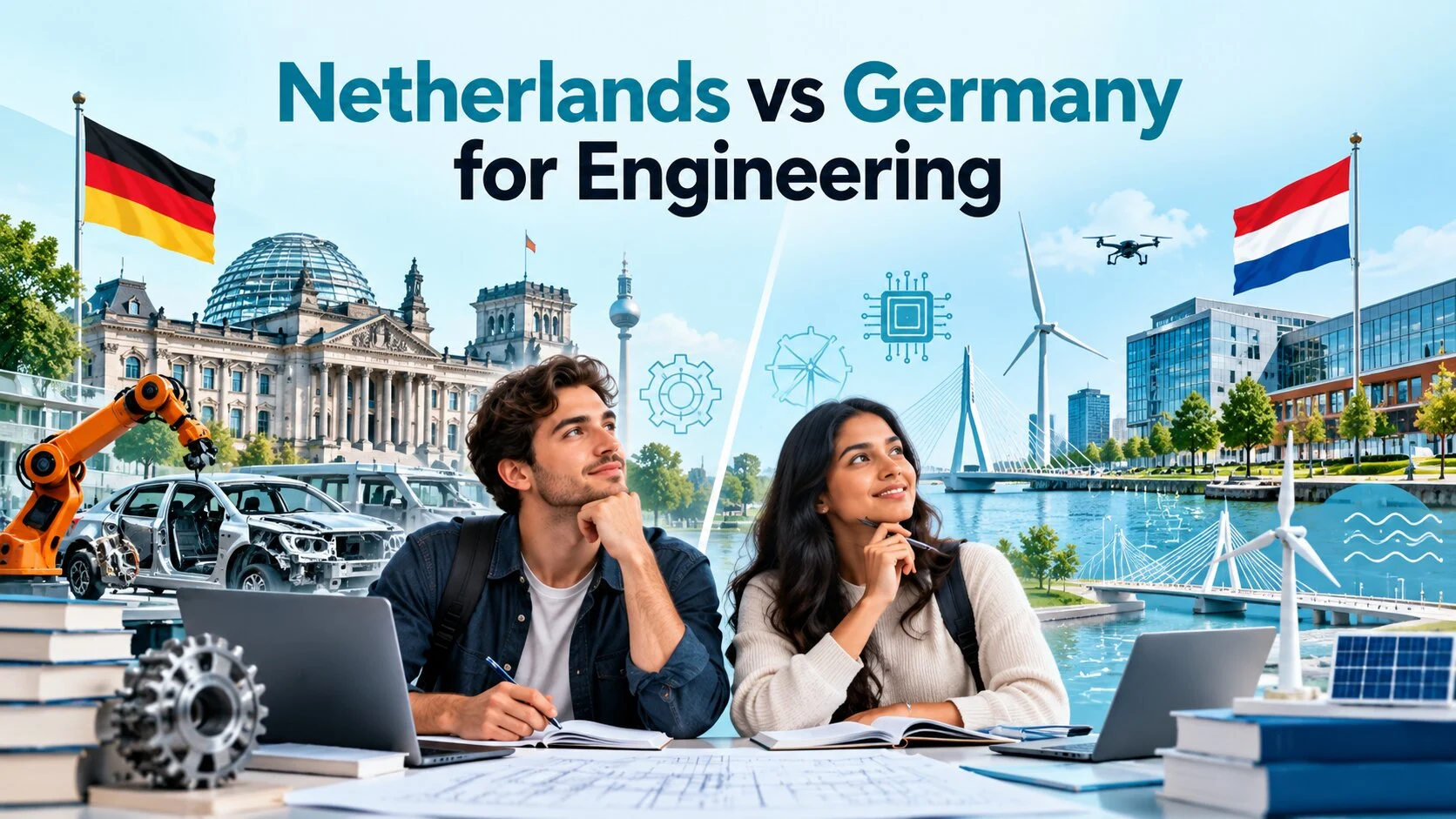
If you have your heart set on studying engineering and you are torn
between the Netherlands and Germany, you are asking exactly the right
question. These are two of the best places in the world to become an
engineer, so the honest truth is that you cannot really go wrong. The
good news is that the two countries are strong in different ways, which
means the best one is not the same for everyone. It is simply the one
that fits you.
Perhaps your parents prefer Germany because they have heard that
education is free, while you are looking at an English-taught course in
the Netherlands. Both views leave out details that could change your
decision. Some German universities charge substantial fees, and an
English-taught Dutch degree does not remove every language barrier when
you start looking for work.
This comparison is for Indian students considering a bachelor’s or
master’s degree. It explains how university type, specialisation,
housing and application requirements affect the choice, so you can build
a shortlist that works for your circumstances.
Germany and the
Netherlands at a glance
| What to compare | Germany | Netherlands |
|---|---|---|
| Tuition for Indian students | Many public programmes have no standard tuition, but university and state exceptions matter | Non-EU fees are generally higher and vary by course and degree level |
| Language | English-taught options exist; German matters for many bachelor’s courses and jobs | English-taught options exist at both levels; check each programme and intake |
| Learning format | Research universities and universities of applied sciences offer different approaches | Research universities and universities of applied sciences offer different approaches |
| Fields to explore | Mechanical, automotive, production, electrical and energy engineering | Semiconductors, precision systems, aerospace, civil and water engineering |
| Work during study | Generally 140 full or 280 half-days a year; alternative weekly rules apply | For employees, employer work permit required; choose 16 hours weekly or full-time in June, July and August |
| After graduation | Eligible graduates can apply for up to 18 months to find qualified work | Eligible graduates can apply for a one-year orientation permit |
| Housing | Compare actual rents and availability in the university’s city | Serious shortage; arrange suitable accommodation before travelling |
The work rules above concern students from outside the EU/EEA on the
relevant study residence permits. The official rules and their
conditions are linked in the sections below.
Choose the
university type before comparing rankings
A common mistake is to assume that Germany means theory and the
Netherlands means practical learning. Both countries have research
universities and universities of applied sciences. The type of
institution often tells you more about your classroom experience than
the country does.
Research
universities and applied universities in Germany
Technical universities and other research universities generally put
more emphasis on scientific foundations, mathematical analysis and
independent research. They are worth considering if you enjoy the
reasoning behind engineering problems or want to pursue research
later.
Universities of applied sciences, often called HAW or FH, focus more
on professional practice. Their courses commonly include practical
projects, labs and contact with employers. If you prefer learning
through design tasks, testing and workplace experience, include these
institutions in your shortlist. DAAD’s explanation of German
university types is useful when comparing the options.
Dual-study programmes combine academic study with structured company
experience. Check the employer arrangement and language requirements
carefully before treating this as an alternative to a regular
degree.
Research
universities and applied universities in the Netherlands
Dutch research universities, known as WO institutions, offer
academically focused degrees. TU Delft, Eindhoven University of
Technology and the University of Twente belong to this category. Their
engineering courses can involve substantial theory alongside projects
and research.
Dutch universities of applied sciences, known as HBO institutions,
focus on professional skills and practical application. A bachelor’s
degree at a research university generally takes three years, while an
applied-sciences bachelor’s generally takes four. That extra year
affects your total budget. The official descriptions of research
universities and universities
of applied sciences explain these routes.
Before deciding, compare compulsory modules, assessment methods,
internship requirements and progression to a master’s degree. A familiar
course title can cover quite different material at two institutions.
Match
your engineering interests to universities and regions
If you are still choosing a branch, think about the problems you
enjoy solving. Designing a vehicle, improving a production line and
developing a chip involve different subjects and skills. Use the
examples below as starting points for research, rather than a ranking or
a promise of admission.
| Your interest | German options to investigate | Dutch options to investigate |
|---|---|---|
| Mechanical and production engineering | RWTH Aachen, TUM and relevant HAW/FH programmes | TU/e and Twente for mechanical engineering and high-tech systems |
| Electrical engineering and semiconductors | TUM and KIT; compare electronics and device-related modules | TU/e for semiconductor technology, electronics and related specialisations |
| Aerospace | TUM and programmes connected with German aviation research | TU Delft for aerospace engineering |
| Civil and water engineering | Compare civil and environmental departments by specialisation | TU Delft and Twente for relevant civil and water programmes |
| Robotics and automation | RWTH Aachen, TUM and applied engineering programmes | TU/e and Twente; check the balance of mechanics, electronics and software |
For example, TU/e’s Semiconductor
Devices and Technology track sits within electrical engineering.
It is a more useful starting point for a student interested in chip
technology than a general university ranking. TU Delft’s aerospace
master’s information gives a different picture, centred on
aerospace study and a final research project.
Location also affects the employers you can approach. Eindhoven’s
Brainport region is relevant to semiconductor equipment and precision
engineering. Aachen and the surrounding North Rhine-Westphalia region
are worth investigating for production and industrial research. Munich
and Stuttgart may interest students considering mobility and automotive
work, while Delft and Rotterdam provide a setting for civil, water and
maritime interests.
A nearby company does not guarantee an internship. Check whether the
department has company projects, an industrial thesis option or a
placement built into the course. Then look at current vacancies to see
which skills and languages employers actually request.
Compare the full cost of
the degree
Germany
usually has lower tuition but is not always free
Many German public universities charge no standard tuition for a
first degree or certain master’s programmes. Students still pay semester
contributions and living expenses. Private institutions,
continuing-education courses and some other programmes can charge
tuition.
Two exceptions deserve attention. Baden-Württemberg generally charges
many non-EU students €1,500 per semester, subject to exemptions. At TUM,
tuition for newly enrolling students from third countries is usually
€2,000 or €3,000 per semester for bachelor’s programmes and €4,000 or
€6,000 for master’s programmes, with programme-specific rules and
exemptions. Check TUM’s tuition
fees before putting it in the same budget category as a
tuition-free option.
DAAD’s study
cost guidance explains why the state, institution and programme
all matter. Even within Germany, your total cost can change considerably
between two offers.
Dutch fees
need to be checked at programme level
Study in NL gives broad average annual tuition ranges of €9,000 to
€20,000 for non-EU/EEA bachelor’s students and €12,000 to €30,000 for
master’s students. These are national planning ranges across subjects,
not engineering fee quotations or upper limits. Use the university’s fee
for your exact intake when making a decision. Indian applicants
generally need the non-EU rate, unless they qualify for an exception
under the Dutch tuition
fee rules.
Build a budget your family
can use
For each offer, add tuition, compulsory university charges, twelve
months of rent and everyday spending, insurance, travel, residence
paperwork and initial setup costs. Keep money available for a housing
deposit and unexpected expenses. Compare the full degree length as well
as the first year.
Use actual accommodation listings near the campus. A lower tuition
bill can lose some of its advantage if the only available room has a
high rent or a costly commute. Convert your budget into rupees with an
allowance for exchange-rate changes instead of relying on one fixed
conversion.
If you are considering international
scholarships for Indian students, check the eligible
institutions, award amount and deadline separately. Build your initial
budget around confirmed funds. A scholarship application or a hoped-for
student job is not money you can count on yet.
Housing should
influence your final choice
Start checking accommodation while you are applying. Ask whether the
university offers housing, how places are allocated and what happens if
you do not receive a room. Compare contract dates, deposits, utilities
and travel time to campus.
The Netherlands has a serious
student housing shortage. Do not plan to arrive and find a room
afterwards. An admission offer does not include accommodation unless the
university explicitly confirms it.
German university cities also differ in availability and cost. Check
current options for the specific campus rather than assuming every
smaller city will be cheap. If two courses suit you equally well, a
realistic housing option can reasonably decide between them.
Studying
in English and finding work are separate questions
You can find English-taught engineering programmes in both countries,
but availability depends on the degree level, subject and intake. Many
German bachelor’s programmes require German. English-taught options are
common at master’s level, but check the language of compulsory modules
and the university’s accepted language evidence.
The Netherlands can be a comfortable option for students looking for
an English-taught course. Still, verify the programme language rather
than relying on a university’s general international reputation.
For employment, local language skills widen your options. German can
matter in production facilities, smaller engineering firms and roles
involving safety instructions or customers. Dutch can help with local
employers and everyday student jobs. Start learning early if you hope to
work locally after graduation.
Part-time
jobs and internships for engineering students
Working while studying in
Germany
Under the official student
work rules in Germany, students from third countries can
generally work up to 140 full days or 280 half-days a year without
Federal Employment Agency approval. An alternative arrangement allows up
to 20 hours a week during the lecture period, with different treatment
during semester breaks. Check which provisions apply to your role and
residence status before accepting work.
A Werkstudent position is a working-student job, often related to
your degree. Engineering students might support CAD work, software
development, testing, simulation or production tasks. University
assistant positions are another possibility. These roles can give you
relevant experience, but availability depends on your skills, language
ability and timetable.
Working while
studying in the Netherlands
For paid employment on a Dutch student residence permit, your
employer generally needs a work permit called a TWV. You must choose
between working up to 16 hours a week and working full-time during June,
July and August. The IND
student permit conditions also distinguish employment from
internships that form part of your course.
Possible jobs include university support work, hospitality, retail
and technical support roles. An English-taught degree does not mean
every employer will hire students without Dutch or arrange a work
permit. Taking paid work can also affect your Dutch
health insurance obligations, so check before starting.
In either country, treat student income as help with expenses. You
need a funding plan that still works if finding a job takes several
months. For internships, ask the university who finds the placement,
whether it is compulsory and what happens if you cannot secure one on
time.
What Indian applicants
need to prepare
Applying to Germany
Begin with academic eligibility. An Indian Class XII certificate does
not automatically provide direct entry to every German bachelor’s
programme. Your route may involve a Studienkolleg, a preparatory course
followed by an assessment, or another recognised admission pathway.
APS India’s updated
undergraduate eligibility guidance applies from Winter Semester
2026/27. For the routes described in that notice, students need at least
70% overall in Class XII. The notice distinguishes the Studienkolleg
route from direct subject-restricted eligibility after one successful
academic year in a recognised bachelor’s programme. Meeting these
criteria does not guarantee university admission.
Plan your APS document verification, language evidence and academic
documents early. Check whether each university uses uni-assist, requires
a preliminary review document or accepts direct applications. Master’s
applicants should compare their previous subjects and credits with the
programme’s prerequisites.
Selected master’s applicants also need to check the APS dMAT requirements for
Summer Semester 2027 and later intakes. Applicability depends on the
previous degree field and the registration and document-submission
conditions published by APS. Do not assume that every engineering
applicant follows the same checklist.
Applying to the Netherlands
Check how the university assesses your school board or bachelor’s
qualification, including required maths and science subjects. Confirm
whether you are applying to a research university or a university of
applied sciences, since their admission requirements differ.
Applications commonly involve Studielink and additional steps in the
university’s own system. Study in NL lists 15 January as the general
deadline for numerus-fixus programmes, which have limited places, and 1
May for other programmes. However, individual courses and international
applicants can have different or earlier deadlines. Follow the specific
programme instructions in the Dutch
application process.
Create a separate timeline for admission, scholarships, required
payments, immigration documents and housing. If you are applying after
school, undergraduate
admission consultants can help organise course requirements and
application preparation, but the university decides whether your
qualifications meet its criteria.
Staying after graduation
Germany allows eligible graduates of German higher education
institutions to apply for a residence permit of up to 18 months to look
for qualified employment. You need to meet the requirements, including
livelihood and health insurance conditions. You can work while
searching. Moving to a work residence permit or EU Blue Card requires
meeting that route’s conditions; it is not automatic. The official options
after graduation in Germany explain the next steps.
The Dutch orientation-year
residence permit, also called the zoekjaar, lasts one year for
eligible applicants. It allows you to work freely in the Netherlands
without an employer obtaining a TWV. It does not grant unrestricted
working rights across the EU. Moving to another country for work means
following that country’s rules.
Germany offers the longer search period of these two routes. However,
time alone does not secure a job. Compare your likely skills, language
level and relevant experience at graduation, and budget for the search
period.
How to make your final
decision
Start with three or four actual programmes and compare them on the
same basis. Can you meet the entry requirements? Do the compulsory
modules interest you? Can your family cover the full cost? Is
accommodation realistic? What evidence is there of relevant projects or
internships?
Germany deserves the first look if low tuition is essential and you
are willing to learn German, especially for mechanical or production
interests. Eindhoven deserves attention if your interest is
semiconductor devices or precision systems and its course and cost suit
you. TU Delft may belong on your list for aerospace or water-related
study. If practical learning is your priority, compare applied
universities in both countries.
You do not need to settle on a country before researching courses. A
suitable programme, an affordable budget and a workable application
route give you a much stronger basis for deciding than a general claim
that one country is better.
Masterclass Space’s admission
consulting can help you compare your academic profile with
course requirements and organise your shortlist. For school students who
need support through the application process, premium
undergraduate admission consulting covers preparation and
application guidance. Bring your grades, preferred subjects and budget
to the discussion so the advice can address your actual options.
Frequently asked questions
Is Germany
or the Netherlands better for engineering?
Germany is often a stronger starting point for lower tuition and
mechanical or manufacturing interests. The Netherlands is worth
comparing for semiconductor, aerospace and water-related courses. Choose
at programme level.
Is engineering
education free in Germany?
Many public programmes have no standard tuition, but students still
pay other costs. TUM, Baden-Württemberg and certain programmes have
tuition charges. Check the exact course and your fee category.
Can I
study engineering in English in both countries?
Yes, but check the degree level and intake. English-taught master’s
options are available in both countries. Bachelor’s options vary more,
and German is required for many German undergraduate programmes.
Can a part-time
job pay for my entire degree?
Do not build your plan around that expectation. Jobs are not
guaranteed, work restrictions apply, and tuition and living costs
continue while you search. Arrange reliable funding before
committing.
Does
studying near a major engineering company guarantee a job?
No. Location can make industry events, projects and applications more
accessible, but employers select candidates based on skills, experience,
language and work eligibility.
Can
I work across Europe with the Dutch orientation permit?
The permit allows work in the Netherlands. It does not provide
unrestricted EU-wide employment rights. You must check the destination
country’s requirements before moving there for work.
Should
I choose a research university or an applied university?
Compare how you want to learn. Research universities emphasise
academic analysis and research; applied universities focus more on
professional practice. Check the modules, placements and further-study
route before choosing.
Fees, immigration conditions and application requirements checked on
29 September 2026. Confirm the rules for your intake through the linked
official sources and your chosen university before applying.