
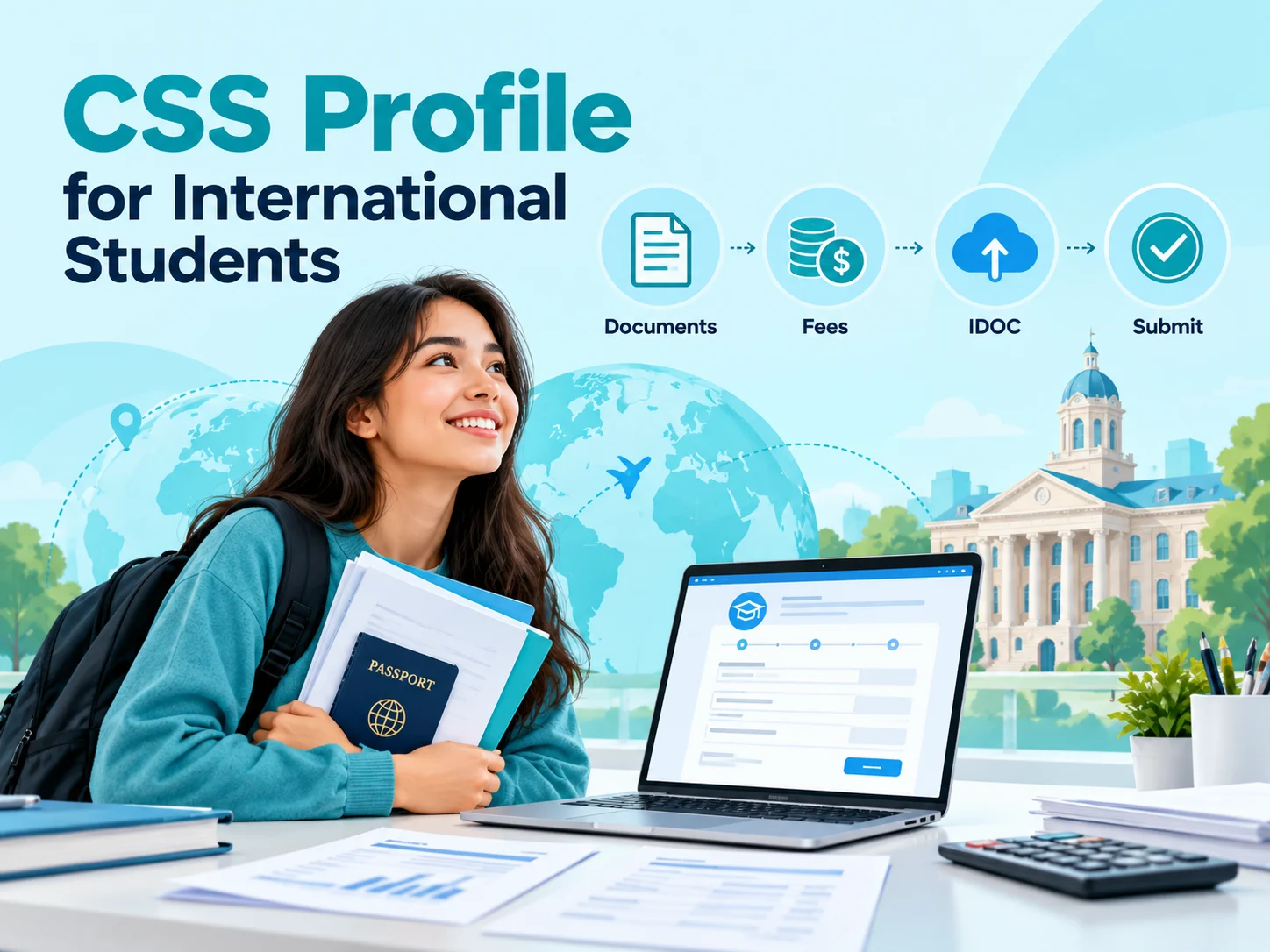
You can spend months researching universities, writing essays, and
tracking deadlines, and then the CSS Profile suddenly asks you questions
about family income, tax records, property, assets, and currencies you
may have never dealt with before. For many international students, this
is where the financial-aid process starts to feel confusing. The
important thing is that you do not need to understand everything like a
financial expert. You just need to know what information to collect, how
to report it correctly, and what each university expects. This guide
breaks down the documents, fees, currency rules, application steps, and
what happens after submission, so the CSS Profile feels like a process
you can actually manage.
What Is the CSS
Profile?
The CSS Profile is an online financial-aid
application administered by College
Board. Colleges, universities and scholarship programmes use it
to award non-federal institutional financial aid.
It is different from the FAFSA,
which is used for U.S. federal student aid. The CSS Profile gives
participating institutions a more detailed picture of a family’s
financial situation, including income, assets and expenses.
International undergraduate applicants may need the CSS Profile when
applying for need-based institutional aid at
participating U.S. universities. However, not every university uses it,
and requirements can differ for international students.
Students should therefore confirm the financial-aid requirements of
every university before submitting the form.
For students beginning university in Fall 2027, the relevant
application is the Fall 2027/Spring 2028 CSS
Profile.
Documents
and Information Needed for the CSS Profile
Students do not normally need to upload every financial document
while initially completing the CSS Profile. However, having the correct
records ready helps ensure that the information entered is accurate.
| Information | What You May Need |
|---|---|
| Parent income | Tax returns, salary statements or equivalent income documents |
| Student income | Student earnings and income records where applicable |
| Current-year income | Payslips, employer statements or other current income records |
| Untaxed income | Benefits, allowances or other applicable income |
| Bank accounts | Current account and savings balances |
| Investments | Information about investments and financial assets |
| Property | Property value and related debt where requested |
| Business or farm | Ownership, income and asset information where applicable |
| Household information | Family members and financial dependants |
| Education expenses | Relevant education costs for family members where requested |
| Special circumstances | Information supporting unusual financial circumstances |
The exact questions can vary according to the family’s circumstances,
so students should follow the information requested in the live CSS
Profile.
What
If Your Parents Do Not File U.S. Tax Returns?
Most international families will not have U.S. tax returns, and that
does not prevent them from completing the CSS Profile.
If parents file taxes in their home country, they should use the
official tax documents from that country’s tax system and select the
appropriate non-U.S. tax-return option when completing the Profile.
If parents are not legally required to file a tax return, they should
select the appropriate non-filer option.
If supporting documents are later requested through IDOC, students
may need to provide a Non-Tax Filer Statement together
with salary or other income evidence.
Documents submitted in another language may also need an English
translation.
CSS Profile
Fees for International Students
The standard CSS Profile fees are:
Initial application to one institution: $25
Each additional institution: $16
Students should confirm which universities actually require the CSS
Profile before adding institutions and paying additional fees.
Can
International Students Get a CSS Profile Fee Waiver?
College Board’s automatic undergraduate CSS Profile fee waivers
generally apply to qualifying students living in the United
States.
International applicants outside the U.S. should therefore not assume
that a low family income automatically qualifies them for a College
Board fee waiver.
If paying the fee creates difficulty, check the individual
university’s financial-aid policy. Depending on the institution, it
may:
- provide a payment code
- offer its own fee-waiver arrangement
- accept an alternative international financial-aid form
- provide separate instructions for international applicants
Policies vary between universities.
How
to Fill the CSS Profile as an International Student:
Step-by-Step
The process becomes easier when students prepare the required
financial information first and then complete each section
carefully.
Step
1: Check the University’s Financial Aid Requirements
Before starting the CSS Profile, confirm:
- whether the university uses CSS Profile
- whether international undergraduate applicants need to submit it
- the financial-aid deadline
- whether additional university forms are required
- whether supporting documents will later be submitted through IDOC
Do this for every university on your list.
Step 2:
Sign In With Your College Board Account
Students who already have a College Board account from the SAT, PSAT
or AP can generally use the same account.
If you do not have an account, create one before beginning the CSS
Profile.
The application can be saved and completed across multiple sessions,
so families do not need to finish the entire form at once.
Step 3: Select
the Correct Academic Year
Students planning to begin undergraduate study in Fall
2027 should select:
Fall 2027/Spring 2028 CSS Profile
Check the academic year carefully before entering financial
information.
Step 4: Add
Your Universities and Programmes
Add only the universities that need to receive your CSS Profile.
Check the institution and programme carefully, particularly when a
university has separate undergraduate, graduate or professional
schools.
Additional universities can generally be added after the initial
Profile has been submitted.
Step 5:
Complete Student and Family Information
The application may ask for information about:
- the student
- parents or guardians
- household structure
- family members
- financial dependants
- living arrangements
Beginning with the 2026–27 CSS Profile, applicants are no longer
asked for citizenship status.
Some institutions may require financial information from both
biological or adoptive parents when parents live in separate
households.
Step 6:
Enter Parent Income and Tax Information
Families should use their actual financial records.
Depending on the situation, information can include:
- salaries and wages
- self-employment income
- business income
- rental income
- investment income
- taxes
- untaxed income
- benefits
- other sources of income
International families should use their own country’s tax records
rather than trying to recreate a U.S. tax return.
Step 7: Enter
Student Income and Assets
Where applicable, students may need to report:
- employment income
- savings
- bank balances
- investments
- other student-owned assets
Only report information that applies to the student and follow the
instructions shown in the application.
Step 8: Enter
Family Assets and Expenses
Depending on the family’s circumstances, the CSS Profile may ask
about:
- savings
- bank balances
- investments
- real estate
- businesses
- farms
- debts connected with relevant assets
- household expenses
Use current and accurate figures wherever the form requests
present-day values.
Step 9:
Explain Special Financial Circumstances
Sometimes tax records do not fully represent a family’s current
financial situation.
Relevant circumstances may include:
- recent job loss
- significant reduction in family income
- major medical expenses
- natural disaster
- substantial support for another family member
- unusual one-time income or expenses
Keep the explanation factual and specific.
Where possible, explain:
What changed, when it changed, and how it affected the family’s finances.
Step 10: Review, Pay and
Submit
Before submitting, check:
- university selections
- student and parent details
- income figures
- asset values
- currency
- tax status
- household information
- special-circumstance explanations
CSS Profile deadlines are based on Eastern Time, so
international students should account for the time difference when
submitting close to a deadline.
After reviewing the information, pay the applicable fee and submit
the Profile.
Step 11: Check
Your CSS Profile Dashboard
Submission is not necessarily the end of the financial-aid
process.
Check your dashboard for:
- submission status
- selected institutions
- payment receipt
- deadlines
- additional requirements
- IDOC instructions where applicable
Continue monitoring both College Board and university portals until
the financial-aid application is complete.
How
Should International Students Report Income, Taxes and
Currency?
International applicants should report their finances according to
the instructions designed for non-U.S. families rather than attempting
to convert everything into a U.S. format.
Enter
Financial Information in Your Home Currency
International students and parents should generally enter financial
information in their home-country currency.
The CSS Profile handles the currency conversion for participating
institutions.
For example, families using Indian rupees, euros, Singapore dollars
or another currency should normally enter amounts directly in that
currency rather than manually converting everything to U.S. dollars.
This reduces errors caused by different exchange rates.
What If
Your Country Uses a Different Tax Year?
Many countries do not follow the same January-to-December tax year
used in the United States.
International families should use the appropriate completed tax
records from their own country and follow the non-U.S. tax-return
instructions shown in the CSS Profile.
Do not change financial periods simply to make them resemble a U.S.
tax return.
What If Your
Parents Do Not File Taxes?
If your parents are legally not required to file a tax return, select
the appropriate non-filer option.
Supporting documentation may still be required later, including:
- Non-Tax Filer Statement
- salary statements
- employer records
- other evidence of family income
What If
Financial Documents Are Not in English?
Supporting financial documents submitted through IDOC may need to be
translated into English.
Students should make sure both the original financial information and
its translation are clear enough for the institution to review.
What
Happens After You Submit the CSS Profile?
Universities may require additional documents before they can
complete their financial-aid assessment.
Check Whether IDOC Is
Required
IDOC, or Institutional Documentation
Service, is College Board’s system for collecting supporting
financial-aid documents for participating institutions.
Not every university using CSS Profile also uses IDOC.
If IDOC applies to you, the dashboard should show the documents and
deadlines you need to follow.
Upload Requested
Financial Documents
Depending on your family situation, these may include:
- tax returns or equivalent documents
- salary or wage statements
- non-tax-filer documentation
- parent financial records
- student financial records
- other documents requested by the university
Only submit documents that are requested.
Monitor IDOC and
University Portals
Continue checking:
- CSS Profile dashboard
- IDOC dashboard
- university applicant portal
- university financial-aid portal
A submitted CSS Profile does not automatically mean the university
considers your financial-aid application complete.
Correct Errors
Promptly
If you notice a mistake after submission, eligible corrections can be
made through the Correct Your CSS Profile function.
However, College Board currently allows only one correction
submission per academic year.
If another error is discovered after that correction, students may
need to contact the relevant university directly.
Reviewing the application carefully before the first submission is
therefore important.
CSS Profile
Deadlines for Fall 2027
There is no single CSS Profile deadline for all
universities.
Each institution establishes its own financial-aid deadline.
| Application Situation | What You Should Do |
|---|---|
| Early Decision / Early Action | Check the university’s early financial-aid deadline |
| Regular Decision | Check its regular financial-aid deadline |
| Applying to several universities | Plan around the earliest deadline |
| IDOC required | Check the separate document deadline |
| Additional university form required | Follow that institution’s separate deadline |
Students should organise their financial-aid deadlines alongside
their undergraduate admission deadlines.
A useful application calendar should therefore track:
- University application deadline
- CSS Profile deadline
- IDOC deadline
- Other institutional financial-aid forms
This reduces the risk of submitting the university application on
time but missing the financial-aid deadline.
Before You
Submit: CSS Profile Checklist
Before paying and submitting, confirm that:
- the correct 2027–28 academic year is selected
- every university added actually requires CSS Profile from you
- financial-aid deadlines have been checked
- student and parent information is accurate
- income figures match the available records
- figures are entered in your home currency
- current bank and asset values have been checked
- the correct tax status is selected
- special financial circumstances are explained where necessary
- additional university requirements have been checked
- IDOC requirements are understood where applicable
- the entire application has been reviewed before payment
A careful final review can reduce the need for corrections later.
How
Masterclass Space Can Support Undergraduate Financial Aid
Planning
Masterclass Space can help international students coordinate
financial-aid requirements with the wider undergraduate
admission process. This can include identifying which
shortlisted universities require the CSS Profile or another
institutional financial-aid form, tracking admission and financial-aid
deadlines together, and considering affordability while building a
balanced university list. Students and families can also receive
guidance in understanding university-specific financial-aid instructions
and organising these requirements alongside essays,
recommendations, testing and other admission tasks. Financial figures
entered into the CSS Profile should always come directly from the
family’s own records. Individual universities independently assess
financial need and determine final financial-aid awards. For students
who want structured support, Masterclass Space’s admission
consulting and premium
undergraduate admission consulting can guide the full process
from university shortlisting to financial-aid submission.
Frequently Asked
Questions
Do I need to
complete the CSS Profile?
Only if a university or scholarship programme requires it as part of
your financial-aid application. Always check the individual university’s
requirements before submitting the form.
Does
every university require the CSS Profile from international
students?
No. Some universities require CSS Profile from international
undergraduate applicants, while others use a different institutional
form or process.
Do
I need the CSS Profile if I am not applying for need-based financial
aid?
Usually, CSS Profile is used to assess eligibility for institutional
need-based financial aid. If you are not requesting this type of aid,
check the university’s instructions before submitting and paying for a
Profile.
What
documents do international students need for the CSS
Profile?
Students should generally prepare tax or equivalent income records,
current income information, bank balances, asset details and information
about household finances. Additional documents may later be
requested.
How much does the
CSS Profile cost?
The standard fee is $25 for the initial institution and $16
for each additional institution.
Can
international students get a CSS Profile fee waiver?
College Board’s automatic waiver programme generally applies to
qualifying undergraduate students living in the U.S. International
students outside the U.S. should check whether the university offers its
own payment code, waiver or alternative process.
Should
international students enter financial information in U.S.
dollars?
Generally, no. International families should enter financial
information in their home-country currency. The CSS
Profile handles the conversion.
What if my
parents do not file tax returns?
Select the appropriate non-filer option. Supporting evidence such as
salary records, income statements or a Non-Tax Filer Statement may later
be required.
What is IDOC?
IDOC is College Board’s Institutional Documentation
Service. Participating universities use it to collect
supporting financial-aid documents. Not every CSS Profile university
uses IDOC.
Do
both parents need to complete the CSS Profile?
It depends on the family’s situation and the university’s policy.
Some institutions require financial information from both custodial and
noncustodial parents.
Can I
correct the CSS Profile after submitting it?
Yes. Eligible corrections can be made after submission, but College
Board currently allows only one correction submission per
academic year. Further changes may need to be communicated
directly to the universities.
Frequently Asked Questions
What does UCAS stand for?
UCAS stands for Universities and Colleges Admissions Service. It is the UK’s shared admissions service used for most undergraduate applications.
Can international students use UCAS?
Yes. International students use UCAS to apply to undergraduate courses at UK universities and generally follow the same central application process and deadlines. Universities may have additional international qualification or English-language requirements.
How many universities can I apply to through UCAS?
UCAS allows up to five course choices. These may be at five different universities or include multiple courses at the same university. Medicine, Dentistry, Veterinary Medicine and Veterinary Science applicants can use a maximum of four choices in one of those subjects.
What is the UCAS application fee for 2027?
The 2027 undergraduate application fee is £34.50, covering up to five choices.
What is the UCAS deadline for 2027 entry?
The deadline for Oxford, Cambridge and most Medicine, Dentistry and Veterinary courses is 15 October 2026 at 18:00 UK time. The equal-consideration deadline for most other undergraduate courses is 13 January 2027 at 18:00 UK time.
What are the three UCAS personal statement questions?
Students answer why they want to study the subject, how their qualifications and studies have prepared them, and what they have done outside formal education to prepare. All three answers share a total limit of 4,000 characters.
What is the difference between a conditional and unconditional offer?
A conditional offer requires the student to satisfy specified conditions before the place is confirmed. An unconditional offer means the academic conditions have already been satisfied, although other administrative requirements can remain.
What is a firm choice in UCAS?
Your firm choice is the university and course you most want to attend. If it is conditional and you meet the conditions, that is normally where you will study.
What is an insurance choice?
The insurance choice is a backup to a conditional firm offer. If you do not meet your firm conditions but meet your insurance conditions, you may be placed at the insurance university instead.
Do international students need UCAS Tariff points?
Not always. Many international qualifications do not have a UCAS Tariff value, and universities can still accept them. International students should check the qualification and grade requirements published by each university rather than assuming they need a particular Tariff score.
Can international students use UCAS Clearing?
Yes. International students can use Clearing if they are eligible and a suitable course still has places available. Clearing for 2027 opens on 2 July 2027.
Does UCAS issue the CAS for a Student visa?
No. The university or college issues the Confirmation of Acceptance for Studies after the student has secured and accepted an eligible place and completed the university’s required steps. UCAS does not issue visas or CAS documents.